
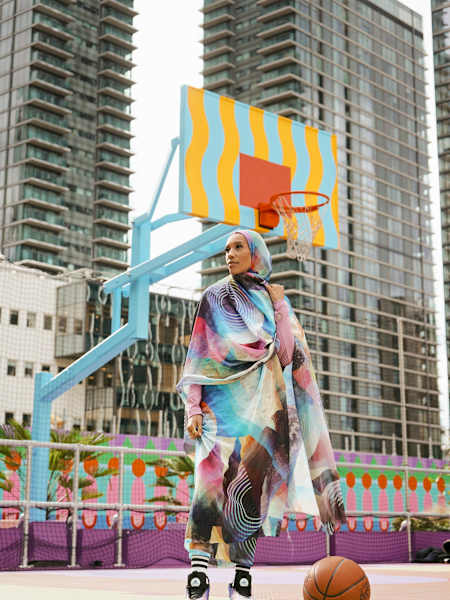
Faith, hoops and charity with Asma Elbadawi
How does one balance basketball and poetry?
It's not that easy. My poetry forces me to be vulnerable and to open up to others, whereas sport requires you to be your toughest self. Like, you can push and shove me, but I'm still gonna make the shot. Poetry has helped me become a better basketball player.
What skills have you learned from each of those worlds?
In sport, I'm the kind of person who wants to be perfect. With poetry, when I was first performing I'd make mistakes on stage and no one cared. It made me realise that it's OK to make a mistake. They're both sides of me that I need and I can't imagine life without them. I'm a sensitive person and if I don’t release that in my poetry, it affects other parts of my life. But I'm also goal-oriented, so being able to challenge myself physically and mentally allows me to be focused. I've made them work as best as I can in a world that hasn't fully created an environment where women can be athletes.
What barriers do hijab-wearing women face in sport?
The pathways to being an elite athlete are very unknown to women from my community. Part of it is that we're not visible – people assume our families won’t allow us to take those professions. When I was growing up, I wasn’t encouraged by my PE teachers to play netball – which I was really into – for local or national teams. And these are the pathways that get you to where you can represent your country. That's one major barrier. The second is that women don't get paid the same as men, even at the elite level. I know so many athletes who are part-time teachers or have bank jobs or whatever, just so they can continue playing sport.
How do you respond to those who say that athletes shouldn't voice their opinions?
I have this conversation with myself a lot. My first encounter with racism in sport felt like I was being punished for speaking out. For years, I thought athletes should just play and not get involved with politics or humanitarian issues; that they should stay neutral for their own safety. Then, I realised the power of having a platform. So many people who have platforms in this world are saying negative things, so if you're an athlete and do have a platform, you have a responsibility to stand up for people with less of a voice. Athletes should have personality, an opinion – they should speak out when they see that something isn't right.
Is it important to challenge others' expectations?
I think that when we judge others, we do so through [the prism of] our own experiences or those of our communities. We can stop people from achieving their highest potential just because of our own perception of their limits. Don't let other people define who you are and who you can be in this world.


