Premier Padel 2026 so far: the rivalries, players and subplots to watch
With 17 tournaments completed and seven remaining, both world number one rankings are still in play. Here’s what to watch when the Premier Padel season resumes in Rotterdam.
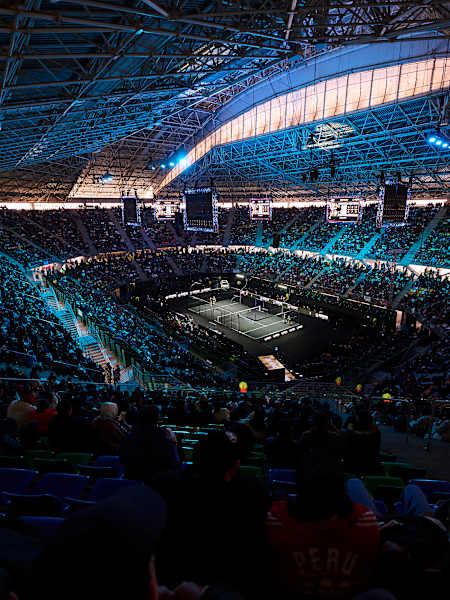
The 2026 Qatar Airways Premier Padel Tour season has already delivered a record 81,000 spectators at Roland Garros, the youngest champion in the sport’s history, five different women’s pairs lifting trophies and a men’s rivalry that has now produced 11 finals between the same four players. Here are the key storylines that will shape the second half of the 2026 Premier Padel season.
01
Nine titles to seven: the battle at the top
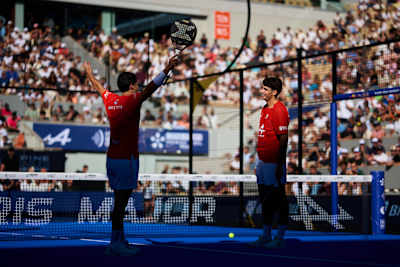
The rivalry between the top seeds is taking padel to a whole new level
Top-ranked pair Arturo Coello and Agustín Tapia have won nine tournaments in 2026. Alejandro Galán and Federico Chingotto, the number-two pair, have won seven. The only other duo to win a title is Juan Lebrón and Leo Augsburger, ranked third, who triumphed once in Brussels in April.
Coello and Tapia’s nine titles came at the Riyadh P1 in February, the Cancún P2 in March, the BNL Italy Major in Rome in June, the Valencia P1, the Valladolid P2, the Bordeaux P2, the Málaga P1 in July, the London P1 in August and the Alpine Paris Major in September.
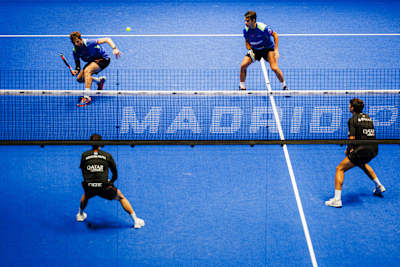
Galán and Chingotto’s seven came at the Gijón P2 in March, the Miami P1, the NewGiza P2 in April, the Asunción P2 and Buenos Aires P1 in May, the Pretoria P1 in August and the Madrid P1 at the start of September.
Both pairs have four P1 titles. Both have three P2 titles. The entire difference comes from the Majors, where Coello and Tapia have won two while Galán and Chingotto have won none. A Major awards 2,000 ranking points – double the 1,000 available at a P1 – so those key match-ups in Rome and Paris have tilted the race towards the top pair.
The win-loss records tell a different story. Galán and Chingotto are 64-10 in 2026, with more match wins than any other pair on tour. Coello and Tapia are 62-7. Chingalán have won more matches overall, but remain third and fourth in the individual world rankings behind Coello and Tapia because they have lost during the weeks when the biggest points were on offer.
02
Eleven finals and the run that changed the season
Galán and Chingotto have faced the top seeds in 11 finals this year
The two pairs have met in 11 finals this season, with Coello and Tapia winning seven.
Galán and Chingotto dominated the spring. They won Gijón in March, Miami two weeks later, then Asunción and Buenos Aires on consecutive weekends in May. That meant four wins over the world number ones inside 10 weeks, with the ranking gap narrowing each time.
Since the Italy Major on June 7, 2026, Coello and Tapia have won every final contested between the two pairs: Rome, Valencia, Valladolid, Bordeaux, London and Paris. That's six consecutive victories across a Major, three P1s and two P2s, indoors and outdoors, on two continents.
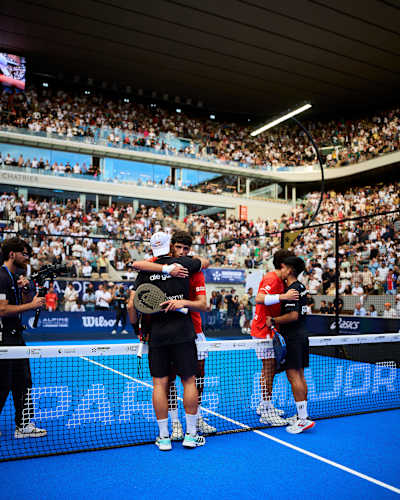
Paris showed just how tight the margin has become. Galán and Chingotto won a set against Coello and Tapia in a Roland Garros final for the first time, raced into a 3-0 lead in the deciding third set and served for the title at 5-3. They then lost the next four games and the tie-break 7-1. Coello and Tapia claimed a fourth consecutive Paris Major, while Tapia remains unbeaten in a match at the venue across those four editions.
Madrid, seven days earlier, went the other way. Coello and Tapia lost in the quarter-finals, while Galán and Chingotto beat Coki Nieto and Mike Yanguas 6-4, 5-7, 6-4 in the final. It was their seventh title of the season and Galán’s first Madrid P1 since 2022.
03
Lebrón and Augsburger: the only pair to break the duopoly
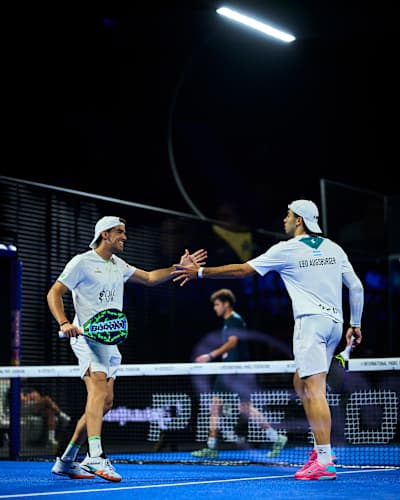
Lebrón - Augsburger have been the only pair able to challenge the top teams
Juan Lebrón and Leo Augsburger are the reason 2026 has a third name on the honours list.
On April 26, 2026, in Brussels, they beat Coello and Tapia 2-6, 6-3, 6-3 in one hour and 39 minutes. It was their first title together and their first win over the world number ones. Since then, however, they've endured a series of near misses against the same opponents. They lost the Cancún P2 final 6-7, 6-3, 7-5 in March. They lost the Málaga P1 final 6-2, 6-2 in July. Then, in September, they lost the Paris Major semi-final 7-5, 6-3 on Court Philippe-Chatrier in just over an hour.
Their record together in 2026 is 40-16. Lebrón is fifth in the world on 8,040 points, while Augsburger is sixth on 7,359. Both have already secured their places at the Premier Padel Finals in Barcelona, where the top 16 players in the season standings qualify.
Their chances of adding one or two titles before Christmas will depend on the draw as well as their level. Two of the seven remaining tournaments are Majors, which means five-round draws and more opportunities for a top seed to slip up. Madrid proved that can happen, as did Pretoria. Lebrón and Augsburger need one of those opportunities to fall in their half of the draw.
04
The pairs to watch behind the top three
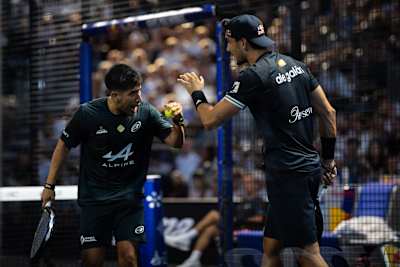
Mike Yanguas and Coki Nieto upset the top seeds in Madrid
The men’s tour was reshaped in early August, with players from the fourth- and fifth-ranked teams switching partners. Franco Stupaczuk left Mike Yanguas, while Jon Sanz left Coki Nieto. The new pairings were Stupaczuk-Sanz and Yanguas-Nieto. Both combinations clicked immediately. Stupaczuk and Sanz won the FIP Gold in Belgrade in their first week together without dropping a set, beating their former partners 6-3, 7-5 in the final. They then entered the Paris Major as the fourth seeds. Yanguas and Nieto reached the Madrid P1 final three weeks later.
The run of the season outside the top three belongs to seventh-seeded Javi Leal and Fran Guerrero, who are enjoying a second spell together after first forming a team at the age of nine. At the Pretoria P1 in August, they knocked out Lebrón and Augsburger in the quarter-finals before beating Coello and Tapia 7-5, 7-5 in the semi-finals. That ended a run of 27 consecutive Premier Padel finals for the world number ones. Leal and Guerrero then pushed Galán and Chingotto to 7-6 in the third set of the final.
05
The rankings and the seven weeks that will decide them
Tapia and Coello hold the advantage going into the season's run-in
After Paris, the FIP ranking shows Coello and Tapia still at the top with 20,454 points each, closely followed by Galán and Chingotto on 18,289. That is a 2,165-point gap.
The 2026 Race, which counts only results from this season, puts them at 12,620 and 11,350 respectively. The 1,270-point difference between those figures represents points from 2025 that Coello and Tapia still have to drop before the end of the year, because the FIP ranking operates on a rolling 52-week cycle and each point expires exactly one year after it is earned. All of those points will have gone before Barcelona.
So the real target for Galán and Chingotto in the 2026 Race is to make up 1,270 points on court across the final seven weeks. Beating Coello and Tapia in a Major final accounts for 800 of those points in one afternoon. A P1 final accounts for 400.
Seven tournaments remain, with three carrying particular weight. The Kuwait Major on October 26, 2026, was upgraded from P1 to Major status for 2026 after the Qatar Major was postponed, doubling the points on offer. The Mexico Major in Acapulco follows on November 23, 2026. The Premier Padel Finals in Barcelona close the year, with 1,500 points awarded to the winners. Rotterdam, Germany, Milan and Dubai fill the weeks in between, while the FIP World Cup in Doha from November 2 to 7 awards no ranking points, making it the only week of the autumn when the standings remain unchanged.
06
Six titles each: the ultra-competitive women’s tour
Bea González and Paula Josemaria celebrate after a rally in Valladolid
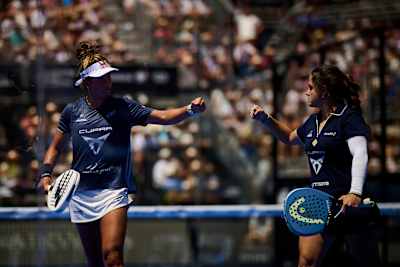
The women’s tour has produced an even tighter race. Top-ranked pair Gemma Triay and Delfi Brea have won six tournaments in 2026. Bea González and Paula Josemaría, currently the number-two pair, have also won six.
Triay and Brea’s six titles came at the Gijón P2 and Cancún P2 in March, the BNL Italy Major in Rome in June, the Málaga P1 in July, the Pretoria P1 in August and the Madrid P1 in September.
González and Josemaría’s six came at the Miami P1 in March, the NewGiza P2 and Brussels P2 in April, the Asunción P2 and Buenos Aires P1 in May, and the Valladolid P2 in June.
The shape of those runs is what truly sets the two pairs apart.
González and Josemaría won five Premier Padel tournaments in succession between Miami in late March and Buenos Aires in mid-May, the longest winning streak of the women’s season. Triay and Brea have spread their titles across the season and have reached 14 of the 17 finals played.
Head-to-head, the two pairs have met in eight finals, with González and Josemaría winning five. Triay and Brea took Cancún in March, then the last two encounters – Málaga in July, 7-5, 3-6, 7-6, and Madrid at the start of September, 6-7, 6-3, 6-3, after losing the opening tie-break.
Madrid also gave Triay a record of her own. She became the first player in Premier Padel history to reach 200 tour wins.
07
Sánchez and Ustero, and the Major that broke the pattern
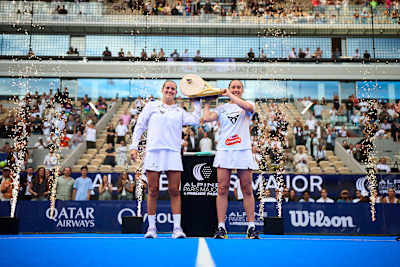
Sanchez and Ustero with their trophies after winning the Paris Major
Ariana Sánchez and Andrea Ustero, the third seeds, have won three tournaments in 2026 and have timed their victories well. They opened the season by beating Triay and Brea in the Riyadh P1 final in February. They won the Valencia P1 in June. Then, on September 13, 2026, they won the Alpine Paris Major at Roland Garros 6-2, 6-0.
Sánchez, 29, controlled the final from the opening game. It was the biggest result of the women’s season, and it went to the pair that had spent most of the year in third place. Claudia Jensen and Tamara Icardo, and Claudia Fernández and Martina Calvo, are the fourth and fifth pairs to win in 2026, taking the Bordeaux P2 in early July and the London P1 in August respectively.
The rankings show just how compressed the top of the women’s game has become. Triay and Brea lead on 16,974 points each. Sánchez is third on 14,029. González is fourth on 14,017. Josemaría is fifth on 13,889. Three players sit within a relatively narrow points range from third to fifth in the world, while the pair at the top has already lost a Major semi-final to a team that had been together for just nine weeks.
08
Calvo and Fernández: the fastest rise in the sport
Martina Calvo and Claudia Fernández lifted the trophy in London
Claudia Fernández and Martina Calvo joined forces on July 7, 2026, as part of a four-player swap. Fernández left Sofía Araújo, while Calvo left Marta Ortega. Eleven weeks later, they've played four tournaments, reached three finals and beaten the world number ones twice.
Their first week together was the Pretoria P1, where they reached the final, served for the title at 30-15 in the third set and lost the deciding tie-break 7-4 after two hours and 53 minutes.
Seven days later in London, they met Triay and Brea again in the same round and won 7-5, 6-3 in one hour and 45 minutes. Calvo was 18 years, one month and four days old that afternoon, making her the youngest champion in top-level padel history. She broke Andrea Ustero’s record by 20 days.
In Paris, they knocked out top seeds and defending champions Triay and Brea 6-4, 6-2 in the semi-final, becoming the youngest pair to reach a Major final in the women’s game. The four finalists had a combined age of 86.
The final showed that they still need greater consistency to beat the world’s best pairs on a regular basis. Sánchez and Ustero won 6-2, 6-0, while a recurring weakness in the new pair’s short history surfaced again. They missed two match points in Pretoria and three more in a Madrid semi-final, where they lost 6-4, 2-6, 7-5 to González and Josemaría. In Paris, they never settled into the biggest match they had played. Everything else in their game is already causing problems for the best teams in the world.
Calvo left Paris at a career-high world number eight with 7,484 points. Fernández remains sixth on 11,817, and is one of seven women already through to Barcelona.
Find more information on all tournaments, including ticketing, match schedules, current scores, player updates and the latest news, on the Premier Padel website.
About the author
Javier is CMO at Siux Padel and a certified padel coach with deep roots in the sport, on and off the court. He previously led content and digital strategy at Babolat Padel. As a racket sports writer, he brings an insider's perspective on the players, events, brands and trends shaping padel's global rise. He's also an avid player and one of the most active voices in the padel industry on LinkedIn.