
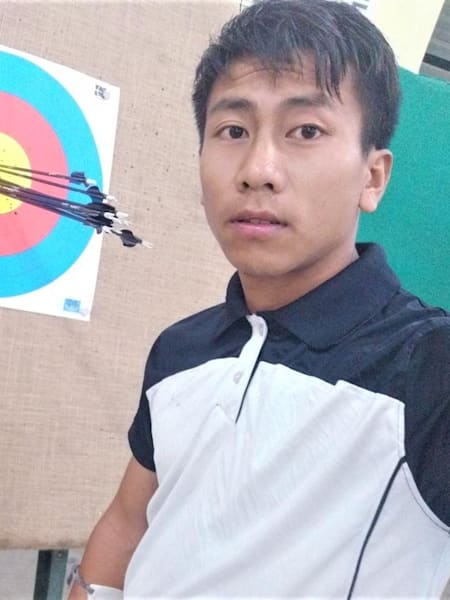
Athletics
Meet the archery champion who is the only pro athlete from his village
Jemson Singh Ningthoujam of Manipur talks about honing his talent with little infrastructure and resources, and why he switched from taekwondo to archery.
Nerves were starting to fray as Jemson Singh Ningthoujam prepared for the final at the 2017 Archery Youth Championships. Along with his partner Ankita Bhakat, the Manipuri was aiming to become the first Indian to win the junior crown since Deepika Kumari’s titles in 2009 and 2011. But ahead of the tie against Russia in Rosario, Argentina, he needed international youth bronze medallist Atul Verma to whisper a few words of encouragement.
“He told me that I’ve practised for this, and asked if I don’t do [my best] now, then when will I?” Jemson says. “Whatever I had, he told me to get it out now otherwise I will regret this moment for the rest of my life. That was all I needed to motivate me.”

Jemson and Bhakat shot their way to a historic gold at the youth championship in October 2017. And with it, the 21-year-old kept the promise he made to his village when he got back home.


“Before going, my family, friends, neighbours, everyone was telling me to bring back a medal. So I thought that if I came back empty-handed, I would lose face,” he says.
Upon his return though, the village opened its arms to happily welcome their only professional athlete, who had now proved himself on the international stage.
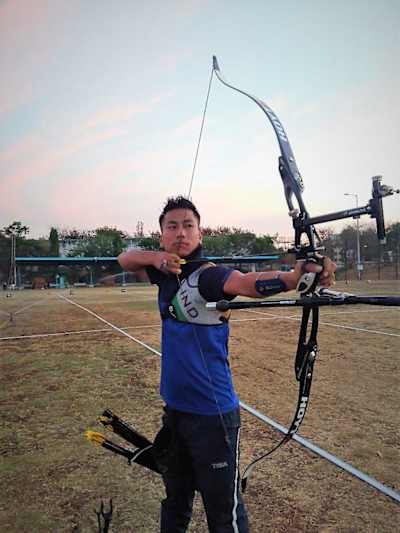
Jemson with his recurve bow
© Jemson Singh Ningthoujam
Born and raised in Naharup Pangong Makhong, five kilometres away from Imphal, Jemson was the first resident of the village to make a foray into professional sport. “The only other person who is in sport of any kind is a bodybuilder,” he chuckles.
Jemson’s village lies in Imphal East and has a population of around 2000 people. Agriculture is the backbone of his village, but being in the state of Manipur means that football is played with enthusiasm. However, Jemson’s achievements in archery are the only one putting his village on the world map in professional sport.
“The village people welcomed me when I came home, but still not many know me; nor do they know what archery is,” says Jemson. “They just know I’ve won some major international tournament.”


Despite his recent success in archery, he makes it known that the sport wasn’t his first choice; nor was football. Instead, he was an avid fan of taekwondo and had even trained in the martial art for five years before making the switch to archery.
“There wasn’t much recognition for taekwondo, and it’s difficult to get enough practice to win at international competitions,” he says. “That’s why I shifted to archery. I thought I could win something there.”
What aided Jemson’s choice in switching to archery was the fact that Manipur has a strong culture in the sport. Back in 2009, when Jemson was just 12 years old, news broke that an archer from a neighbouring village had won a national medal. This was the impetus he needed to leave taekwondo.
“I thought, even I wanted to win a national medal,” he recalls. “I would have been happy with a state medal also, but I couldn’t get that in taekwondo since it’s still not a very formalised sport in India. So I decided to switch.”
The transition was smooth concerning archery’s physical demands. The bow weighs an average of two kilograms, and when pulling the string to load a shot, the tension can reach up to 20 kilograms. At the same time, the mind has to be focused on the target that is roughly the same circumference of a two-rupee coin. Jemson’s training in taekwondo had given him a running start in training the mind and the body.
“I could do anything. I had done taekwondo for five years, so I never felt tired.”
There wasn’t much resistance from his parents either, especially his father. “If I ever bunked school and my father caught me, he’d scold me. But if he got to know that I bunked to play sports, he wouldn’t be angry at all,” he says, laughing.
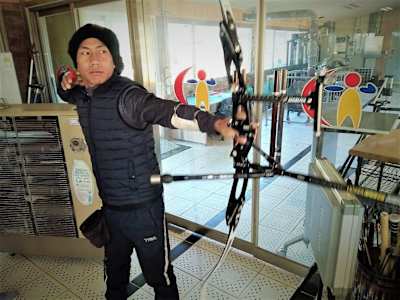
Jemson has been improving since being inducted in the Indian army
© Jemson Singh Ningthoujam
A serious hurdle though were the finances. Even with taekwondo, a sport that does not demand much equipment, the family of six — Jemson’s parents and three other siblings — struggled to make ends meet. His father works for forest conservation on a part-time basis while his mother looks after a small grocery store. “We sell goods around Rs 500 worth daily,” Jemson says.
“There’s a mountain nearby that has lots of trees and wildlife. My father’s job is to make sure nobody cuts down any trees or goes in there to hunt,” Jemson explains. “But it’s not a permanent job. He gets called to work sometimes.”
Jemson remembers the financial struggle, which at times meant there wasn’t enough money to purchase footwear. “Once in a while, if I was really upset, my father, I don’t know how would somehow manage to save and get us new pairs of sports shoes.”
Till date, the youngster doesn’t know how his father managed to save the Rs 2000 needed to buy the wooden ‘India-made’ bow he needed to start in archery.
But that life in uncertainty changed in 2010 when the army came to Imphal looking for recruits in their sports program. Jemson applied and earned himself a spot as a Sepoy. With the military looking after his athletic needs, he changed tack and took up recurve archery. He is now honing his skills, eight to ten hours a day, at the Army Sports Institute in Pune.
“I’m the only one in my family who has a stable job,” he says. “Now I don’t have to worry about my equipment because the army helps me, I don’t have to worry about my meals either. And I don’t have to worry about my parents worrying about me either. My focus is only on my sport.”
Four years ago, Jemson had a shot at the biggest youth games, until his bow broke during a practice session. “I cried a lot that time,” he says. “In archery, you can’t really replace equipment that quickly, you need to work with one bow for about a year to be familiar and comfortable with it.”
“My focus is on the games in Tokyo,” he says. “The training is on for that. I’m trying to perfect my game for Tokyo.”
Now with the target set on Tokyo, there is a hope that by then, his village in the North East will know all about him.