
Mind Gaming
Meet the two friends that are helping India’s cubing scene grow
Buddies from Raipur, Jainendra Jain and Nitesh Deshmukh, have been at the helm of India’s expanding obsession with the Rubik’s Cube as a competitive sport.
In a brightly-lit basement of a South Delhi hotel, Komal Gupta and Syed sat facing each other with a table between them. The table had large displays attached to them which were timers to show the two competitors how quickly they were going.
A minute later, a man in a black T-shirt proceeded towards them and placed two Rubik's Cubes on the table, one in front of each participant. Both examined their puzzles for a few seconds, put them down on the table and simultaneously hit the timer as they swiftly picked up their respective cubes to solve it with just one hand.

Komal and Syed were competing in the New Delhi qualifier of the 2018 Red Bull Rubik’s Cube World Championship. The championship features four categories — Speedcubing Mixed, Speedcubing Women, Fastest Hand, and Re-Scramble — each played in a knockout format as competitors faced each other while attempting to clock a quicker time than the other. The current scene played out as Komal and Syed competed in the Fastest Hand category; where participants must solve the Rubik’s Cube using only one hand.

Standing around them, a dozen young boys looked on curiously as spectators while also solving jumbled cubes in their hands without looking down at them.
Within a few seconds, the scene had played out as Syed dropped his cube to the table and stopped the timer at just 34 seconds. Komal kept going, knowing she had been eliminated from the competition but relentless to clock the best time she could.
The Red Bull Rubik’s Cube World Championship is one of few competitions in India for cubing enthusiasts. The worldwide championship was held in India for the first time earlier this year and featured city qualifiers in Kolkata, New Delhi, Chennai and Mumbai, followed by a national final in Mumbai where Indian champions were crowned.
Vijay Kishore, Priyadarshini and Sripad Sharma from Chennai, and Aniketh Arya from Bengaluru, are the Indian champions. They will now represent India at the finals of the world championship in Boston, USA, on 22nd September.
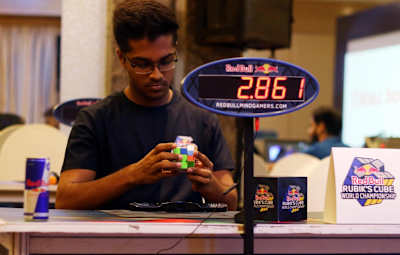
A competitor in action at the qualifier in Chennai
© Focus Sports
Popularity in India
The Rubik’s Cube was invented by Hungarian professor of design Ernő Rubik in 1974. When it launched, it was one of the world’s bestselling toys, but today, it is the focal point of the world’s obsession with puzzle-solving as a competitive sport.
The first Rubik’s Cube competitions began in the early 1980s. However, it took until 2004 when the World Cube Association was formed for the sport to become organised and have uniformly established rules that were followed globally.
The sport of cubing was slow to pick up in India but has become very popular over the last few years.
According to the WCA website, the first official cubing competitions in India were held in 2008; one in February at IIT Kanpur and another in October at IIT Madras. After the first few years seeing an inconsistent number of tournaments added and subtracted from the Indian calendar, 2015 and 2016 had 34 competitions each. That number almost doubled in 2017 as 61 cubing competitions were held around the country. Encouragingly, the first five months of 2018 have already witnessed 32 tournaments in India, setting the community up for what could be the most successful year in terms of participation in competitive cubing.
One of the drawbacks for the Indian cubing community is that there is no official cubing federation in the country. But while that held the scene back previously, two friends have dedicated themselves to promote the sport of cubing which has seen an upswing in recent years.
Cubing buddies
Jainendra Jain and Nitesh Deshmukh are the two friends from Raipur who have helped organise most cubing competitions in India with the assistance of the WCA. The pair provides organisers with the equipment needed to host tournaments — including the competition-standard Rubik’s Cubes and timers to keep score — as well as the technical know-how and set of rules handed down from the WCA.
They also run the website cubelelo.com, an online store that sells Rubik cubes and other puzzles. The pair rightly claims to have witnessed the tremendous growth of cubing in India firsthand.
"Even though it is something that most people only do for a certain period of time in their life there is still a lot of competition, and people are taking it quite seriously," says Nitesh.
The 25-year-olds started their journey in cubing much like other cubing enthusiasts in India. In 2013, when they were both in college, Jainendra naturally gravitated towards the Rubik’s Cube because of his appetite for puzzle-solving. After realising there were no online retailers for Rubik’s Cubes in India, Jainendra took it upon himself to start selling cubes online for those interested in purchasing them from the comfort of their home.
"There were no good Rubik Cubes available in India. [I had a good quality cube because] a friend of mine bought one from Hong Kong. There were a few stores in India, but there was no payment gateway to buy it online. You needed to do a bank transfer and all that," says Jainendra.
But Jainendra, who was in his sixth semester at NIT Bhopal at the time, needed more to play with than just a 3x3 cube. He was setting his sights on the 6x6 and even 12x12 cubes for himself and others. He began the long process of purchasing the cubes through bank transactions and then made it easier for others to buy them via simpler online portals like eBay.
After selling the puzzles on eBay, Amazon and Shopclues for seven months, the rocketing sales motivated both of them to start their website.
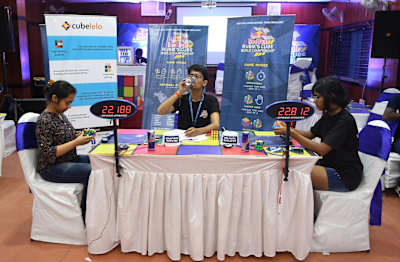
Competitors face each other at the Kolkata qualifier
© Focus Sports
While they were still in college, the pair would stock up their hostel rooms with Rubik’s Cubes before they were sent to the customers. But this led to their rooms being crowded, prompting them to have a bumper sale at one point just to be able to clear their rooms.
"We had a lot of inventory in our hostel room at one point, and it was my last semester. We didn't want to move it, so we pushed a sale. From 30 orders a day, our sales went close to 100 a day," says Nitesh, who was studying at IIT Bombay when the friends started their website.
After graduating from college, they took up different jobs in Raipur but continued to sell puzzles online. "We handed over the working of the business to my dad, who had invested some money in it," says Jainendra.
Things changed in 2015 when both left their jobs to dedicate their time to selling Rubik’s Cubes and building a cubing community in India.
"In December 2017, we got our first investment. He was also a seller, but he saw that I was more into the puzzles and dealt with the customers well. He decided to invest, and we gave him a share of the profit," Jainendra says.
Cubelelo.com sponsors cubing events in India which have directly led to the rise in the number of cubing competitions in the country. Jainendra and Nitesh have also become fairly well-known cubers in their hometown of Raipur, where they conduct workshops to teach young students the tricks and techniques to solve the cube.
“Most people just drop it after 10th or 12th, and that hurts the scene a lot," Nitesh says ruefully.
Growing scene
While many who take up cubing in school and college abandon it before getting well-versed with the competitive aspects of the sport, there are several who stick by it wholeheartedly.
22-year-old Komal is a great example of someone who picked up the cube but didn’t put it down.
She is a first-year postgraduate student at Delhi University. She received a Rubik’s Cube as a gift from a friend last year which started her obsession with the sport. After digging into the puzzle for a few days, she managed to solve it. But she didn’t stop there and pushed herself to keep improving her speed.
After picking up a few tricks and techniques, she started to take part in cubing competitions in New Delhi. "Last year, I won the fastest female cuber award at a competition held at St. Stephens College," Komal says.
At the New Delhi qualifier of the Red Bull Rubik’s Cube World Championship, Komal finished first in the Speedcubing Women category with a timing of 42.147 seconds. While her timing is impressive, it is quite a few seconds off the fastest cubers in India.
The cubing community in India is mostly made up of young men that have an affinity towards maths and science. The sport is particularly popular among engineering students across the country.
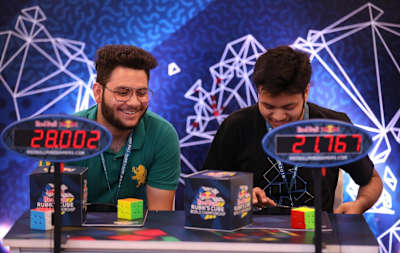
Participants compare their timings at the New Delhi qualifier
© Focus Sports
Another standout cuber from New Delhi is 16-year-old Vansh, a class 12 student who has participated in several of the city’s cubing competitions. At the New Delhi qualifier, Vansh was able to clock within 15 seconds in his attempt at Speedcubing.
"I picked up cubing after a friend gave it to me at school. It's a hobby for me. Like some people like to play video games," Vansh says.
He takes cubing quite seriously, and he practices every day for at least an hour. "I pick up new techniques from YouTube, and I also learn from fellow competitors at events," he says.
While his parents think he should stop cubing so he can focus on his studies, Vansh has a different opinion. "It's not just about fun solving the puzzle; it also improves your cognitive skills," he says.
About Red Bull Rubik's Cube World Championsip
Red Bull Rubik’s Cube World Championship is a global competition that seeks to find the world’s fastest cuber. After national competitions are held around the world — involving city qualifiers and national finals — each country will be represented by their respective national champions in the world finals happening in Boston, USA, on 22nd September.