
Hurdles
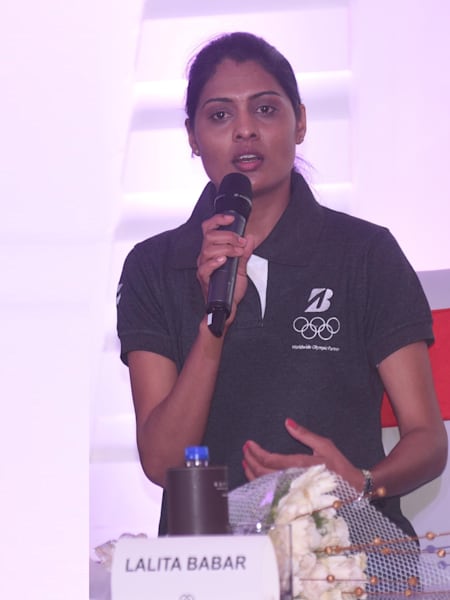
How Lalita Babar, India’s steeplechase record holder, got back on track
India's 3000m steeplechase record holder took a break from sport to get married last year. She speaks about her struggles while returning to training.
Lalita Babar had made promises before participating in the world's biggest sporting event of 2016 in Rio de Janeiro. And she knew she had to keep them.
Hailing from a village called Mohi, in the parched Satara district of Maharashtra, Babar’s parents had given her the freedom to pursue her ambition – athletics. While most girls in her village, including her sister, were married off once they were 18, her parents kept those pressures away from Lalita. They knew she had big dreams, some well beyond their imagination. But after the games in Rio, things would change.


“My mother had told me sternly that I have to get married after I come back,” Babar recalls. “In my village, girls get married very early, but I got married when I was 28. So it was a big deal for them (family) to support me for so long.”


The whole village celebrates
At Rio, she stretched her athletic potential. In the Estadio Olimpico Nilton Santos, Babar became the first Indian woman in 32 years (since PT Usha’s fourth-place finish at the 1984 Los Angeles Games) to qualify for the final of a track event, breaking the national record in the heats — running 9 minutes 19.76 seconds — and finishing 10th in a competitive 18-woman 3000m steeplechase race.
Celebrations were in order when she got back home. No one from Mohi had gone so far and achieved so much.
“People organised big processions in the village. I felt like I had won the medal,” she says. “Even though I don’t get to spend as much time at home or in the village, they really honoured me with the reception. I felt like I won the medal already.”
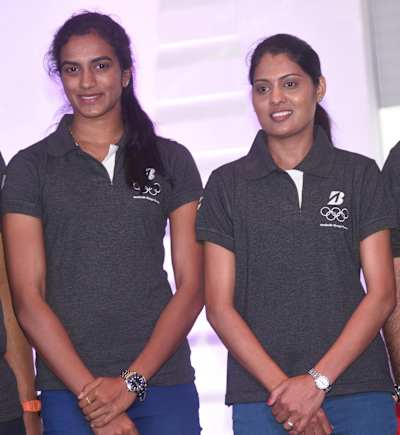
Lalita Babar (right) and PV Sindhu being felicitated
© Lalita Babar
The celebrations to mark her athletic achievement soon made way for the matrimonial festivities. Babar kept her word and got married to IRS officer Sandeep Bhosale in May 2017. The only glitch was that she could not participate in the 2017 Asian Athletics Championships in Bhubaneshwar in July. She took some time away from sports, playing the role of a wife and daughter-in-law instead of the one that saw her become the country’s best steeplechaser.
But not for long.
“I don’t feel like I am a married woman and need to stay at home,” she says. “My husband is also into sports (amateur handball) and understands me. My in-laws always tell me that I have so much more that I have to achieve. They’re all very interested in sports.”
And so, back in October 2017, just months after her marriage, Babar returned to the gruelling training sessions that took her to Rio. But the return wasn’t easy. For starters, she had to deal with her own lethargy. She shifted base from Dharamshala — where the rest of the middle-distance and marathon runners trained — to Pune because she could not bear the cold weather. Once she was over the initial steps, the struggle to achieve the success she earned years ago became a little more palatable.
“While training for Rio, I had to wake up at 3am, train, eat boiled food. There was no entertainment, and I was getting very, very tired. Even a year’s rest wouldn’t have been too much,” she says. “When I restarted, I was thinking, ‘Why am I doing this? I have already lived this life of struggle.’ Aur Nikolai sir to jaan nikal dete hai [and Nikolai sir draws the life out of you in training].”


Dealing with the struggles
The return meant she had to deal with her coach Dr Nikolai Snesarev. The Belarusian – who has a reputation of being a strict disciplinarian but a masterful tactician – did not take Babar’s decision to get married too well. Nor did he let her ease back into the sport.
“When I came back, I had put on some weight. So he used to keep telling me about that and didn’t let me eat much. He knows that I can do better,” she says. “Nikolai sir was not ready to let me go for my own marriage either! I wrote a letter a month earlier stating I had to go and had to explain that it’s a part of Indian culture.”
Babar always knew she would return to the track after marriage. The difficult bit was to put the work back in.
“Starting again after marriage was a bit of a struggle because going back to hurdles is difficult, it is a very technical event. Also once your endurance drops, it’s very difficult to reach that level again,” she says.


Steadily, she began clocking the miles; about 200-250 in a week. The rhythm was back, as she’d re-find her feet in an event that involved heavy planning and pre-race strategizing. The 2018 Commonwealth Games in Gold Coast, Australia was the first event on the agenda. But unfortunately, things didn’t work out.
In early January 2018, during a training session, she felt something twitch painfully in her back as she cleared a hurdle — she had pulled a muscle in her back. Suddenly, the path to a return was forced to detour in rehabilitation. The comeback had to be delayed.
“I’m not concentrating too much on the Commonwealth Games since I didn’t get enough practice because of the injury,” she says. “I didn’t want to go just for the sake of it.”
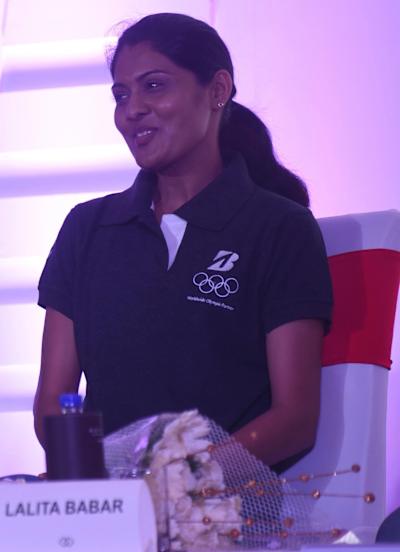
She has been easing back to fitness since her marriage
© Lalita Babar
She is back on track in Pune, nursing her injury and steadily building her endurance and speed. The focus instead has now shifted to the tournament where she had made her first big impression in the steeplechase field four years ago — the Asian Games. At Incheon 2014, her first appearance at a multi-discipline event, Babar won silver after breaking the national record for the first time.
She’d break it again at the World Championships a year later, and then set the current mark at Rio 2016. Qualification for the 2018 Asian Games in Jakarta is still pending, but there’s a bigger set of fans supporting her now in her husband and his family.
“If I feel lazy sometimes, they motivate me to get back on track. Everyone is expecting a lot from me,” she says. “I keep thinking if I can fulfil [their expectations]. Especially for my husband. I’m trying really hard to win a medal for him.”
Two years after Rio, there’s another promise now for Babar to keep.


