








Fitness
Ultrarunning
Fernanda Maciel runs 172.8km across Bolivian salt flat to break record
Brazilian ultrarunner Fernanda Maciel ran for almost 20 hours straight, navigating the Salar de Uyuni, Bolivia’s high-altitude salt flat – and cut more than 13 hours off the crossing record.
Located about 3,700m (12,100ft) above sea level, Bolivia’s Salar de Uyuni is one of the world’s largest high-altitude deserts. At that elevation, even walking can leave many people short of breath. Brazilian ultrarunner Fernanda Maciel ran across it, setting a new overall fastest known time (FKT) on the route.
The 46-year-old covered the 172.8km route faster than anyone before, finishing in 19 hours, 50 minutes and eight seconds. She ran through the day and into the night and navigated the near-featureless salt flat, cutting more than 13 hours from the previous record, set by fellow Brazilian ultrarunner Valmor Giuseppe Leonardo in 33 hours, 4 minutes and 10 seconds in 2023. Follow her during the challenge in the clip below:
01
Running across a high-altitude salt desert
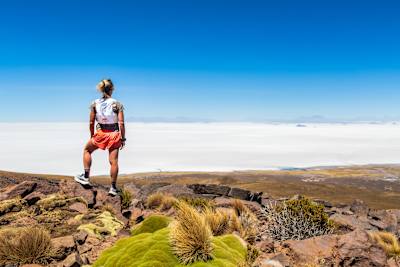
Fernanda Maciel surveys the expanse of the Salar de Uyuni
© Rudolf Hauser/Red Bull Content Pool
Maciel's started off on her quest at 5am on September 28, 2026, beneath the entrance and exit arch in Llica, on the western side of the Salar.
Her achievement was exceptional not simply for the distance covered, but for the conditions in which she completed it. Running that far in such a short time meant sustaining an extraordinary effort at far above sea level, where the reduced availability of oxygen makes prolonged exertion more demanding. With little shelter from the elements across the vast, exposed salt flat, she also had to contend with prolonged exposure to the sun and changing weather conditions, while managing hydration and nutrition over almost 20 hours on her feet.

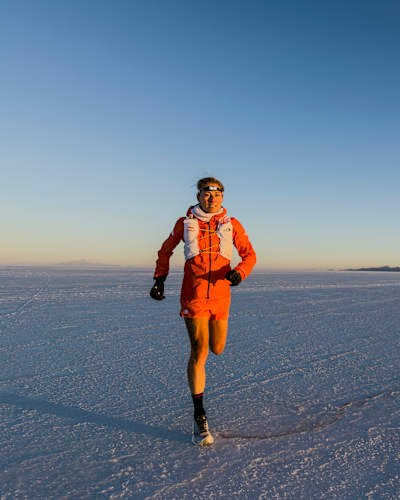
Fernanda Maciel faced extreme conditions during the run
© Rudolf Hauser/Red Bull Content Pool

Part of the challenge was the immense, near-featureless landscape
© Rudolf Hauser/Red Bull Content Pool
The challenge extended beyond physical endurance. Maciel ran for nearly 20 hours - all day and well into the night - across an immense, almost featureless landscape with no marked trail to follow, relying on a route mapped on her phone to stay on course. As darkness fell and visual landmarks became harder to distinguish, navigation demanded additional concentration at a time when fatigue was already accumulating. She also had to adapt to unexpected surface conditions, including shallow water, mud and more.
Combining sustained physical performance with careful navigation, constant adaptation and the mental resilience to keep on track in such an unforgiving environment makes her FKT particularly remarkable.
02
A salt flat turned into mud
Conditions across the Salar proved far more challenging than anticipated, as a hailstorm transformed sections of the salt flat into a patchwork of shallow water and mud. Beneath the surface, Maciel also encountered numerous small water-filled holes, demanding constant adjustments to her footing.

Fernanda Maciel found the surface of the Salar could be unpredictable
© Rudolf Hauser/Red Bull Content Pool

What looked flat and even, could be deceptive
© Rudolf Hauser/Red Bull Content Pool
After navigating the pools at kilometre 145, she was forced to change her shoes and socks. “I had to pay attention all the time to where I was putting my feet,” she said.
03
A very different kind of ultra run
Physically, the crossing pushed her into territory she rarely encounters in competition. After 100km, her stomach began to reject food, forcing her to manage nearly 70km with compromised nutrition.

Fernanda Maciel celebrates her incredible FKT across the Salar de Uyuni
© Rudolf Hauser/Red Bull Content Pool
I know how to run in the mountains, but not [on the] flat. I didn't have any more power, but I tried my best
Later, as she approached Uyuni, her legs began to cramp and lose power. She described the final hours as pure grit: “My whole body was exhausted… My legs were destroyed; I couldn't open my steps.”
Despite knowing how to suffer in the mountains, she admitted that running such a long, flat stretch at altitude demanded a completely different kind of resilience: "I know how to run in the mountains, but not [on the] flat. I didn't have any more power, but I tried my best.”
