

Tennis
7 fascinating facts that make Wimbledon so unique
One of Britain’s most iconic sporting events, discover why Wimbledon holds a special place in the hearts of tennis players and fans alike.
The third Grand Slam of the year, Wimbledon, which this year runs from June 29 to July 12, is the oldest tennis tournament in the world and widely considered the most prestigious. Played on the famous grass courts at the All England Lawn Tennis and Croquet Club (AELTC), it is renowned for the long-standing traditions that help it stand out from the other majors, those being the Australian Open, French Open and US Open.
Held each year in southwest London, Wimbledon is known for its all-white dress code and grass courts, but those are only part of what sets it apart. These seven facts show why.


01
Thousand of tennis balls are used each year
A Wimbledon tennis ball has a surprisingly short lifespan. That's because new balls are used after the first seven games, then after every nine subsequent games. That's the same for every single match that takes place across the two weeks. The reason new balls are used so often is to ensure the quality of the match, as the constant heavy hitting from players can reduce the air pressure and adjust how it bounces. Throughout the tournament, the AELTC estimates that a staggering 55,000 balls are used every year.
02
14 straight days of matches
For decades, Wimbledon was the only Grand Slam that featured a rest day, with no matches played on the middle Sunday of the tournament. That rule was only broken four times, with games being played in 1991, 1997, 2004 and 2016 due to rain disrupting play earlier in the week. The tradition came to an end in 2022, marking one of the most significant modern changes in Wimbledon's history.

Iva Jovic will look to excel on Wimbledon's precision-cut grass courts
© Marleen Fouchier/BSR Agency/Getty Images
03
The grass is cut with millimetre precision
It is not just the players who demonstrate remarkable accuracy at Wimbledon. The groundskeepers are also equally precise, meticulously maintaining all 18 Championship courts by cutting the grass to exactly 8mm throughout the tournament. Court wear, surface hardness and ball rebound are also measured daily to ensure consistent playing conditions.


04
Nearly two million strawberries are eaten during the tournament
Strawberries and cream have long been a tradition at Wimbledon. Believed to date back to the early days of the tournament in the Victorian era, they were considered a seasonal delicacy and only available for a few weeks of the year. Still hugely popular today, fans consume around 28,000kg of strawberries (nearly two million) and 7,000 litres of cream across the two weeks. Freshness is also taken seriously, with Wimbledon's strawberries sourced from Kent and picked at sunrise before being delivered to the grounds on the same day.
05
One of Wimbledon’s most popular viewing spots is not on court
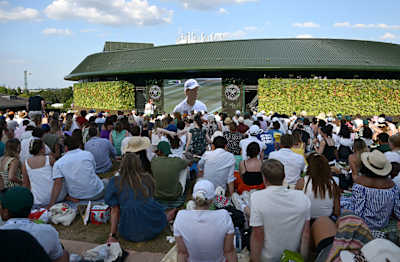
Is it a hill, a mound or possibly a ridge?
© Hannah Peters/Getty Images
One of the best spots to watch the action unfold at Wimbledon is on a grass bank inside the tournament grounds. The picturesque location, where fans gather to watch matches on a giant screen, has been given a series of nicknames to honour the best British players. First known as Henman Hill during Tim Henman’s rise, it was later named Murray Mound after two-time Grand Slam champion Andy Murray. Should Emma Radacanu enjoy a successful run, then perhaps it will become Radacanu Ridge.
06
The longest match lasted more than 11 hours
Before the introduction of a fifth-set tie-breaker in 2022, matches at Wimbledon could stretch for hours and even days. But nothing quite compares to the epic contest in 2010 between American John Isner and France’s Nicolas Mahut. Spread over three days at SW19, Isner eventually won 6-4, 3-6, 6-7, 7-6, 70-68 in a match that lasted 11 hours and five minutes. It's a world record that due to the change in rules, can never be beaten.
07
Fans camp overnight for tickets
The idea that British people love to queue may be a cultural stereotype, but when it comes to Wimbledon it becomes a statement of fact. Each year, as many as 10,000 people a day attempt to gain entry to the tournament by joining a queue. Thousands will leave disappointed, but that doesn’t stop them from waiting for hours on end in the hope of securing entry. Some will even show their dedication by camping overnight.