





Skateboarding
Skateboarding
Diego Poncelet on his skateboard speed record: “Falling was not an option”
Spain's Diego Poncelet hit 150kph on a skateboard, pushing the limits of downhill speed. He reveals what it takes to stay in control and why he’s always loved being called mad.
For most people, travelling at 150kph is something they will never experience, even in a car. Diego Poncelet reached that speed standing on a skateboard, hurtling down a mountain road with nothing between him and the tarmac but a set of wheels and his own ability to stay in control.
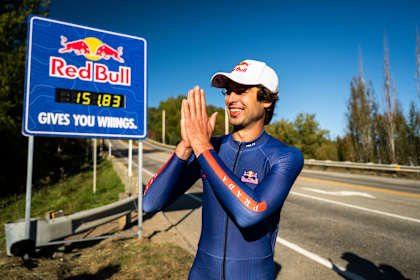
This September, the 27-year-old Spaniard and two-time downhill world champion took on a closed section of Route des Éboulements in Canada’s Charlevoix region. He hit 151.83kph (94.34 mph), becoming the fastest skateboarder in history and claiming a new Guinness World Records™ title.
Watch Diego Poncelet set the world record for the fastest skateboard speed in a standing position.
It was a milestone years in the making, and it required Poncelet to confront a speed he had long dreamed of reaching but was never certain was possible.
“I never truly admitted to myself that my real objective was to get to 150kph; I was scared that it wouldn’t be doable,” he said after the attempt. “But I couldn’t lie to myself. At 146.88kph, I wasn’t satisfied yet. It was only when I got to 151kph that I was completely ecstatic.”
For Poncelet, who has been captivated by speed since childhood, the achievement was the culmination of a lifelong obsession. But reaching those speeds on a skateboard demands far more than a willingness to take risks. It requires meticulous preparation, extraordinary precision and the composure to keep moving when even the smallest mistake could have serious consequences.
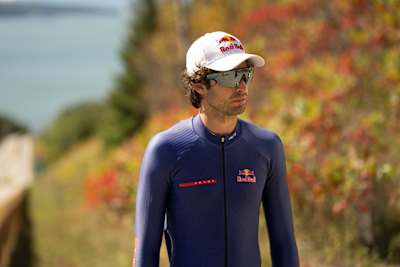
Poncelet entered a flow state during his record attempt
© Red Bull Content Pool
In this exclusive interview, Poncelet reveals how he prepared for the record attempt, negotiated cracks and bumps, and kept his focus when falling was not an option.
A tiny pebble could have caused a serious crash. Was there any way to make sure the road was completely clear?

In terms of technique, I trained at speeds of over 100kph almost every time I went out to skate to become accustomed to the way the board reacted at high speeds, while also doing a great deal of visualisation to ensure that, on the crucial day, I would keep my emotions under control.
And lastly, in terms of the conditions of the road, the Canadian hill has a lot of cracks and bumps which I had to memorise beforehand. I also adapted my optimal aerodynamic position so as to absorb those shocks and vibrations to the best of my ability.
How did you train your body to absorb the shocks and the huge amount of G-force?
I always say that the most important factor is to just skate a lot, which will develop the many skate-specific muscles that are needed to perform to our full potential. Of course, going to the gym is also very important, especially for injury prevention and weight gain, which is important in my sport as gravity will pull harder on you. Moreover, I believe a lot of coordination training is what separates good athletes from great ones, and it’s always been my favourite part of my training programme.

Poncelet's equipment and attire were specially designed for the attempt
© Red Bull Content Pool
My team and I tried to innovate from head to toe on anything that could bring us an extra tenth
Your legs must have been burning after so many attempts. How painful was it and how did you cope?
During the run, I am in a flow state and focus exclusively on the air that wraps around me. Adrenaline probably helps too. It is only at the end that I wonder, ‘How did I not feel how tired my legs were until now?’.
How do you stop your wheels from bursting at that speed? Can you tell us a bit more about your setup?
My setup for this record attempt was quite complex. My team and I tried to innovate from head to toe on anything that could bring us an extra tenth. Regarding the helmet, my team tested about twenty different shapes on a 3D model of my position in CFD [computational fluid dynamics] simulations until we found the perfect shape.
For the suit, we used a special aerodynamic fabric and built a spoiler to tuck my hands underneath. For the shoes, Prada Linea Rossa custom-built asymmetric shoes meant to maximise stability in the front and minimise drag in the back, while also reducing vibrations through D3O technology and lowering my position through a sleek rubber outer sole.
Prada Linea Rossa also made gloves with a puck designed specifically for aerodynamic purposes while still maintaining the possibility of drifting if needed in an emergency. For the wheels, Seismic made a new prototype of urethane that arrived the day before the record and outperformed everything else. Last but not least, we built a custom fairing for my board, which radically reduced its air resistance. It almost looks like a spaceship.
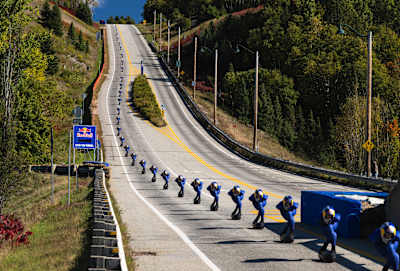
Diego Poncelet tucks in tight as he hurtles down Route des Éboulements
© Red Bull Content Pool
What did your parents say when you told them about your record attempt?
By that time they were accustomed to my extravagant ideas, so I don’t believe they were particularly surprised. I do remember my mom asking me: ‘Haven’t you done enough? Is going 150kph really necessary?’ Well, of course it was!
What would you say to people who think what you’re doing is completely mad?
Thank you! I’ve always loved being called mad. Since I was a kid, that’s where I’ve found my own place in the world: my authenticity. Madness is to carve your own path without fear.
Diego Poncelet’s world record in numbers:
- 151.83kph – Poncelet’s world-record speed
- 2.2km – approximate length of Route des Éboulements
- 18% – the road’s maximum gradient
- 600m – length of the steep straight section
- 5 days – how long Poncelet waited after his first record-breaking run for better conditions
- 10–14kph – the tailwind during his 151.83kph run
Get to know Diego Poncelet
