










Bike
MTB
Do downhill pros get nervous before a World Cup race?
What exactly does it feel like to be sitting in the start gate before you go down a Mercedes-Benz Downhill World Cup run?
There could surely be little more nerve-wracking than sitting in the start gate of a Mercedes-Benz UCI Downhill World Cup race, the clock ticking away, final seconds rapidly disappearing between a moment of calm and the fate of a race weekend. Once the timer beeps, and the start line is crossed, it's make or break – the outcome of a race, title chase or even a career might hinge on what happens next.
But do the pros even operate like the rest of us? Perhaps they're superhumans who feel no pressure, who know no nerves. We sought to find out and hear from people who are no strangers to the pressure of a World Cup start: Amaury Pierron gives a racer’s point of view, top coach Chris Kilmurray tells us why nerves aren’t always bad, Kurt McDonald explains how different riders go about their warm-up, and Renaud Smaniotto and Fabien Cousinié let us into the mind-sets of two top athletes who are on the top of the mental game of downhill in 2019, Loïc Bruni and Tracey Hannah.
Behind the goggles – World Cup winner Amaury Pierron
As fans and onlookers, the start gate is usually our first interaction with the world’s top downhill racers. When they appear on our screens ready to drop in, we are often greeted with a focused look of determination as they stare down the barrel of what might be a life-defining ride. To realise just how much pressure and nerves a rider must be feeling at this point, you really have to put yourself in their shoes. Commencal-Vallnord’sAmaury Pierron talks us through the intense moments before a race run:
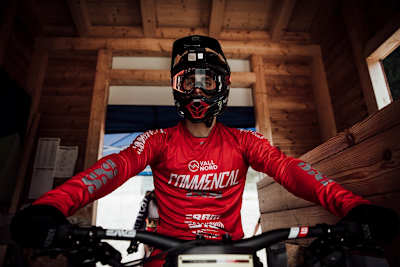
The last few seconds before the beeps
© Bartek Woliński
“The last few minutes before starting a race run are really special. To be honest, the feeling is hard to describe. Some of us call it ‘the zone’. When we're in that zone, we're just in our own bubble. In the zone, you’re not alone, because there's your mechanic with you, and the UCI people at the start. But you feel alone, or at least I do. Me, my bike, the track. No noise, nothing.
"Focusing on my breath. I know everything is ready to go. I just have to give my best, push hard, handle the pain, keep pushing. But at this moment I don’t think about it. It’s inside me. A beep at 10 seconds. Five more beeps to go. Just separated by deep breaths. And you’re gone."
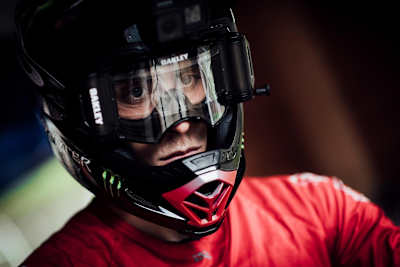
Amaury Pierron is in the zone
© Bartek Woliński
"I don’t really have a particular feeling at this time. I’m in my focus zone. If I’m 100 percent in my zone, I’ll be happy about my run because it’ll be good, or at least I’ll ride at my best. But you have to keep that during a full run and that’s sometimes not easy. Mistakes or a changing track can disturb that.”
It’s not as simple as just setting a time to get oneself in the zone though. With the entire World Cup circus going on, there are endless distractions to deal with and challenges to deflect, as Pierron describes:
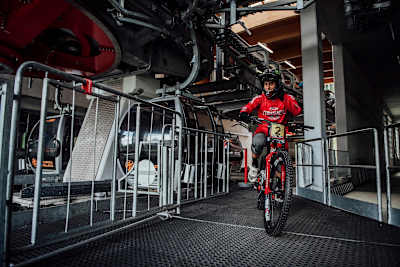
Amaury Pierron enjoys the stress
© Bartek Woliński
“Nonetheless, before getting into the zone, there are a few moments of stress. When you finish your training, everybody around you starts to be in that zone. Mechanics, staff, riders who drop before you... because they all do their thing at their best, so they are in that zone too. And that make me a bit nervous, but worse (sometimes good at the time) is to hear the speaker screaming for a sick move, or a sick new time. And this happens every 10 minutes on a race day! That gives you butterflies in your stomach. It’s funny, but I like this kind of stress.
But not funny at all is when your sponsors ask, !How do you feel? You going to win?" That makes you weird, and you just try to find a right answer."
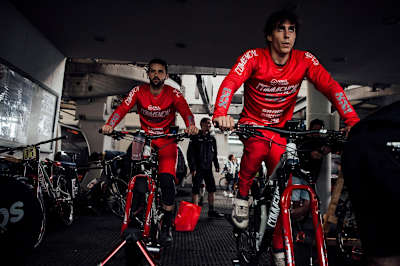
Getting ready for track action
© Bartek Woliński
"People nearby who are not super close to you or super close to the race programme don’t know what it's like to race. Racing to win is a long process. And the mental game is a third of success. We just need to think about ourselves, about what we're doing. A few words can change the way you think. It’s hard to explain – but don’t worry, we always give our best. But this is World Cup racing, so it’s hard to win every single race.”
Experience brings results – team manager Fabien Cousinié
Tracey Hannah has so far had a long and prosperous career and, at this point, seems only to be getting faster. Her team manager at Polygon UR Team, Fabien Cousinié, puts her recent success and consistency down to the way she channels the pressure of a race run:
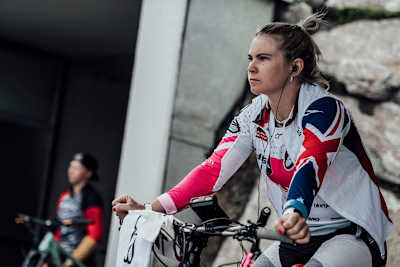
Full focus before the race
© Bartek Woliński
“You can feel the pressure building once you get closer and closer to the race run, but I think what Tracey has done recently is to transform this pressure into focus. It’s now becoming more of a gradual build-up toward maximum focus before she drops in.
"From my experience as a team manager, what splits the difference between normal people and the best pros is their abilities to manage their emotions when it’s time to race. There are a lot of mental and related techniques to do that, but for me I believe the two things that help the most centre around putting things into perspective."
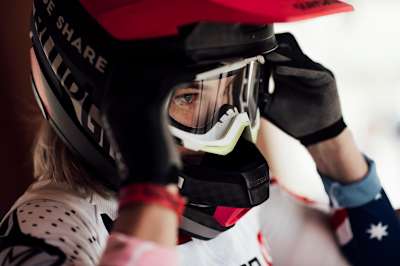
The final moments
© Bartek Woliński
"The first thing is to not think about the crowd or going for glory, but just thinking about going fast on the bicycle. The second thing is just to gain experience – the more World Cup starts you take the less intimidating it becomes.”
Positively nervous – athlete coach Chris Kilmurray
The people around the top racers – team members and friends – understand the pressure well, feel it themselves even, and all work together with each rider to help them channel every bit of preparation into a best possible race run.
Chris Kilmurray of Point1 Athletic Development, who trains top racers such as Tahnée Seagrave, talks us through from a coach’s point of view:
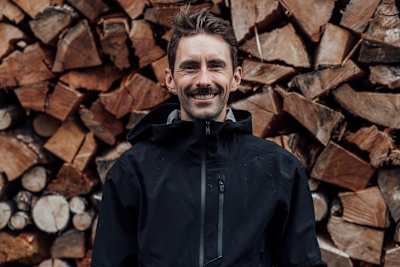
Chris Kilmurray works with a lot of the top athletes
© Bartek Woliński
“The last minutes before a race run are critical to a successful performance. That doesn't mean they are to be filled with a precise schedule or a rigid system.
"The final moments before dropping in and taking the risk needed to win a race run, for most riders, are spent with people they trust. A mechanic, coach or manager. Maybe applying the finishing touches to a pre-race routine or warm up, or simply being there to chat and fill the quiet void that happens with three minutes to go before a start time. A race run may not be won in these minutes, but a major defeat can be avoided by fine-tuning and adapting tried and tested finishing touches before the rider rolls into the start house."
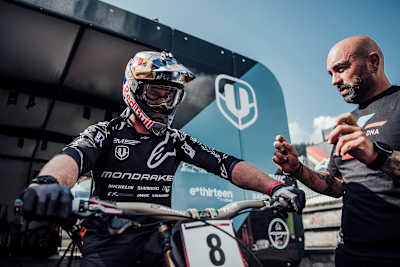
Brook Macdonald and mechanic Ben Vergnaud go through final tweaks
© Bartek Woliński
"This period is the perfect time to capture the pre-race nerves and turn them into a positive. Nerves are essential and natural. They are the body’s way of getting us ready to work – fight or fly. They serve the same purpose regardless of sport.”
While nerves may at times feel like a hindrance, Kilmurray explains they are the way in which our body gets us ready for action. When we’ve got a battle on our hands, in fact, they are positively vital, he says:
“Nerves tell us that the task facing us is risky, but also important. If it didn't matter nor excite you, there'd be no nerves. That means they are a positive. It's a simple way for our body’s central and autonomic nervous systems to prime for action."
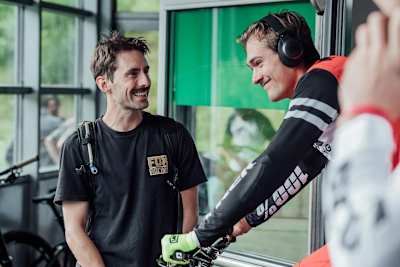
A few final words of wisdom
© Bartek Woliński
"The easiest way to channel these nerves into a positive performance is preparation. If you've done the physical training, put the work in trackside and on course and lined up your tasks, then ticked them off, there is nothing to worry about. If a rider knows where their wheels need to be, and they are physically ready for the challenge, then the pre-race nerves serve simply as a positive primer for the action to come.”
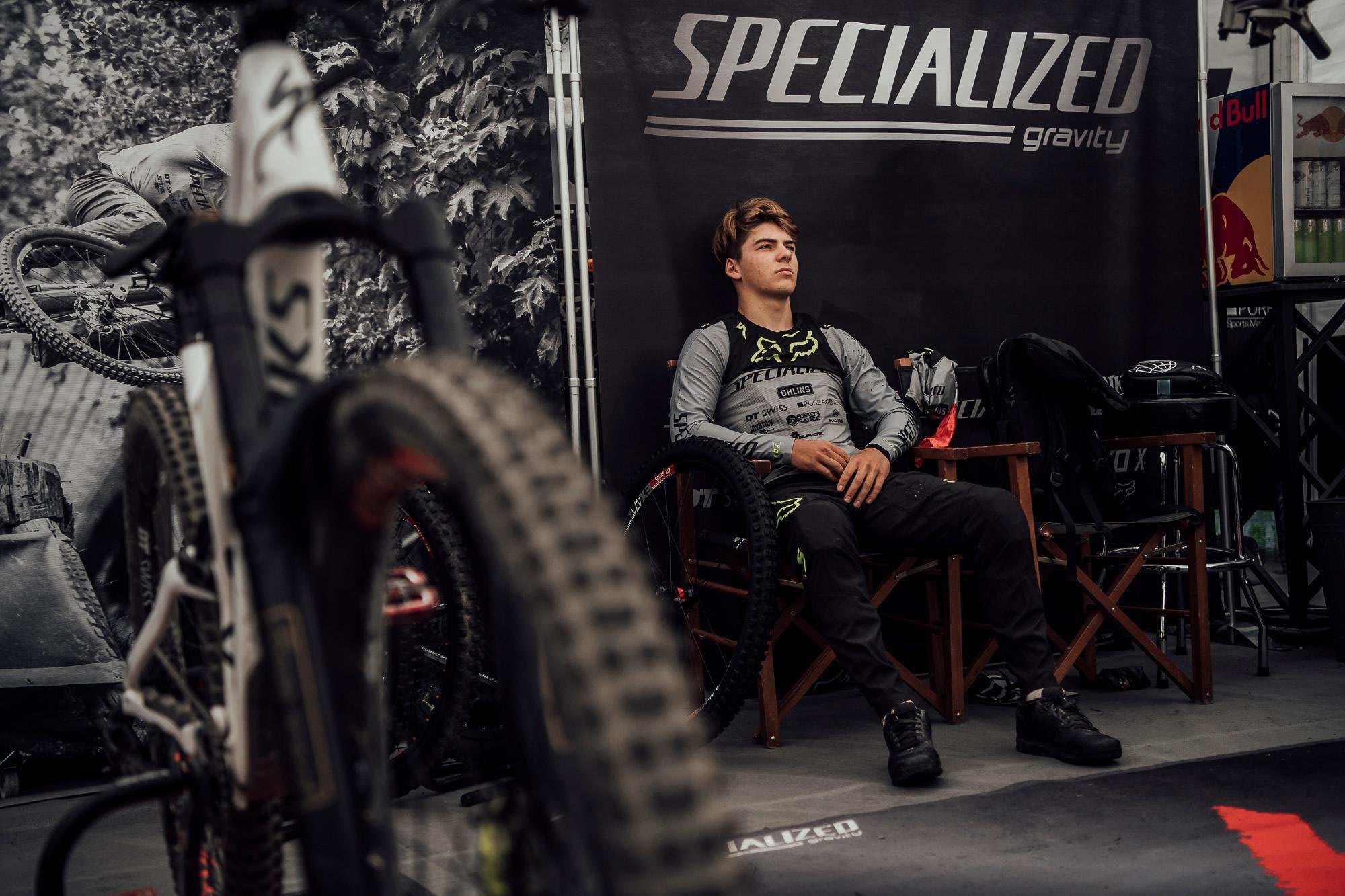
Finn Iles pauses for a moment to reflect
© Bartek Woliński
Knowing you got it – mentor Renaud Smaniotto
A large part of the reason top racers can deal with the pressure and nerves before a race run is in knowing they've done everything in their capacity to prepare perfectly for this moment. World Champion Loïc Bruni's close friend and Specialized Gravity Social Media ManagerRenaud Smaniotto understands this. He works as one part of a well-oiled machine to ensure that when Bruni rolls up to the start gate he has complete confidence that he will perform his best.
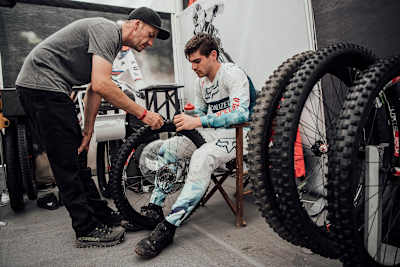
Jack Roure, Loïc Bruni's mechanic, talks Loïc through tyre options
© Bartek Woliński
“Loïc works hard all year on his mental preparation. Even during race week, he talks a lot with both his physical and mental coaches. The race week is planned from the track walk to the final finish line."
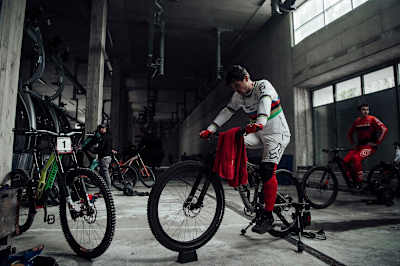
Loïc Bruni spends all year working on mental preparation
© Bartek Woliński
"We work hard on the track during training to find the best lines for him. When he’s on the start gate for finals he is completely confident; he knows exactly where he has to go and what he has to do in order to get the best possible result.”
Sharing the pressure – team mechanic Kurt McDonald
Perhaps the people closest to the top racers, and who witness the build-up – from pre-season testing and training all the way to the start gate – are the mechanics. In downhill, a mechanic is more than someone on the spanners. They are the right hand of the racer and a constant among the sport’s many variables.
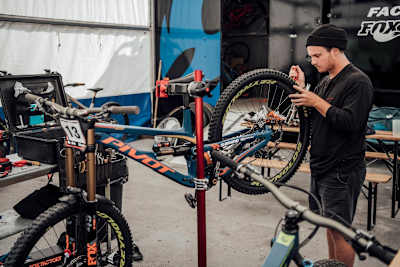
Team mechanic Kurt McDonald
© Bartek Woliński
Kurt McDonald of Pivot Factory Racing, Eddie Masters’s personal mechanic, explains the atmosphere at the top of a World Cup race, and the different approaches to dealing with nerves.
“The atmosphere around the start gate in a World Cup race run changes from track to track, depending on the set-up at the top and also the track and weather conditions. It can be pretty dependant on who you are around, as well."
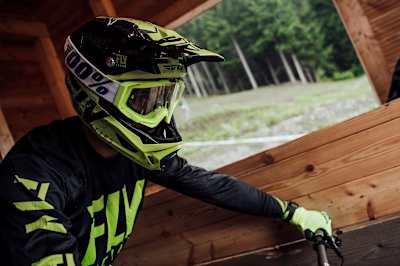
The atmosphere in the start gate changes from round to round
© Bartek Woliński
"One thing is clear though: everybody up there is there to get it done. The mechanics want it as much as the riders do. Everyone knows their job and every move is calculated in working towards the race run.
"Some riders really keep to themselves and build themselves inside some kind of zone. Headphones in and cracking on with their warm up, only making contact with their mechanic and blocking out everything else. Others are more casual and chat people who are around, maybe as a way to keep themselves calm. You see a variety of emotions. I think everybody is nervous, but every person handles it in their own way."
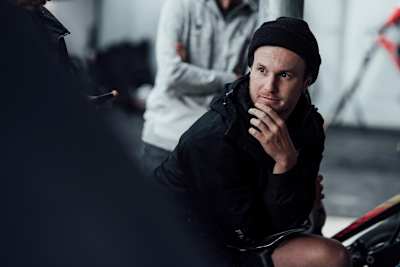
The nerves are felt by mechanic and rider alike
© Bartek Woliński
"Most riders have a warm-up routine, which involves a turbo trainer. They listen to music and spin on the bike to get themselves warm. Some riders have a pretty intense warm-up involving visualising the trail and their run. Some riders ride around on their bike doing wheelies and tricks, sprints up and down a path.”
Eddie Masters is quite unique in his approach. For anyone who’s seen Masters’s inimitable World Cup start hut style, McDonald’s explanation should come as no surprise:
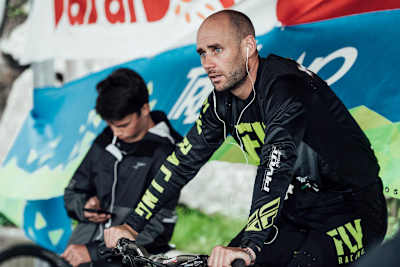
Eddie Masters gets himself ready to ride
© Bartek Woliński
“Eddie sits on the turbo trainer for half an hour or so before his run and does a quick lap on his bike doing a few hops and brake checks before rolling in to the gate. He acknowledges the riders around him, wishing them a good run, and he always fist bumps the timing person before dropping in, that’s his little thing.
"It’s quite funny – I definitely notice a difference in Eddie before he drops in to a race run. He’s pretty wired, but the moment he acknowledges the people around him and fist bumps that timing person I know he’s in a good place and ready to give it a proper go.”
Dropping in
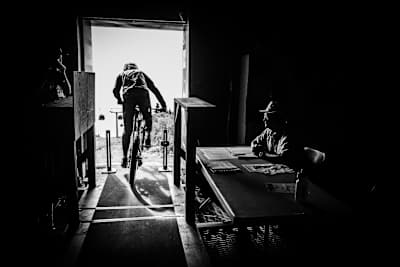
Finn Iles drops in
© Sebastian Schieck
There's no doubt that even the world’s very best downhill racers feel the nerves. If they didn’t, they might not even be where they are today. But it’s their handling of a high-pressure situation, and the way they and their team prepare, that guides them to top results. Even if at times it seems almost impossible that they'll be able to hold it all together while riding the infinitely fine line of triumph vs tribulation that is downhill racing.
