






Red Bull Motorsports
Red Bull Motorsports
Find out what happens when F1, MotoGP, rally and more race on ice
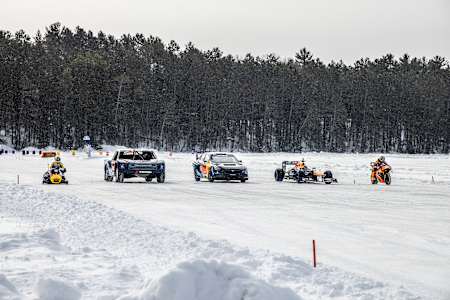
On a frozen Wisconsin lake, five elite motorsport athletes were challenged to see which machine performs best on ice.
Part of this story
Five high-speed, high-adrenaline athletes faced off in a multi-sport race on a unique surface: ice. For a competition on frozen Eagle River, Wisconsin on Dollar Lake, Red Bull invited five elite drivers from radically different motorsport disciplines to pit their skills against each other on this notoriously unpredictable racing surface.
Racing against each other in the Red Bull Ultimate Winter Race were Dani Pedrosa on a MotoGP bike, Gunnar Sterne riding a snowmobile, Andrew Carlson wrangling a Pro 4 trophy truck, Patrick Friesacher in an F1 car, and Scott Speed jumping a rally car. These five competitors are all masters in their craft, with decades of experience between them.

Dani Pedrosa on a MotoGP bike
© Chris Tedesco

Gunnar Sterne riding a snowmobile
© Chris Tedesco

Andrew Carlson wrangling a Pro 4 trophy truck
© Chris Tedesco

Patrick Friesacher in an F1 car
© Chris Tedesco
Meet the competitors
Vehicle
Competitor
Challenge on ice
KTM MotoGP bike
Maintaining grip while cornering
Snowmobile
Managing the longest route
Pro 4 truck
Handling jumps on ice
F1 car
Generating traction from a standstill
Rally car
Visibility and changing grip levels
Built to highlight the strengths, weaknesses, and driving styles of each machine to determine who is the best of the best on ice, each route was unique. Each contained its share of thrilling moments that looked terrifying from the outside. Beyond the logistics, this event was a rare motorsport crossover where success depends less on the machine itself and more on how drivers interpret traction, control, and strategy on ice.
01
Watch Ultimate Winter Race
02
Driving the same surface, different realities
Vehicle type changes everything—braking points, cornering, acceleration, and visibility—creating totally different experiences on the same track.
Andrew Carlson started racing snowmobiles at the tender age of 3 and hasn’t looked back. Now competing full time in a high-performance Nissan Pro 4 race truck, Carlson has the benefit of experience on two wheels, four wheels, and a sled. In his Pro 4, Carlson had one element the others didn’t: a jump at the start of the race.
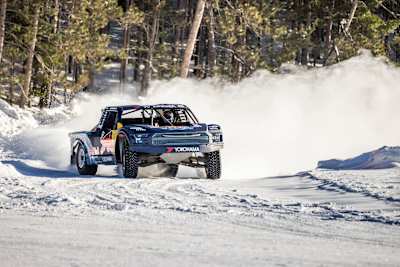
The Pro 4 truck brings off-road power to frozen conditions
© Chris Tedesco
“We have jumps like that pretty regularly in races, but on the ice I’d say it’s a lot more mental,” Carlson said. “After I hit it the first time, the nerves were gone and then it was just fun. I’ve always wanted to bring the truck to the ice; to be able to do that, Red Bull fashion, was awesome.”
Scott Speed is a legend whose career includes Formula One, NASCAR and multiple championships in Red Bull Global Rallycross competition. In his rally car, Speed encountered a long straightaway to build up acceleration before navigating right angles and curve-outs that challenged him.
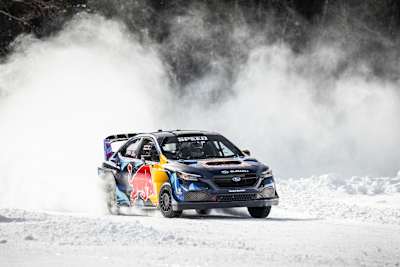
The rally car balances speed and control on frozen terrain
© Chris Tedesco
“My part was great because it was nice and warm in my car, which was designed for this exact thing,” Speed said. Since he had never driven on ice before, however, he found visibility to be challenging.
03
How the athletes prepared for frozen conditions
Three-time Grand Prix world champion and legendary MotoGP rider Dani Pedrosa took his KTM bike for a spin in the snow this past season. Riding on the snow track on his KTM equipped with gnarly 1-inch spiked tires, Pedrosa exhibited the balance and calm poise he’s known for. That experience prepared him for the ice in this challenge.
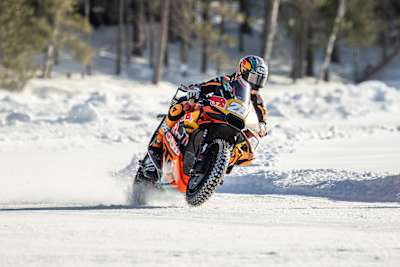
One-inch tire spikes deliver grip on the icy surface
© Chris Tedesco
Pedrosa had the sharpest turns of the five routes in this race. While it’s already well equipped, the KTM MotoGP bike had to be modified quite a bit. Because of the long spikes on the tires, the suspension had to be shortened so the spikes didn’t hit the radiator. Heated handlebars were added to keep Pedrosa’s extremities comfortable and warm. And the engine was adapted to run properly in the colder temperatures.
Carlson had never run the truck with studded tires before, and he tried out a few styles before settling on the set he used in the Red Bull event. Other than that, his truck didn’t require any modifications.
04
Adapting technique and mindset on the ice
Each athlete prepared differently for a surface they couldn’t fully control, leaning on learned knowledge of their own reaction times, learning curves, and risk tolerance.
For Pedrosa, his biggest concern was falling off the bike as hitting the ice means potentially skidding a long way. Normally he tilts the bike all the way to the side to navigate the corners of an asphalt track, but on the ice with spiked tires he had to learn how far he could push it.
“Slowly, I increased my confidence, and I was able to let go a bit more,” Pedrosa remembered. “The turns were quite tight and close together, so I needed to have the perfect line.”
No stranger to ice oval racing, Gunnar Sterne piloted his Red Bull Ski-Doo around the track at insanely fast speeds. Sterne’s route was the longest by far, with a few tricky loops requiring minor adjustments for maximum control.
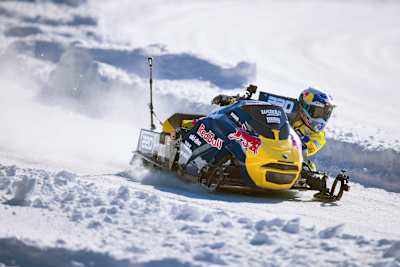
Gunnar Sterne puts years of ice racing to the test
© Joe Gall
“I think experience is everything,” Sterne said. “I’ve raced through a lot of conditions in snow and ice, and I used that experience to make the changes I needed.”
05
Why ice is motorsport's ultimate equalizer
Ice, weather, and course variability can only be predicted to a point. On the day of the race, the temperature dipped to 1.4 degrees Fahrenheit (-17 degrees Celsius) and a curtain of overcast gave way to bright blue skies dotted with fluffy white clouds. The track was pristine; each course was prepared properly for each driver and rider.
“I knew that whoever had the most traction was probably going to do the best,” Sterne said. “I think the other competitors were finding out it’s hard to hook up on ice and snow. It’s not the same as dirt, or grass, or pavement.”
Patrick Friesacher, a well-respected driver who knows his way around a track, already knew from experience that an ice route is decidedly different from pavement. Especially in a multi-million-dollar race car built for sheer power and speed. At the Red Bull Ultimate Winter Race, he learned quickly how to manage the traction issues.
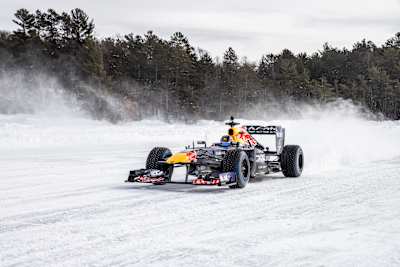
An F1 car searches for traction on frozen Dollar Lake in Wisconsin
© Chris Tedesco
“It was really difficult to start in an F1 car because there was no traction,” Friesacher said. “I was just spinning and saying ‘Come on, come on!’ because the others were going already and I was still at the start.”
Once he got going, the F1 car made up speed, but on the last run the engine misfired. His team made some modifications to the engine mapping, he said, but not much else. Friesacher had driven an F1 car on the ice in Austria once before on small tire studs, but he’d prefer to have longer spikes next time.
“As someone who enjoys motor racing, it was cool to see arguably the most well-designed race car ever really struggle,” Speed said, smiling. “I’m not jealous of the job [Friesacher] had to do.”
06
Competitive mindset & cross-discipline respect
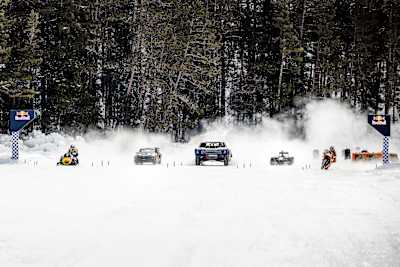
A MotoGP bike, F1 car and more compete on Wisconsin ice
© Chris Tedesco
Across the board, the competitors were delighted to see how far and how high Carlson’s Pro 4 caught air off the ramp at the start. They noticed the extreme spikes on Pedrosa’s bike that kept him from sliding across the track. And they all marveled at the opportunity to see this variety of motorsports machines on the ice.
Sterne says he never imagined he would be racing against an F1 car or MotoGP bike.
“It’s definitely the most unique thing I’ve ever done,” Sterne said. “I’m used to being close to my competitors, so today was a bit different having my own track, but it was cool to see the others’ strengths and weaknesses.”
After the ice shavings settled and the racing was complete, one Red Bull athlete claimed the title: Dani Pedrosa in his studded-tire-wearing KTM bike. As the race drew to its exciting conclusion, Pedrosa could see the other vehicles on their respective courses, but he didn’t know how close they were. He charged through the final corner, giving it his all.
FAQs
Part of this story
