


Gaming
esports
For DotA, Change Has Only Meant Growth
Are serial patches and a steady stream of updates key to the success of F2P?
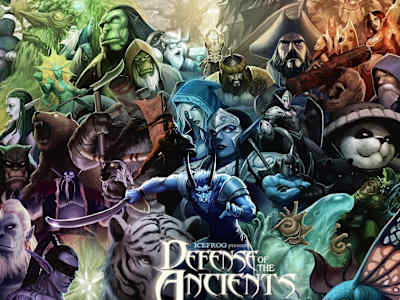
Defense of the Ancients
© Valve
In addition to what the game has become and continues to grow into being, there’s also a rich history of changes and additions that occurred after the transition from its predecessor, Defense of the Ancients. Without them, Dota 2 would be little more than a husk of the game we've come to know and love today.
Defense of the Trademark
Many of the hundreds of subtle alterations between DotA and Dota 2 come from hero and item names. As it originally came into being as a Warcraft 3 mod, Defense of the Ancients is more or less fan fiction, and many of the heroes shared not only character models but names and background with their Blizzard-based counterparts.
Windranger, for instance, started out as Windrunner, in reference to the fictional Windrunner family. Weaver and Nyx Assassins were called Nerubian Weaver and Nerubian Assassin, in honor of Warcraft’s race of intelligent bug monsters.
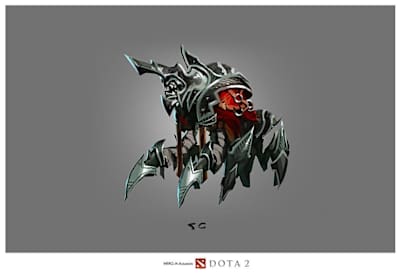
Nyx Assasin Concept Art for Dota 2
© Valve
To avoid copyright disputes, most of the characters had their names altered or replaced completely, but traces remain. "Io", for instance, was still referred to as “Wisp” in some of his ability descriptions even after the name change. In the parlance some of longtime players, you’ll still find those who say "Furion" instead of "Nature’s Prophet".
Heavy Lies the Aegis
The Aegis of the Immortal. These days, it’s an incredibly potent item that can upset the balance of a match or ensure the lead of a winning team. The only way to obtain it is by killing Roshan, the most powerful neutral creep in both DotA and Dota 2.
But it wasn’t always that way.
In earlier versions of the first mod, the Aegis was a recipe-based item that came with its own set of stat boost and three charges. This was obviously incredibly imbalanced, and would have completely ruined the flow of combat in Dota 2. Lucky for us, it never made it that far.
The Wraith King
The King posesses one of the most abnormal histories among Dota 2 heroes.
In Defense of the Ancients, he was known as "Leoric, the Skeleton King" – a reference to the same character from Diablo and Diablo 3. While “Leoric” was dropped in the transition to Dota 2, he retained the Skeleton King moniker until the winter of 2013, during the annual winter holiday event.
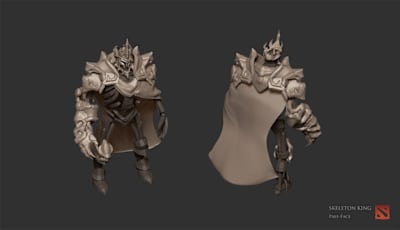
Skeleton King mockup from Dota 2
© Valve
This temporarily added a new mode to Dota 2 entitled “Wraith Night”: a cooperative survival game where players worked together against increasingly difficult waves of enemies. It was also an excuse to change Skeleton King to Wraith King, which added to his back story and altered his appearance. He also lost the ability to temporarily drain the maximum HP of targets with Mortal Strike.
A Woman in Uniform
Another character met with substantial changes between DotA and Dota 2 was Tresdin, the Legion Commander.
Today, she’s a potentially deadly late-game carry capable of permanently boosting her attack damage by winning duels with her ultimate. In DotA, Tresdin was all of that – but also a mounted and mustached man.
No official reason has been given for the Commander’s change in design. If we had to take a guess, I’d say it was to add a strength-based, fully armored woman to Dota 2’s roster – something notably absent prior to Tresdin. She still makes references to her old look in the form of voice-over when meeting other heroes by complimenting their steeds and facial hair.
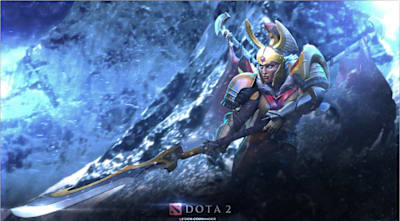
Tresdin in all her glory
© Valve
Fog of War
Just like the naming conventions, a great number of the game's mechanics were tweaked for Dota 2. Some are balance-oriented, but a number of them resulted from limitations of the Warcraft 3 engine. After all, it's easy to forget that the game was originally released back in 2002.
Rubick’s ultimate, which steals an opponent’s last-used spell, couldn’t affect everything, purely due to technical limitations – but now it can. Meanwhile, buffs (used to augment heroes’ attacks), weren't able to stack on top of one another. This greatly diminished the usefulness of multiple heroes attacking the same target, a problem that doesn't exist within Dota 2.
Yet, perhaps one of the most interesting is how Fog of War works. Fog of War is the region of the map which is invisible to a player until they’re within sight range.
Chasing retreating heroes into the fog is a risky but fairly common tactic among players. In Dota 2’s predecessor, heroes couldn’t automatically chase each other past the fog – players had to micromanage their units around it. Now, however, by simply setting a character to auto-attack an opponent will keep them chasing. Suddenly, juking into the forest and using Town Portal Scrolls isn’t quite as effective as it once was.
"The times, they are, a-chan'gin'," observed Bob Dylan back in January of 1964. Much like time, change will always lie at the core of Valve's masterpiece. It's what makes great. It's what makes it the most played game in the world. It's what allows people to make a living playing it.
Here's hoping it never stays the same.
For more news, follow Red Bull eSports on Twitter.
