
Cycling
Giro d’Italia 2025: The key stages that could decide the pink jersey
The 108th edition of the Giro d’Italia kicks off in Albania on May 9 and sees riders tackle almost 3,500km and 52,500m of climbing before they roll into Rome for the ceremonial finale on June 1.


Over the 21 days of racing some stages will prove more decisive than others in the battle for general classification and the all-important iconic Maglia Rosa. From Tuscan gravel to a Queen stage crammed with cols, here are the key stages that could decide the pink jersey…
What’s new in the 2025 Giro Route?
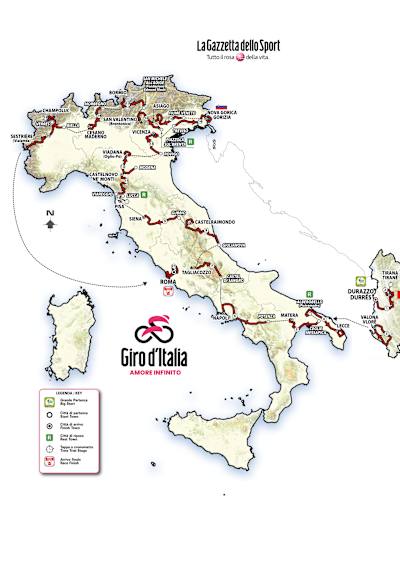
Map of the Giro d'Italia 2025
© Giro d'Italia 2025
The Giro will visit Albania for the first time in 2025 and will head across the Adriatic Sea for the Grande Partenza – the first three stages of racing – before there’s a rest day for the teams to transfer across to Alberobello in Puglia for the start of stage four. As well as two hilly days of racing, the Balkans will host the race’s first individual time trial – a 13.7km circuit in the capital, Tirana. Although too short for serious time gaps to emerge, it could provide an early indicator of who’s in form in the GC battle.
The six stages that could decide the pink jersey:
01
Stage 9, May 18

Stage 9 - Gubbio to Siena
© Giro D'Italia 2025
- Gubbio - Siena (181km)
- 2,458m, hilly
What makes it important for GC?
The final stage before the Giro’s second rest day, stage nine, will have a Spring Classics feel with it featuring five sectors of Tuscany’s white gravel roads made famous by Strade Bianche. The 28.9km of gravel is unlikely to be where the race is won, but any major mechanical issues or crashes could put a serious dent in a rider’s GC ambitions.

Any historic significance?
Like Strade Bianche, Siena’s Piazza del Campo will host the finish of stage nine, with riders crossing the line in the city’s iconic central square, made famous by its hosting of the Palio horse race. Before entering the square, they have a short, sharp climb to tackle, which could prove significant in the race for the stage win and any time bonuses.
02
Stage 10, May 20

Stage 10 - Lucca to Pisa
© Giro D'Italia 2025
- Lucca - Pisa (28.6km)
- 125m, ITT
What makes it important for GC?
The second and final individual time trial of this year’s Giro, the stage from Lucca to Pisa, provides the last opportunity for gains against the clock before the race starts to hit some serious mountains. Its length will make it more significant than the 108th edition’s other ITT (stage 2) in the battle for the maglia rosa, although as it’s flat, it will take something special for a GC contender to open up a big advantage.
Any historic significance?
The Giro first visited Pisa a century ago in 1925, but the site of the leaning tower hasn’t hosted the race for 45 years, then a time trial that also finished in the Tuscan city.
03
Stage 16, May 27

Stage 16 - Piazzola Sul Brenta to San Valentino
© Giro D'Italia 2025
- Piazzola Sul Brenta - San Valentino (199km)
- 4,879m, mountains
What makes it important for GC?
Expect fireworks on the first stage of the Giro’s final week with riders tasked with five categorised climbs, including a summit finish up the category one climb to San Valentino (Brentonico) – 17.4km at an average of 6.4 percent with peaks of 14 percent. If the GC contest hasn’t been ignited yet, stage 16 is sure to do so, with plenty of opportunities for attacks and the grinding down of opponents.
Any historic significance?
The last stage winner in Brentonico was Eddy Mercx en route to his second Giro win in 1970. Could Roglič emulate the GOAT in both senses this time out?
04
Stage 17, May 28

Stage 17 - San Michele All'Adige to Bormio
© Giro d'Italia 2025
- San Michele all-Adige - Bormio (155km)
- 5,722m, mountains
What makes it important for GC?
If the mountains of stage 16 didn’t cause a decisive split in the general classification, then the next day’s racing should. Although there are only three categorised ascents, riders will be heading uphill for most of the day as they clock up close to 6,000m elevation gain on the stage with the most climbing in the entire Giro. The Passo Del Tonale (15.2km at 6 percent) and Passo del Mortirolo (12.6km at 7.6 percent) should whittle down the general classification riders’ climbing domestiques, leaving it a straight shoot-out on the final climb to Le Motte and a fast 9km descent into Bormio.
Any historic significance?
The Giro last finished in the Alpine town of Bormio in 2017 with Italian rider Vincenzo Nibali beating Mikel Landa in a sprint finish. It’s also the closest that this year’s edition will get to the Stelvio Pass – one of the Giro’s and Italy’s most iconic climbs.


05
Stage 20, May 31

Stage 20 - Verrès to Sestrière
© Giro D'Italia 2025
- Verrès - Sestrière (Vialattea) (205km)
- 4,713m, mountains
What makes it important for GC?
The final chance that the pink jersey will have to add to their advantage or a rival steal it at the last, the final 100km of the Queen stage of this year’s Giro can’t be missed. The focal point is likely to be the ascent of the Colle delle Finestre (18.5km at 9.2 percent), with the second half of the climb on gravel. While speeds shouldn’t mean injury is a risk like on stage 9, the unpaved surface could lead to a GC-ending mechanical issue, so domestiques ready to offer up their bikes as a spare could be critical. After summitting Colle Delle Finestre and the race’s highest point, there’s a white knuckle descent to navigate before the race’s final categorised climb to Sestrière (Via Lattea).
Any historic significance?
The Finestre was the climb where the pink jersey Simon Yates cracked in 2018 and Chris Froome launched an audacious solo attack. The four-time Tour de France winner still had 80km to go, but his break stuck, seeing him leapfrog his compatriot to lead the race and ultimately win his first and only Giro.
06
Stage 21, June 1

Stage 21 - Roma to Roma
© Giro D'Italia 2025
- Rome - Rome (143km)
- 794m, flat
What makes it important for GC?
The largely ceremonial final stage in Rome has no bearing on the GC, with the race for the maglia rosa ultimately decided the day before, but it gives the winner the opportunity to celebrate with their team and fans on the Italian capital’s cobbled circuit.
Any historic significance?
While Paris is renowned for hosting the final stage of the Tour de France, it’s only the seventh time that Rome has held the Giro’s finale since 1911. The 2025 edition will be the third consecutive year that the Grand Tour has ended in the Italian capital, and will pass through the Vatican City in tribute to the late Pope Francis.
07
The Red Bull KM: How does this affect the points?

Red Bull KM is set to give extra wiiings to the Giro d’Italia
© Red Bull
Nineteen of the 21 stages of this year’s edition, scheduled from May 9 to June 1, will feature a Red Bull branded kilometre, which will serve as the “gateway” to the only intermediate sprint that counts toward the general classification: the first three riders to cross the exit gate of the kilometre will earn time bonuses of six, four, and two seconds, respectively.
Since the Red Bull KM will be the only intermediate point of the race awarding bonus seconds for the overall standings – alongside the stage finish, where the winner gets a 10-second bonus – it aims to ignite fierce battles within the peloton.