
Stockcar
Behind the mechanics of a stock car engine
Roaring engines are standard fare at a stock car race. What’s the history behind the horsepower and what are the rules now? Read more here for the full story.


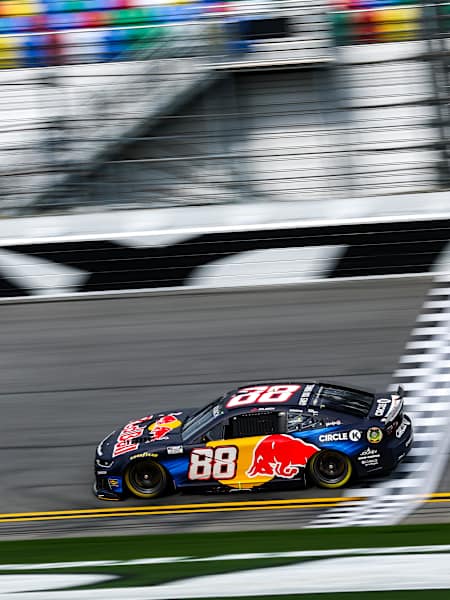
Stock car racing is known for the ear-splitting noise of high-performance internal combustion engines. While drivers like Connor Zilisch spend their time getting to know the car and hone their racing skills, engineers work behind the scenes to ensure the machine runs at peak capability.
Teams aren’t permitted to install just any powerplant they want, though. NASCAR, the governing body for stock car racing, implements strict regulations. The idea is to level the playing field so one team doesn’t have a mechanical advantage over another. During the race, that equitable approach means competition is fast, furious, and tight.

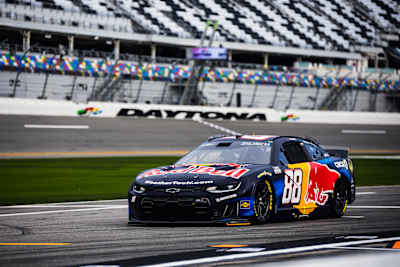
Connor Zilisch behind the wheel of the No. 88
© Daylon Barr / Red Bull Content Pool
01
How NASCAR engines have evolved over time
Ever since NASCAR hosted its first race in 1948, a variety of engines have powered stock cars. It has changed quite a bit over the decades as technology and rules have changed in the sport.
For instance, NASCAR founder Bill France banned fuel injection and superchargers from NASCAR before they could be used in competition in the late 1950s. For the 1963 season, stock car engines were restricted to a maximum displacement of 427 cubic inches (7.0 liters) and two valves per cylinder. A year later, the rules changed again with a mandate that 1,000 of any engine and car had to be sold to the public to qualify as a stock part.
Key Engine Milestones
- 1948 – NASCAR founded
- 1960s – Fuel injection banned
- 1970 – 427 cubic inch limit
- Production rule era – 1,000-unit requirement
- Next Gen era – Standardized components
- 2026 – Horsepower cap increase
While the Hudson Hornet achieved an impressive three-peat in 1951, 1952, and 1953 with a 308 cubic inch (5.0 liter) flathead inline-six, by 1995 NASCAR switched it up again and teams transitioned from 6-cylinder to 8-cylinder engines. The 2026 season saw the most significant performance boost since the Next Gen car was introduced in 2022; Cup cars competing on short tracks and road courses get a horsepower cap increase from 670 to 750. Road courses include the Circuit of The Americas, Watkins Glen, San Diego, Sonoma, and Charlotte Roval. On ovals, Bowman Gray Stadium, Phoenix, Darlington, Martinsville, Bristol, Dover, Nashville, North Wilkesboro, Iowa, Richmond, New Hampshire, and World Wide Technology Raceway at Gateway are on the list.

NASCAR Cup Series Engine Specs (Next Gen Era)
Each team builds its engine within the current guidelines.
Specification
Detail
Engine type
Naturally aspirated V8
Displacement
358 cubic inches
Horsepower
650–750 hp (track dependent)
Top speed
~200 mph
Manufacturers
Chevrolet, Ford, Toyota
02
How fast does a NASCAR cup car go?
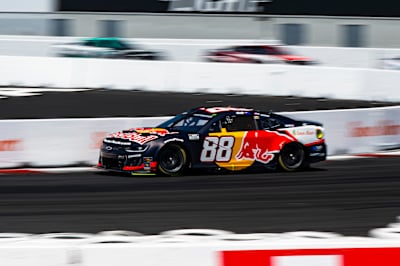
Shane Van Gisbergen races in the Toyota/Save Mart 350 at Sonoma Raceway
© Daylon Barr / Red Bull Content Pool
The first time a NASCAR race car broke the 200 mph barrier in an officially timed lap was at Talladega Superspeedway in March 1970. That was the legendary Buddy Baker, who kept an average speed of 200.447 mph in a Dodge during a test session at Talladega in Alabama. The fastest-ever lap in a NASCAR Cup Series car was clocked for Bill Elliott in 1987 with an average speed of 212.809 mph during a qualifying lap at Talladega.
Notable NASCAR Speed Records
- Buddy Baker (1970) – First to break 200 mph (200.447 mph at Talladega)
- Bill Elliott (1987) – 212.809 mph qualifying record at Talladega
- Kyle Larson (2024) – 186.293 mph at Charlotte Motor Speedway
- Shane van Gisbergen (2025) – Road course record at Circuit of the Americas
Achieving the highest speed started looking a bit risky after at least one car crashed into the barrier separating the cars from the crowd. Before things got any scarier, NASCAR mandated a restrictor plate at Daytona International Speedway and Talladega Superspeedway. Designed to choke off some of the air needed for higher horsepower, the restrictor plate is meant to keep more cars on the track and out of the grandstands.
NASCAR debuted the Next Gen race car in 2022, featuring an ECU - the electronic “brain” of the car - which allows NASCAR to detune the horsepower output at some tracks. Since then, the fastest single-car lap in the NASCAR Cup Series was set by Kyle Larson in 2024 at the Texas Motor Speedway with a 190.369 mph lap average at Texas Motor Speedway. Red Bull’s own Shane van Gisbergen set a record for the fastest lap in the NASCAR NextGen vehicle, hitting 199.438 mph on lap 197 at Talladega in October 2025.
While modern NASCAR Cup Series cars turn laps as high as 190 mph in average speed, that mph total is due in large part to the rules in place by the sanctioning body which are meant to keep the speeds of cars reigned in for the sake of safety. NASCAR has hinted at more horsepower on larger ovals in the future.
“If [it] all looks good, I would not rule out looking at increasing that horsepower at the mile and a halfs and above,” said John Probst, NASCAR executive vice president and chief racing development officer. “It’s just something that we kind of want to crawl, walk, run with this, and so this is the start, looking at the increased power at the short tracks. If that looks well, and I’m not committing to this today, but we will consider expanding the use of that as we go forward.”
It’s not just about the engine, though. NASCAR officials have been collaborating with Goodyear officials to produce softer tires. As the softer tires wear out more quickly, teams have more opportunities to execute different options for tire management, pit strategy, and passing.
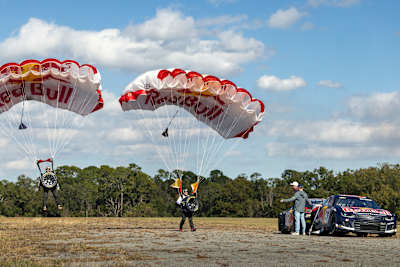
Luke Aikins and Andy Farrington skydive Goodyear stock car tires
© Robert Snow / Red Bull Content Pool
03
How NASCAR enforces engine rules and inspections
NASCAR issued a new set of rule book parameters for 2026 outlining testing procedures for new manufacturers entering any of the three national tours — Cup Series, O’Reilly Auto Parts Series or Craftsman Truck Series.
For each series, NASCAR issued the following testing guidelines for prospective new manufacturers:
- A maximum of three tests for new manufacturers, with each test limited to a maximum of three affiliated organizations with two vehicles each
- Must be a maximum of two consecutive days each
- Must be completed by March 1
- Prohibited at tracks that have been repaved, are new to the schedule, or will host events within 60 days of the test session
Post-NASCAR Cup Series races, two to three cars are selected for additional inspection. While it’s called a “random inspection” and it appears to be a matter of luck (or misfortune, depending on the circumstances), NASCAR has a strategy to its process. Throughout the season, the governing body keeps track to ensure every car competing that season gets an in-depth look.
“It’s random in that the garage doesn’t know what’s coming,” said Mike Forde, NASCAR managing director for racing communications, on a podcast. “The randomness isn’t a pull it out of the hat, and that’s who is coming home with us. What we try to do is pick a selection, we obviously keep track of all this, we have a grid, and try to…spread it out through all the teams.”


