



Breaking
Breaking
Find out what it takes to get to top of the breaking game
Legendary DJ Renegade and breaking pioneer Storm run down their seminal influence on the scene, and what it takes for B-Boys and B-Girls to stay in the game.
After the rousing applause ends, the sweat-drenched battles are won, and the hype-filled stadiums empty out, everything that rises can still fall. The ascent to fame for B-Boys and B-Girls can be a fast and ferocious one, and few mentors on the scene have taken the time to advise up-and-comers on how to weather that kind of rise, and still hold down the game.
If anyone should know about this, it's legends like Storm and DJ Renegade, who've both grafted through breaking's heaviest ups and downs. Not only witnesses to the birth of breaking, they've also seen it die. Despite the fall, as two of the hardest workers on the scene, their commitment and contribution to the cause (Renegade behind the decks, Storm on the floor) undoubtedly helped the European scene survive, and become what it is today.
DJ Renegade and Storm hooked up with us off the back of the Red Bull BC One World Final to share knowledge from their own success stories. From starting at the bottom, to the cost, awareness, and responsibility that comes with riding high at the top, these are their top 10 key points for dancers today.
Good pain
Storm: I was broke all my life. The way I grew up, we never had money. I had to improvise more, but I think most of the time that's where the greatest creativity is born. When I was 14, I found out that there was nothing that made me as happy as when I was dancing.
I don't know what it is, but if you look at B-Boys, you can see that a lot of us come from broken homes. A lot of us have gone through so much pain and tough situations, but the pain that (at least) I got from the bruises doing all the floorwork breaking, and all the injuries, kinda stabilised the other stuff. Dancing became my form of meditation. When my family fell apart, my neighbourhood was shit or my girlfriend and I broke up, dance was all I needed. I went home and practised, and after that my head was clear and things were cool.
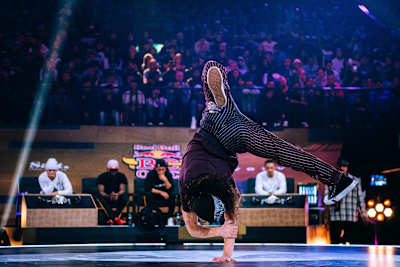
San Andrea doing a freeze
© Little Shao/Red Bull Content Pool
Think fast
Storm: I knew there was no chance I could get a decent job with my school diploma. Swift dropped out of school too, but both of us knew we weren't stupid. We wanted to become professional dancers, and that was our only choice. We went to the central station in Hamburg, where they had a big post office with all the Yellow Pages for Germany. We ripped out all the details for entertainment agencies from each city. We both had open train tickets across Germany so we looked at each other and said, "Where are we going first?" That's how we did it.
We'd heard one of the most promising agencies at the time was starting a team called The Flying Circus so we set up a meeting, and travelled hours to get there. When we walked into their office, Swift and I realised it was just their living room. There were a bunch of guys watching football on TV, and they all just kinda dismissed us.
Back then, in 1988, most people had only seen B-Boys with the white gloves, mirrored glasses, and stuff. They had no idea what we were capable of, and there was no way I was leaving without showing them. I looked at Swift, put the cassette in the machine, and we started breaking right there in their living room. They were in shock and freaking out about the slow-motion stuff (and also about all their furniture), but we wound up working with that agency from 1989 to 1998.
Never compromise on your brand and what you believe
Storm: I went to Paris one time for a show, and I didn't know what we were supposed to wear. I found out we had to wear these crazy costumes that were basically like a jockstrap and tights, in a museum among dinosaurs and all that kind of stuff. I said to the guy, "Listen, I'm not dancing in this", and I left to go back to London. People thought I was crazy.
Another time, I got a call from a cigarette company, who wanted me to break in an advertisement for their brand. They were offering money like I'd never seen in my life before, and I turned it down. The guy said. 'What do you mean? You're perfect for this job. What if we pay you more money?', but I said "Sorry, I can't run around telling people my whole life not to smoke, and then sell out like that."
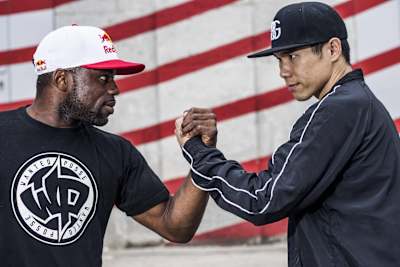
Junior and Physicx after their legendary exhibition battle in Paris
© Little Shao/Red Bull Content Pool
Flex your skills whenever you can
Storm: I was always super passionate. From the moment Swift and I decided we wanted to become professional, we didn't think we were the best in the world, but we knew if we were going to be successful we had to be so good that no one would think to ask anybody else for the job. We knew we had to be at that level where it was unquestionable.
Every minute I had free I was thinking about dance, and how I could contextualize it. When I was doing a part-time job painting houses, I would make sure I painted with both hands. I was thinking, 'If I paint this way, I'll work this muscle. If I bend this way to pick up the brush, I'll work that part'. My whole life went in an extreme direction and I was totally obsessive at times, but it's that same crazy drive that I think took me places.
Stay grounded
Renegade: I have two lives. I do tech in the week, doing computer stuff for super high-level companies all over the world, and then I DJ at weekends. In the breaking world, you can become a bit of a celebrity. People start to treat you in a certain way, and that can go to your head. I've seen it happen to a lot of people I've moved with, but because I always had that alter ego, where in the week I was 'normal' again, it kept me super grounded.
At the weekend when people rushed up to me, and I thought it was dope that they looked up to me like that, but I also had the humility to know that shit could end in a flash.
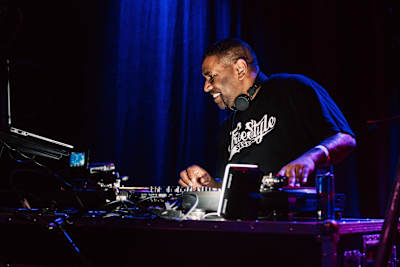
DJ Renegade at Red Bull BC One in Antwerp
© Jan Opdekamp/Red Bull Content Pool
If things aren't happening the way you want, make them happen
Renegade: Hip-hop hit London in about 1983, and I started getting hired to do shows pretty quick. Breaking then started to die in out about '86, in fact, all of the street dance stuff did. In '87, I started DJing with a rapper called Blade. I was still seeing footage from breakers in Europe, and I was like, "Yo! It's still happening." But people didn't care.
I was DJing at a jam with Blade and Afrika Bambaataa, and these breakers from Europe showed up. That's the first time I met all of them. We exchanged VHS tapes, and years went by of us exchanging stuff like that, and jamming together.
A lot of people might not know, but the reason I started teaching was because of Storm. He came to stay with me in Denmark, where I was dancing and performing. I was complaining about how shit the UK scene was, and that no one was promoting it. He looked at me and said, 'Shut up and do something about it. Make it happen'. That moment changed everything for me. I went home to the UK, and started teaching.
Link up
Renegade: If you love something so rare like breaking, you try to connect with every single person that has some knowledge about it they can share. When we started breaking there was no internet, no mobile phones, nothing. You had to go to events and make those connections yourself to find out what was going on. You had to get your hands on a VHS of what people were doing in other countries to stay fresh on the knowledge.
It's always been a thing for me to connect people up, and make things happen. We once got booked to break in a video for a rap group. I thought about it for a bit and then was like, "You know what? Second to None is a way better crew than us. Let me call them up". I got them the job, and they got more work from that.
I've always been like that about connecting people. The future in breaking for me is to give jobs to people – provide a professional outlet that gives them the opportunity to make contacts and build whatever path they pick after that.
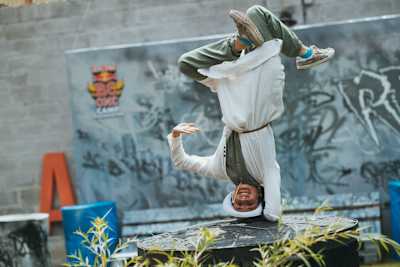
Nadia with her signature freeze
© Little Shao/Red Bull Contennt Pool
Not all dancers are out to bite your moves
Storm: For me, one of the reasons breaking stopped in the early '80s was because there were so many breakers holding back. There was a point when you'd walk into a club and 20 guys would be all standing there with their backs against the wall. I'd ask why they weren't dancing, and they were like, 'If I dance, these guys are gonna bite my moves, man'.
Renegade: This happened in the UK, too. Everybody was too cool, and nobody wanted to battle, because they were either too afraid of losing or afraid of winning, and everyone stealing their moves. I didn't get it. What are you practising all day for if you're gonna come out and then not dance?
Storm: If I saw people getting better than me, I knew I had to practise even more. I needed to stand out more. I had my name on my shirt, and I wore Adidas all the time. That way, on the VHS tapes they'd know who I was. I didn't care if breakers were gonna try and bite my moves, I wanted them to recognise me when I walked into the club, like 'Oh shit, that's that Adidas guy, Storm!'.
It's about carrying on the legacy as much as it's about the competition
Storm: The reason I even started judging was that people came to me and felt like all the people who were judging truly had no clue. In the beginning, I didn't feel good about it, because for me breaking was an art form. It was an art I was doing myself in theatres, and as a performer I preferred a different route for breaking to develop other than battles. When I saw that people liked the competition element more, and more and were really getting hyped about it, though, I felt like if I could tell them two or three things that made them love the dance more, and get better as dancers, I had to do that.
Renegade: The whole judging thing has just only become a thing. Before now, Dawn from accounts could judge, and no one cared. They had celebrities judging battles that had never danced a day in their life, and no one said a thing. As breaking has become more established, and these larger platforms for competitions have been created, it's a good thing for the evolution and the future of the dance. But for those of us that were here from day one, we have a responsibility to set a standard within that, which keeps it going in the best way.
Storm: When I look around, I'm still inspired by so many dancers, and that's what drives me to continue this legacy. I still see the constant growth in breaking. A lot of the reason breaking ended, and was exploited the first time, was because it was the first time anyone had ever done it before.
Dancers like Rock Steady Crew were all too young to understand the industry. They had no idea. Now, if you're young and you're not sure what you're doing, there are people around like ourselves that have been there and done it all before. I feel a lot of responsibility to push people to just get in and have fun like I did, and get the most they can from it, whether as a performer or a champion.
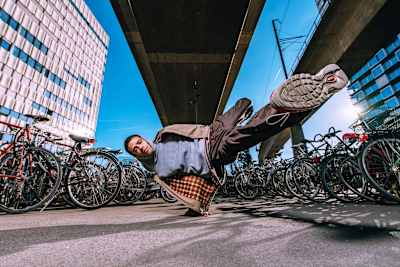
Luigi doing an Airchair
© Little Shao/Red Bull Content Pool
Feel the music
Storm: Physically, you can prepare yourself for a cypher and mentally you can prepare yourself, but your interpretation is the moment when you determine whether you've really got it or not as a dancer.
You know what you can physically do, because you've trained for it, and you know your mental state, which helps. Ultimately, though, what you'll be judged on is what you do at that moment. You can't predict what the DJ is going to put on until you step on the dancefloor.
People forget that it's not about the hundreds of big power moves you can do, but it's the music that's the soul of the dance. It's the music that should dictate the steps, and be the reason we all break. If you take that away, then it might as well be gymnastics. You've got to be attached to the rhythm, and feel that in order to develop the performance. You might be doing all the moves perfectly, but none of that matters or will make any sense if you don't know how to express it with the music.
