


Fitness
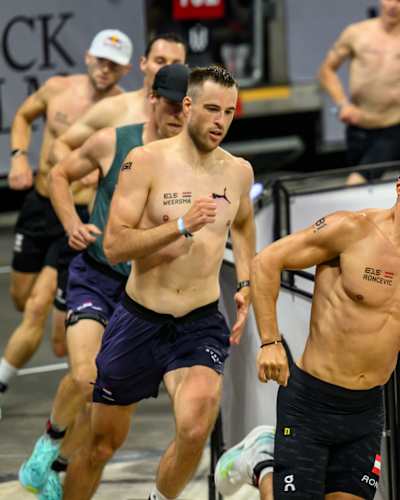
Fitness Training
What Hidde Weersma learned on the road to HYROX success
The Elite 15 record-breaker discusses victories, training mistakes, lessons learned, and how HYROX training is different to any other sport out there.
At just 28, it’s fair to say that Dutchman Hidde Weersma is one of the most promising young athletes in the HYROX Elite 15. The numbers back him up: he was the first man in HYROX history to complete the course in under 53 minutes, setting a new record of 52m 42s at the EMEA Championships in London on March 20, 2026. He didn’t just break the previous record by a fraction of a second, but by a significant 33 seconds.
A former triathlete who still works as a strength coach back home, there’s plenty of gas left in Weersma’s tank, even if he slipped down the rankings for a 13th-place finish at the HYROX World Championships in Stockholm this June. Finishing in 56m 56s, it wasn’t the result Weersma had hoped for, and he has admitted that he “almost stepped out” of the race and that his “head was not in the right place” after the sled push hit him hard.
Here, he reflects on lessons learned, his day job keeping him grounded, and a new, less intense and more fun approach to training.
You posted a video explaining that your Elite 15 men’s singles race at the HYROX World Championships in Stockholm didn’t go as planned. What went wrong?
Well, it’s easy to talk about it now that it’s behind me. I've been doing HYROX for about five years, and started to chase the Elites a year ago. Because I worked full-time before, I naturally had boundaries in how many hours I could train. But since I stopped working full-time in January, I can train like a full-time athlete.
To begin with, this was great. I had more time to train and rest, and it worked out really well for the European Championships in London. But, after that race, I got really enthusiastic and thought ‘OK, I will do more volume, more intensity, more heat training, and if I lose a little bit of weight, I will be unbeatable in Stockholm'.
It was a rookie mistake because, as a coach myself, I know you shouldn’t try to improve everything at the same time. I walked into that trap and ended up becoming sick three weeks before Stockholm. Ignored all the signals from my body and trained too hard. So I wasn’t in the best shape for Stockholm, and I know I can do much better.
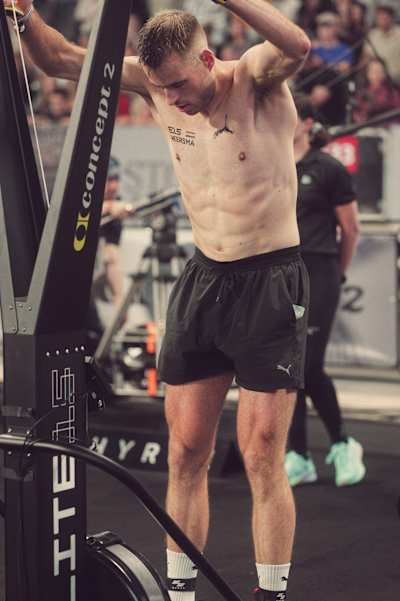
Hidde Weersma is a former triathlete and still works as a strength coach
© HYROX
You did break the world record in London, so that enthusiasm is understandable. What are you changing going into the next season?
When I worked full-time, I was coaching myself by necessity. I didn’t want a strict coach because I needed to be flexible and just fit in with what was best for me at that time. But now, coming back from Stockholm, I decided that I do need somebody who looks over my shoulder because, to be honest, I don’t trust myself not to overtrain!
Now I have a coach – an exercise physiologist who also works for the Dutch Olympic team. He doesn’t write my programmes, but does look at what I do on a week-to-week basis and helps me with the periodisation. He also checks a few metrics in the morning, like heart rate variability, just to make sure that I don’t overtrain again. I have a lot of confidence in him.
Has your training for London influenced this new approach?
I am looking at the differences in how I trained for London and Stockholm. I’m trying to make what I did for London the blueprint for next season. It is difficult because HYROX is growing so fast, so you need to experiment a bit and take a few risks so that you can keep up. It’s a game we all play with our training routines.
For London, I did a lot of low-intensity training sessions. And around five weeks before London, I went to Tenerife, where I did loads of running and cycling, with one heavy work session per week. The focus was on building the biggest aerobic engine that I had ever had. And allowing lots of time for recovery. Once I had that, I noticed that every training session improved, and it increased my sports-specific fitness.
Before Stockholm, it was two months of very specific training sessions, with quite a lot of volume. Now, I’ll definitely go back to having a large aerobic block of two weeks about six to eight weeks before a big race – something I didn’t do before Stockholm.
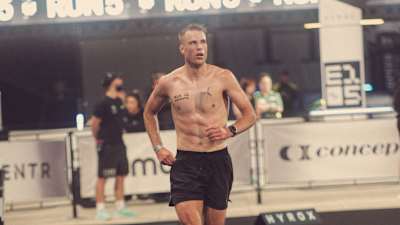
Weersma is embracing a more fun approach to training
© HYROX
Will low-intensity training be your focus going forward?
Some HYROX stations are actually really difficult to train in a low-intensity session. Sled push, sled pull, burpees, wall balls – it’s almost impossible to train them at low intensity. I think a lot of HYROX athletes do overdo it because the nature of the sport is you have to attack these things full on in training. And we all want to improve our running too, so before you know it, half of your workout has become high intensity, even on ‘easy’ days.
Do you ever look at your competitors' workouts or get inspiration from social media for your own training?
It's not that I stalk my competitors on social media, but when I'm scrolling, I might see someone doing a workout and take inspiration from it. But I'm never that worried about what others are doing, to be honest, because I have seen so many athletes who are posting things on social media where I think ‘if this is what you're capable of in a session, then you should absolutely destroy me in a race’, and often, that doesn’t happen. I think people aren’t always telling the full truth about their training sessions. So I’m not that bothered about what they post.

Weersma is targeting wins rather than world records
© HYROX
HYROX is growing so fast, so you need to experiment a bit, take a few risks, so that you can keep up.It’s a game we all play with our training routines
Do you like to train with other HYROX athletes in person?
Yes. The Dutch and Belgian Elites are trying to train together. Last year we had five training weekends together. I already knew Louis Osselaer [one of Belgium’s best HYROX athletes and a qualifier for the Elite 15 in 2026]. I love his training philosophy. I have an endurance background with triathlon, and he has a CrossFit background, so we can learn from each other’s approach.
I also watch Dylan Scott online [AKA ‘The Hybrid Racoon’ on Instagram]. It’s no wonder he became World Champion. His workouts are totally different to what I would do myself, and I find that really interesting. Charlie Botterill has a similar background to me, coming from cycling. These are the three where I see their training schedule and think 'hmm, maybe I will give this a shot'.
You’re talking about pros and former world record holders here. Is that your goal?
I’m more interested in winning races. If you were to ask me, ‘Would you rather win the World Championships, or take back the world record?’, I would choose winning a major or the World Champs. But, if I break a record during a race, I will be very happy. To be known as the fastest is very cool, but at the same time I already did that, even if it only lasted three weeks before my record was beaten.
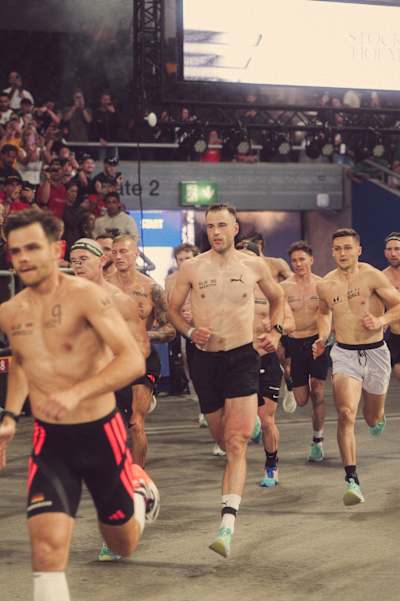
Weersma believes it is common for athletes to be too intense in training
© HYROX
Do you have a race in mind to start next season with?
Yes, in the Netherlands, where I’m from, we have quite a lot of events, despite being a small country. At the end of September, we have an event in Maastricht. I don’t know what category I will be in, but I’ll be there. It will probably be a Solo race, but it could be a fun Double. And there are great courses in Belgium, Germany and the UK.
There is a Major in London at the start of December that would allow me time to have a good training block, so people can expect me to be in good shape over there. Geographically, it’s the perfect location to be a HYROX athlete.
It sounds like you have a good balance between competing and downtime at the moment? What do you do when you’re not training?
I actually still work two half days a week as a strength and conditioning coach for the Dutch Olympic team. I used to be full-time, but now it’s only with the Paralympic cycling team, which is great as cycling is one of my favourite sports. It means I get to spend a lot of time on the bike. Apart from that, I’m watching a lot of bike racing. I really enjoy working; it gives me something else outside of HYROX, plus colleagues and athletes to guide. It feels more like a hobby than work!
Downtime and recovery are so important. I also like playing video games, reading and walking outside. Social media, I have a love-hate relationship with, but I do really like to do it in my own way. Luckily, my Doubles partner, Thierry Willigenburg, and I have a similar sense of humour, so when we do race recaps, we bounce off each other, and it’s fun, and we’ll continue to do that next year!
About the author
