
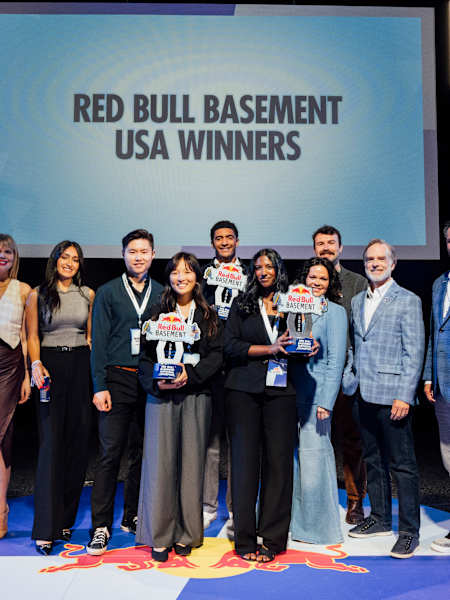
Meet the U.S. Finalists heading to the 2026 Red Bull Basement World Final


Sahasra Upputuru - SafeStep Secure

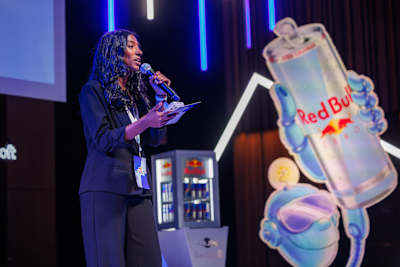
Sahasra Upputuru at Red Bull Basement National Finals
© Joe Gall / Red Bull Content Pool

What motivated you to submit for Red Bull Basement?
I came across the website and I saw that they’re looking for new innovations. I remember that Safestep Secure was something I had in the back of my mind, but never a platform to pitch it properly, so this was my best opportunity.
How would you describe your idea?
SafeStep Secure is a real-time protection platform that helps users mitigate through calls, text and emails by allowing them to have contact with a trusted adult to take over that situation.
What was the inspiration behind SafeStep Secure?
My parents and a few members of my community received phone calls from what they thought was a legitimate internet service provider offering them a discounted plan, but it ended up being fraudulent and they ended up losing thousands within just a few hours. So that really pivoted what I felt about this. And both my parents are in tech, so imagine someone that's elderly or doesn't know how to use the internet or technical aspects of it.
My dream goal is for this to end up as an app that users can have and it would prevent scams from going through and users from actually going through with the scams. Scalability wise, it would be nice to have them in banks or in other cyber security start ups.
What was the highlight of participating at the National Final?
The highlight was meeting all these amazing innovators. Each of them had such beautiful pitches that they provided something different. They helped me perfect my pitch and grow – no one was in rivalry with each other – we all thought even if one of us wins, it shows that our pitches are making it somewhere.
What advice would you give to other young entrepreneurs who want to turn their idea into a reality?
The biggest advice is to always put yourself in the room. I would think that I didn’t belong in the room or I didn't know as much. Even at the workshop sitting around, I heard so many people pitching new things. It's really just having belief in who you are and your idea itself, your passion for it is going to cultivate what you really want to create.

Darnell Adler - Lifeline AI
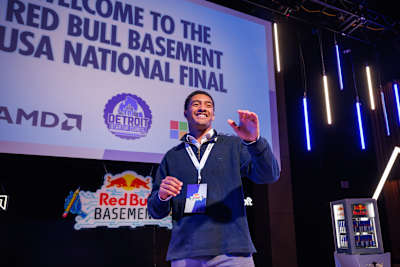
Darnell Alder at Red Bull Basement National Finals
© Joe Gall / Red Bull Content Pool
How would you describe your idea?
We’re redesigning emergency infrastructure because existing safety tools fail at the exact moments when you need them the most. This idea can genuinely save lives and it's so applicable to anyone in the world. It’s a global need, there are 6.8 billion global smart phone users so being able to make the world a safer place for everybody is really important.
What was the inspiration behind Lifeline AI?
Since existing safety tools fail at the exact moment you need them the most, people are faced with staying in an uncomfortable situation or staying silent and giving them an option to get out of those situations is what I'm addressing and making the world a safer place.
The dream goal is to create Lifeline to be the global standard in how people can call for help. And knowing that this idea is helping people and making the world a safer place.
How did AI contribute to the development of your national winning idea?
AI was used in a lot of aspects, from the demo to actually building it out. It worked on my backend, it worked on helping my pitch and also helped on creating a part that people will be able to use.
What advice would you give to other young entrepreneurs who want to turn their idea into a reality?
You should go after it. I don't think there’s a better time than now. Don't be afraid of having an idea that you think someone else had or being afraid that you don't have the expertise. Use AI! Any idea is a good idea, so just go after it.
What are you most looking forward to at the World Final?
It’s my hometown! I’m excited that my friends and family will be there. It’ll be a great opportunity to get this idea out, even if it means my idea stays with me, it's just bringing awareness to the fact that existing safety tools aren’t viable in real situations.
Hayoung Ahn and Xuelong Mu - Neurosense
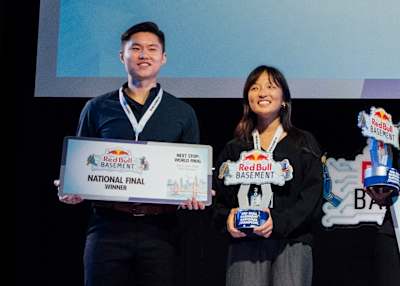
Hayoung Ahn and Xuelong Mu at the Red Bull Basement USA National Finals
© Sal Rodriguez / Red Bull Content Pool
What motivated you to submit for Red Bull Basement?
We were really interested in building an idea and seeing how far we can take it. We both come from pretty different backgrounds, but for me entrepreneurship is an entirely novel field. I come from medicine, media and content creation, a lot of those things that have always been passions of mine. But recently, I’ve been thinking a lot about the very rapid development of technology and how I think that the people I surround myself with in the fields I am in right now – like medicine – there’s kind of a gap between those teams. So I'm really interested in bridging those gaps together, I want to see how far I can take this idea.
What was the inspiration behind Neurosense?
One of the biggest problems it aims to address is the fact that it’s so hard to see your doctor. Appointments are usually hard to schedule and follow up appointments end up being a few months out after you’ve last seen your physician. It’s even harder in specialized care, such as epilepsy care. So I was really interested in how a doctor shouldn’t just see a snapshot view of how the patient is doing during that one clinic appointment, but they should be able to accurately, and with a lot of rich data, be able to understand how their patient was doing in the months beforehand. And right now, as medicine has always been traditionally, it’s been very dependent on what the patient brings to the table in terms of what they share has been going on for them.
How did AI contribute to the development of your national winning idea?
AI is incredible in helping us develop a prototype. We used Replit in order to create a mockup of how the app should look and feel in terms of what the patient sees when they open it, what kind of data gets recorded, how all those signals translate into insights so that the patient can make more informed decisions about how likely they might be to have symptoms or have seizures that day. It's just really easy to build these types of mockups and prototypes using AI, so even though we haven’t connected it to real data yet, it’s much easier to pitch and sell this idea to our target customers because of these AI tools.
What was the highlight of participating at the National Final?
Going back to something I wanted to share, building healthcare technology, it's a very highly regulated and sometimes rigid space, but then you also have these beautiful moments connecting with real people you can help with the thing that you’re building. We had a chance to talk to someone today whose son was diagnosed with infantile spasms, so as an infant they were having seizures, and they were really interested in what we are building and how Neurosense might be able to help their child. So, having those real world human touch points is really motivating for us and we hope to find more of those as we develop this out and try to get this in the real world.
For me, a big highlight as a participant was truly feeling so much support, not just for our idea, but also just as people. Everyone that was here was just so encouraging and truly uplifting, reminding us of our worth and the value we’re bringing to the table just by being here. I think imposter syndrome is such an effervescent and constantly present force in everyone's life, especially as you enter a space where you have to prove yourself.
How are you going to prepare for the World Final?
I think we’ll work backwards from what the format of what the competition is and if there’s any new presentation, we’ll also consider feedback from our judges and the questions that were asked and try to build that into the pitch.
Even today, we kind of gathered a mental list of frequently asked questions for our idea, which has been super helpful to rehearse through and work out those kinks together. I think between now and the World Final, we’ll be able to hone our idea further and bring it to life and we’re just so excited to be a part of it.