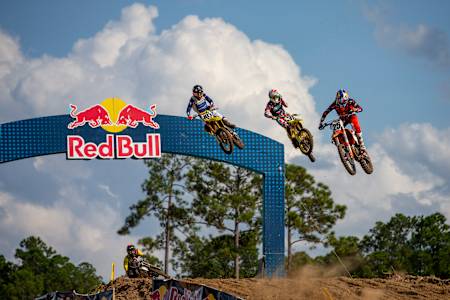
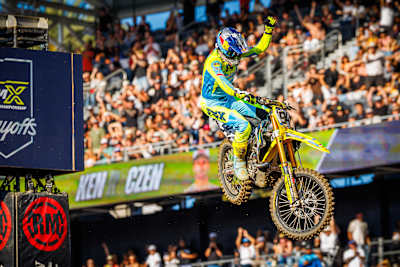
You have Ken Roczen's precision and technical mastery under the stadium lights of Supercross to Eli Tomac's speed and endurance on the outdoor motocross circuit, the world's best riders showcase two very different forms of dirt bike racing. MX and SX are both beloved disciplines with passionate fan bases, but each presents unique challenges for riders, bikes and teams. Let's explore what makes motocross move and supercross soar.
01
Motocross: The original
Let’s get the most obvious difference out of the way: motocross is raced outdoors. It may seem like a small difference but consider all the might and fury that Mother Nature can dish out, and then reconsider what it means to race on an outdoor course. And while the races may not always happen in mud or rain, when they do it separates the pros from the merely hopeful. And it affects every other part of the racing discipline. From line selection, racing strategy, and the physical endurance, motocross pushes racers and their bikes to the limit.
To better understand how the sport evolved into today's high-speed outdoor competition, check out our guide to the History of Motocross.
02
What are the main differences between supercross and motocross?
Supercross packs elite racing into stadium-sized spectacles
While both motocross and supercross tracks are purpose-built, motocross tracks rely much more on natural terrain and environmental conditions. Consider rain, humidity, wind, air temperature and even the brightness of the sun. What this means is a more diverse racing skillset. While riders in both disciplines need to know how to hit a holeshot, scrub a jump, and corner like a demon, motocross riders do it in a much wider variety of conditions, more often. Mastering changing terrain requires a diverse skill set, from cornering and braking to jump technique. Learn more in our Motocross Riding Techniques Guide.
Motocross tracks feature long straightaways that allow racers to get up to high speeds. With long straightaways comes lofty airtime. On the other hand, supercross is crazy technical and it leads to a more dynamic race format. Riders have no room (or time) to rest. Everything happens in closer quarters. More crashes. High emotion.
When you’re talking competitive motocross, the tracks are as punishing as they are long. Many outsiders think motocross is “easy” because all you have to do is twist a throttle but this is an extremely naïve viewpoint. Anyone who’s ridden and wrestled a 225-lb.-plus bike around a track will laugh you out of the room, and definitely beat you in arm wrestling or even a medium distance running race. Motocross breeds crazy fit athletes. Consider two-minute lap times around courses that are 1.5. miles or more. Add in all the obstacles and consider the fact that the course is getting chewed up by 40 athletes and gets rougher and changes every single lap and you begin to understand how much physicality it takes just to finish a 30-min. +2 lap race.
Supercross
Supercross courses must fit into the confines of the stadiums in which they’re built, so lap times are typically less than one minute. The tracks are made of lanes that travel back and forth across the venue’s floor and they’re packed with obstacles. Riders have no room for errors and even less opportunity to rest. The different style of intensity results in more elevated heart rates. Depending on lap times, main events are 25-laps or more and, just like in motocross, the racing surface deteriorates and changes throughout the event.
04
Superbly sublime supercross
Ready for the bright lights? Supercross takes place inside stadiums and arenas on short, tight courses. While motocross mostly happens in summer, while the supercross season is a winter-to-spring circuit. It makes more money for the riders and therefore means more attention. Supercross is all about tight turns and tighter jockeying for position.
In addition to courses being short and tight, supercross tracks are also narrower than motocross, with shorter straightaways. Some of the features include:
Tabletop jumps – imagine a picnic table with ramps on either side of it
Whoop sections – a series (9 to 11) of treacherous, evenly-spaced bumps, 3 to 4-ft. in height that riders choose to jump through or ‘skim’ over the top of.
Rhythm sections – a racing lane that features an assortment of obstacles with different sizes, pitch and spacing (including tabletops) that riders navigate in various combinations. It’s like a ‘choose-your-own-adventure' novel.
Doubles and triples – a double jump is when a rider takes off from one jump and lands on the back side of the next obstacle in succession. A triple (typically 70-ft. in distance) = 3 jumps at once.
Mastering the corners
Fast cornering often decides the outcome of a race
Ever heard of the phrase, ’Jump for show, corner for dough”? It means jumping looks great but riders win races by getting in and out of the turns the fastest (which gets you to the next set of jumps quicker). Fast and efficient cornering is an absolutely essential skill.
Precision jumps and rapid reflexes
Jumping still matters in supercross and riders get as high as 35 feet in the air and soar 70 feet in distance. The jumps come at riders faster and in tighter configurations and the best riders are able to execute riskier combinations consistently. If motocross allows riders to get up to speed and sail long distances, SX is more interested in testing rider’s quick reflexes and under rapid-fire decision-making.
Race format and main events
Each class races a main event ’final’. The 250cc class runs for 15 minutes plus one lap. The 450cc class races for 20 minutes plus one lap. Each main event features 22 riders. A series of qualifying events and heat races run earlier in the day to determine which riders get to race in the main events.
They must have different bikes, right? No! At the professional level, the premier classes are 250cc and 450cc, though additional amateur and youth classes also exist. They're just set up differently.
Soft vs. stiff suspension
For motocross racers who need higher speeds in rougher terrain, the suspension needs to be tuned for impeccable contact with the ground. Think softer setup, which will affect cornering ability and speeds on average. Fast and rough. Tough as hell. Supercross bikes have stiffer suspension to handle the harsher, steeper and more abrupt landings and the brutal pounding in the whoops. It’s harder on the rider’s body but suspension that is too soft would rob precious momentum and cause them to ’bottom-out’ often (reaching the end of the suspension’s stroke).
Looking at two bikes side by side – one set up for motocross and another for Supercross – they look the same. Take gearing, for example; a Supercross bike is going to have a ’longer’ first or second gear, which allows the rider to get more distance before needing to shift to the next gear. That’s all hidden inside the motor’s gearbox.
The one external part of gearing that you can see (but you have to look closely) is the number of teeth on the two sprockets, which are connected by the chain. The rear (larger) is connected directly to the rear wheel. In supercross, a rider will often run more teeth on the rear sprocket to boost bottom-end torque, which helps better manipulate jumps out of corners.
Tires are also similar but riders will choose different tread patterns and rubber compounds depending on riding conditions.
06
It’s all about spectating
Fans experience motocross and supercross in unique ways
Let’s be honest; watching racers go around a track is fun no matter what, but there are fans of one over the other. Supercross’ stadium tracks mean seats and beer and hot dogs and if it’s an enclosed stadium, staying out of the weather. It’s more like a concert / show atmosphere. There’s also the ability to see the entire race course from any seat in the stadium.
In motocross, spectators can only see part of each racer’s lap but it’s a more pure, organic, festival-like atmosphere. Spectators can get closer to the action and wander around to any section of the track but the best fence-line spots are often gobbled up by early-birds. The crowds are passionate (chainsaws and airhorns!) and the sounds, smells and sights of an outdoor race are what the sport of motocross is all about.
The Two Premier Racing Series
Beyond watching local races, there are two popular series. In January, the AMA Supercross series begins. It features 17 rounds and rewards racers with a points-based tally over the course of the season to determine the series champion. Many of the sport's biggest legends built their reputations in this championship. Explore the Best AMA Supercross Champions of All Time. Riders get a few weeks to recharge, test their bikes for a new format, and practice for the 11-race AMA Pro Motocross series, which starts in late May. Each points-paying “moto” (race) is 30 minutes plus two laps. Overall event winners are determined by combined results from two motos.
07
Which is better Motocross or Supercross?
This is almost like asking a parent which of their kids or pets they like better. Core fans of supercross and motocross love both but they love them differently. There is no right (or wrong) answer to the question, “Motocross vs Supercross, which is better?” Since the same athletes compete in both disciplines, which experience do you want?
Do you want an entertaining evening of explosions, fireworks and racing packed into a three-hour window that allows you to park your automobile in a defined space within a reasonable distance of the venue’s front entrance? Do you want to be able to follow all the action from one seat and never have to leave that spot? Do you prefer more (and shorter) races?
As a spectator, supercross is your jam.
Maybe you prefer music festivals where you can wander around to different stages listening to bands. That’s what motocross is like, and it’s an all-day (or weekend) immersive experience. Spectators can get closer to the action, but they often can’t see the entire picture all at once. But they can truly feel what does blow by. And if you don’t like the spot you’re in, just move on to a new one. There are no permanent seats. The racing in motocross lasts longer, which is a huge plus for some but boring for others.
Motocross-only fans appreciate the endurance and grit it takes to win two 30-min. plus two lap motos. They love being outside and walking long distances; they don’t care if their shoes get dirty.
Whether you're drawn to the outdoor endurance of motocross or the stadium spectacle of supercross, the best way to decide is to experience it for yourself. If you're ready to start riding, check out our guide on How to Get Into Motocross.