Soccer (Football)
How Red Bull Academy is making the footballers of the future
Red Bull Academy is a cutting-edge training facility in Salzburg's Liefering neighbourhood. We went behind closed doors at the football talent factory that's already showing unparalleled results.
A tree-lined country road acts as the unlikely gateway to Red Bull Academy, sandwiched between Salzburg’s two rivers, the Saalach and the Salzach. On a 12,000m2 site, 200 young footballers from seven countries across 11 teams are guided by 120 specialist employees.
A playground for future stars
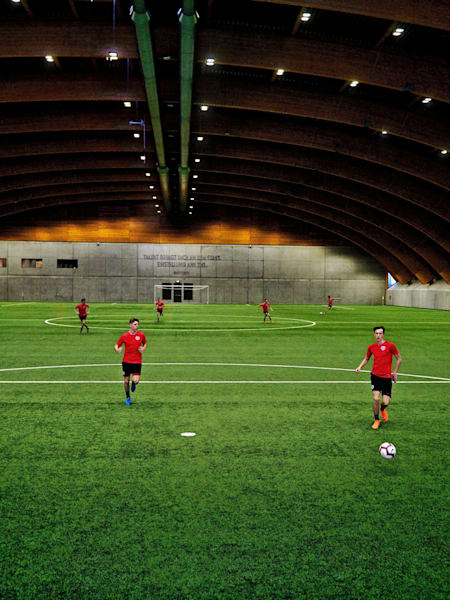
Emblazoned above the main entrance, the message is clear – 'Enter the next level'. Inside is a unique and exceptionally successful high-tech complex, with six football pitches, a football hall, weights room, an athletics room and an outdoor fitness area, all with sensors that collect data day and night. This data is then stored on servers and processed by computer programs. The quest is not for the football of 2020, but of 2025 and well beyond.
Only opened in September 2014, already the results of Red Bull Academy speak for themselves – three years later, the U19s were crowed UEFA Youth League champions. A year on, FC Red Bull Salzburg reached the Europa League semi-finals with six academy graduates. Nowhere in Europe are more academy players making the step into the top tier of competitions.
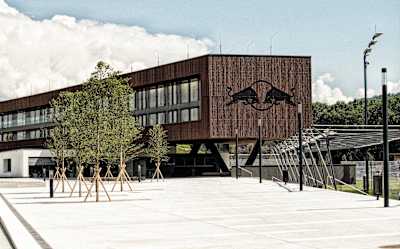
The academy's boarding school has 88 double rooms
© GEPA
What makes it different?
It is not uncommon for top international clubs to visit Liefering, most recently representatives from Liverpool, the Bundesliga and La Liga. Explaining what exactly brings them here and stands the facility apart, Manfred Pamminger, CEO of FC Liefering, explains: "The game and training philosophy. It's set in stone with us. Every single coach, every single employee and every single player operates according to this idea. That's the key to our success."
It's the pressing, counter-pressing and quick switching that becomes a part of every player's psyche, but also the passion shared by everyone on and off the pitch and a philosophy brought to life with state-of-the-art technology.
Stop 1: The athletics room – aiming for a sprint finish
In Liefering, it's sprint training with a difference. The player buckles a belt around his pelvis, which is connected to a computer-controlled high-tech rope winch via a cord, and runs against an infinitely adjustable level of resistance. The coach analyses the performance curve in real time on a laptop and can tell after a few runs at what level of resistance the player applies maximum force, when he reaches maximum speed, how long he can maintain it and even which foot applies more force on the ground.
The data is used to continuously fine-tune the training and, because it's saved in a database, it also means a player's performance progress can be tracked over several years. Pamminger sees the 1080 Sprint device as one of the cornerstones of the academy's success. "Our lads have to be extremely fast - that's what our game system is designed for. And in modern football, 90 per cent of all sprints are no longer than 20 metres," he explains.



Stop 2: The high-tech gym – weights 2.0
Adjoining the running track are 13 workstations for strength training. Unlike at conventional gyms, players log in via a tablet, download their program and receive feedback from the computer or coach. Each station has a computer that monitors training, collects data and feeds it into a network using infrared cameras and a tablet. This way, coaches can create individual workouts via software in the office, or in real time if required.
An additional feature is that players can compare their performance with team-mates in the room. Infrared cameras track the movement of the barbells, count each rep and measure the performance in watts, as well as the maximum and average speed the barbells are pulled and pushed at in metres per second.
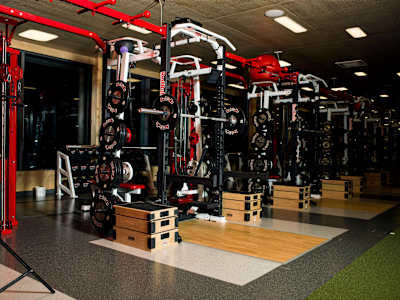
The weights room at the Red Bull Academy.
© Gian Paul Lozza
Stop 3: The anti-gravity running track – the moonwalk
Whether it's a hard tackle or unfortunate turn, however fit you are, injuries are part of football. Players have to learn to deal with them, but also how to return to fitness as quickly as possible. Thanks to the academy's anti-gravity running track, comebacks now take far less time. The training device – originally developed for astronauts – enables recovering athletes to return to preparation at an early stage, even if they're not yet able to.
Pamminger explains: "On the track, the player wears airtight trousers with an air chamber that reaches to the hips. A blower creates pressure in it, which reduces the body weight by up to 80 per cent." The player does a kind of moonwalk, so is used to a natural running movement again at an early stage and this does away with the need for regeneration training in water. With tilt simulation up to 15 degrees, the reverse running program and a top speed of 19kph, the AlterG is a more innovative form of rehab than merely treading water. Plus, there's a built-in gait analysis system tracking stride length and frequency, as well as weight distribution.
A tour of the complex throws up the question of whether football is still seen as a team sport or an individual one, because the players also train according to individual plans, varying in scope and intensity depending on their position, personal strengths, weaknesses and training goals. This not only applies to athletics, but also increasingly to thinking, understanding and solving game situations and making decisions.
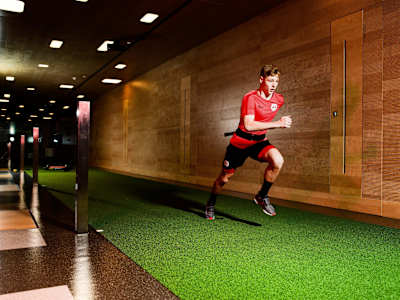
Race in another dimension
© Gian Paul Lozza


Stop 4: The SoccerBot360 – tracking your every move
Alexander Schmalhofer is the 32-year-old head of match analysis and innovative projects, most recently SoccerBot360, a training tool located on the second floor of the academy. Akin to a computer game in real life, it strips the footballers back to being boys kicking the ball against the back wall, albeit with cutting-edge science.
Six projectors display computer images on the wall, such as small goalposts the player has to hit with passes under time pressure. "The boys have to learn to think faster, process quicker and train their gaze behaviour," says Schmalhofer. A high-speed camera tracks how good they are, determining how quickly, sharply and precisely they pass the ball. Or how often their weak foot gets a chance, because a high hit-rate is only really of benefit if both legs pass roughly the same amount.
That footage can be projected onto the wall and relived, letting the players see pass and run routes previously missed. The position data for these big-data calculations is collected by a local position measurement (LPM) system 100m further into the actual heart of the academy.
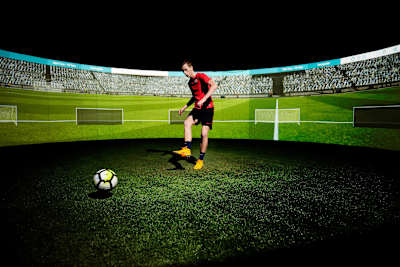
The Soccerbot 360
© Gian Paul Lozza
Stop 5: LPM Indoor – speedy science
An LPM system, the most accurate sports tracking system in the world, collects the position data of all players and the ball on the pitch inside the 6,000m2 hall 25 times every second via eight base stations, which equates to more than three million raw data points in 90 minutes.
It's accurate, too, because the LPM system locates with an accuracy of 5–10cm, making it 100 times more precise than GPS. If you combine the raw data, you'll have exact starting, high-speed and deceleration readings for the players, but also technical and tactical scores such as pass odds and ball possession times.
Even biometric data can be collected with the system, including players' heart and breathing rate, or skin temperature. "However much data I have, without any context it’s of no use to me," explains Schmalhofer. He and his team therefore refine, interpret and link data on the computer, draw conclusions and make their analysis available to the coaches.

Concentration levels have to be on point
© Gian Paul Lozza
Stop 6: Packing scores – data talks
There's no perfect formula for success in football, but Schmalhofer is working on the probability of success, for example with packing scores, which indicate efficiency in football and measure how many opponents are outplayed with a pass. The idea is that a footballer who moves past lots of opponents – by passing or dribbling – is a good player. The score increases when nearer the penalty area, or sliding the ball through a defender's legs.
"The challenge is to refine data, so that coaches and players are interested and can understand them," says Schmalhofer. The best way to do this is via video analysis, which the players recognise themselves in. In the past, match analysts would study the opponent using three or four matches, categorise scoring chances or counter-footage in a video and make it available to the coach. Today, in-house software does the job. Thanks to artificial intelligence, it recognises match footage and learns with every game. The analyst saves one-and-a-half working days spent viewing the material, which he now puts into more detailed analysis.
At the end of the tour, Schmalhofer is convinced football will become even more flexible, individual, independent and demanding over the next five years – all in physical, technical and mental terms. "Those who win out will be those who can make better decisions faster and implement them more accurately – in the 90th minute as well as in the first," he says.