
Cycling
Discover the route for the Tour de France 2026
The 113th edition of the Tour de France begins in July, and this year’s route sees an overseas start, iconic climbs and the return of Montmartre in a popular update to the Parisian finalé circuit.
Part of this story





The team camps are over, the warm-up races are settled, and it’s almost time for the pinnacle of the road cycling racing calendar – the Tour de France. The 2026 edition is the 113th running of the event, and will commence in Barcelona on Saturday, July 4, with riders crossing the final stage’s finish line on Paris’ cobbled Champs-Élysées 23 days and 21 stages later on Sunday, July 26.
Red Bull – BORA – hansgrohe heads into its third Tour de France under Red Bull sponsorship with Remco Evenepoel and Florian Lipowitz leading its challenge for the yellow jersey. Standing in their way are defending champion Tadej Pogačar, chasing a record-equalling fifth Tour title, two-time winner Jonas Vingegaard, Tom Pidcock and rising French star Paul Seixas – with the 2026 route set to play a decisive role in the battle for overall victory.
Stage 1 to Stage 3: A Catalan departure with an unfamiliar test
After staying completely within France’s borders for the 2025 race, the Tour de France is heading back on the road again for the 2026 edition’s Grand Depart. Spain welcomes back road cycling’s biggest race for the third time in the event’s history, with the region of Catalonia in the north east getting its first taste of Tour de France Grand Depart action.

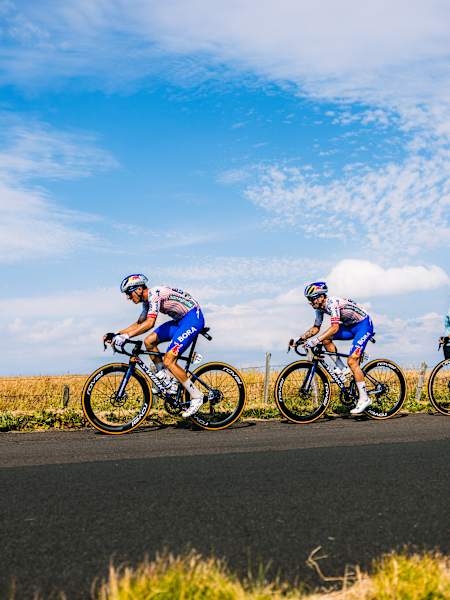
Red Bull – BORA – hansgrohe are ready for the Grand Départ in Barcelona
© Oriol Castello/Red Bull Content Pool
The iconic city of Barcelona will provide the backdrop for the opening stage’s team trial – the first inclusion of a team race against the clock since Stage 2 of the 2019 edition. Riders will navigate their way past some of the city’s legendary sites, including Sagrada Familia, but there is a sting in the tail with an uphill slog up the 800m-long climb of the Côte du Stade Olympique.


The second stage starts down the coast from Barcelona in Tarragona, before working its way back to the Catalonian capital and a hilly street circuit finalé that sees three ascents of the Cat 3 Côte du Château de Montjuïc, before finishing again at the Stade Olympique.
The final day in Spain is also the first mountainous day of the 2026 Tour de France, as it tackles the Cat 1 Col de Toses and crosses the Pyrenees and into France en route to the finish in Les Angles.
- Stage 1: Saturday, July 4, Barcelona to Barcelona – 19.6km – team time trial
- Stage 2: Sunday, July 5, Tarragona to Barcelona – 168.5km – hilly
- Stage 3: Monday, July 6, Granollers to Les Angles – 195.9km – mountains
Stage 4 to Stage 9: Mixed Pyrenean challenges and flat, fast days in central France

Riders battle through the cloudy Pyrenean stage in 2025
© Maximilian Fries/Red Bull Content Pool
The Tour de France visits the mountains of the Pyrenees and the Alps each year, and due to its Spanish start, it makes sense to tick off the former first. There’s only one out-and-out mountain stage in the range on Stage 6, and before that there’s a day for the rouleurs followed by the first proper sprint stage on Stage 5 into Pau. When it does finally arrive, the Pyrenean mountain stage is the first real test for the GC contenders, with the final 80km including an ascent of the Col d’Aspin (12km at 6.5 percent), Col du Tourmalet (17.1km at 7.3 percent), before the mellow-albeit-long summit finish to Gavarnie-Gèdre (18.7km at 3.7 percent).
There are two flat stages for riders to recuperate on before a lumpy spin between Malemort and Ussel concludes the first block of racing and the arrival of the first rest day.
- Stage 4: Tuesday, July 7, Carcassonne to Foix, 181.9km - hilly
- Stage 5: Wednesday, July 8, Lannemezan to Pau - 158.3km - flat
- Stage 6: Thursday, July 9, Pau to Gavarnie-Gèdre - 186.2km - mountains
- Stage 7: Friday, July 10, Hagetmau to Bordeaux - 175.1km - flat
- Stage 8: Saturday, July 11, Périguex to Bergerac - 180.4km – flat
- Stage 9: Sunday, July 12, Malemort to Ussel - 185.5km - hilly
Stage 10 to Stage 15: The Massif Central, Vosges and Jura ranges show they can pack a punch
The mountains of France aren’t limited to the two ranges on its southern borders and Stage 10 gets the second week of racing off to a bang with seven of the Massif Central’s most testing ascents.

Primož Roglič tackles an ascent
© Maximilian Fries/Red Bull Content Pool
Two flat days follow for the sprinters in the pack, but as the route works towards the borders with Switzerland and Germany, the gradient soon starts to ramp up. Stage 13’s 205.8km epic from Dole to Belfort is the longest day of the 2026 edition and gets the legs nicely warmed up for the back-to-back mountain days that make up the race’s third weekend.
Stage 14 is the shorter of the two, although crams 3,800m of elevation into 155.3km courtesy of four Cat 1 climbs (the 11.2km at 7.3 percent Col du Haag arguably the worst of the bunch), while Stage 15 ferries riders into the Haute-Savoie region and concludes with the HC Plateau de Solaison (11.3km at 9 percent) summit finish in Brison. If the GC battle is still tight before this point, expect fireworks ahead of the second rest day.
- Stage 10: Tuesday, July 14, Aurillac to Le Lioran - 166.6km - mountains
- Stage 11: Wednesday, July 15, Vichy to Nevers - 161.3km - flat
- Stage 12: Thursday July 16, Circuit Nevers Magny-Cours to Chalon-Sur-Saône - 179.1km - flat
- Stage 13: Friday, July 17, Dole to Belfort - 205.8km - hilly
- Stage 14: Saturday, July 18, Mulhouse to Le Markstein Fellering - 155.3km - mountains
- Stage 15: Sunday, July 19, Champagnole to Plateau de Solaison - 183.9km - mountains
Stage 16 to Stage 21: Legendary switchbacks, a monster of a Queen stage, and the return of an exciting Parisian finalé
The Stage 1 team trial will seem a distant memory as riders line up in the start hut for the second race against the clock on Stage 16. Starting and finishing on the shores of Lac Leman, the 26.1km course begins with an ascent of the Cat 2 Côte de Larringes (9.7km at 4.3 percent). Although not a mountain by Tour standards, expect it to favour the climbers of the peloton rather than the out-and-out time trial specialists.

Florian Lipowitz claimed the white jersey on his Tour de France debut
© Maximilian Fries/Red Bull Content Pool
Stage 17 offers the sprinters in the pack their last chance to shine before Paris a day on from their least preferred discipline, although a punchy first 60km means it could be one for the breakaway.
Stage 18 begins an epic three-day conclusion that could decide the whole race (or allow a dominant rider the chance to add to their advantage). The 3,900m of elevation gain, which concludes with a summit finish in Orcières-Merlette (7.1km at 6.7 percent) is just a warm up of things to come though.
More stories to get you excited for the Tour de France


Stage 19 sees the return of the Alpe d’Huez (13.8km at 8.1 percent) and the mountain’s 21 switchbacks – the first time the climb has featured since Tom Pidcock’s memorable stage win in 2022. Before riders reach the legendary Alpe’s foothills though, there’s the small matter of three categorized climbs, including the Cat 1 Col du Noyer (7.2km at 8.5 percent).
The penultimate stage is a brilliant way to conclude the GC battle before the final day’s Parisian procession, and is one of the hardest day's racing in recent memory. After tackling Col de la Croix de Fer (24km at 5.2 percent), the famous climbs just keep coming with the Col du Télégraphe (11.9km at 7.1 percent) and Col de Sarenne (12.8km at 7.3 percent) sandwiching the highest point of the whole race – the Col du Galibier (17.7km at 6.9 percent). The day finishes with another summit finish at the top of Alpe d’Huez, although riders will join the climb five switchbacks from the top, rather than having to repeat all 21 again.
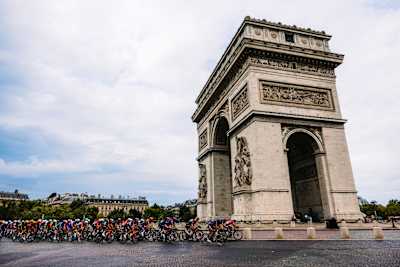
One final push down the Champs-Élysées
© Maximilian Fries/Red Bull Content Pool
While the GC battle might be concluded, Stage 21 is still set to be a spectacle and sees the return of the extended Parisian city centre circuit from the 2025 edition that was inspired by the 2024 Paris Olympics. Rather than being a foregone conclusion for the sprinters as the peloton whizzes up and down the Champs-Élysées, the new course includes a loop out to Montmartre and the Cat 4 ramps of Côte de la Butte Montmartre. Last year, Wout van Aert was victorious on the Champs-Élysses, but with the Belgian absent from this year’s race, he won’t be able to add to his 10 Tour de France stage wins.
- Stage 16: Tuesday, July 21, Évian-Les-Bains to Thonon-Les-Bains - 26.1km - individual time trial
- Stage 17: Wednesday, July 22, Chambery to Voiron - 174km - flat
- Stage 18: Thursday, July 23, Voiron to Orcières-Merlette - 185.2km - mountains
- Stage 19: Friday, July 24, Gap to Alpe d’Huez - 127.9km - mountains
- Stage 20: Saturday, July 25, Le Bourg d’Oisans to Alpe d’Huez - 170.9km - mountains
- Stage 21: Sunday, July 26, Thoiry to the Champs-Élysées in Paris - 133km - flat
Part of this story