
Athletics
The ultimate guide to the triple jump
The triple jump has three main components: the hop, the step and the jump.

With its ancient history and current world records, the triple has been a time-honored part of worldwide track and field events. It’s the ultimate combination of speed, strength, and agility — and the execution almost looks like horizontal gliding.
According to triple jump champion, Will Claye, the triple jump “... looks like the person is just floating — there’s a cadence to it and there’s a rhythm to it.”

Will Claye
© Garth Milan/Red Bull Content Pool
Here’s your deep dive into the triple jump.


01
What is the triple jump?
As the name suggests, the triple jump has three main components: the hop, the step, and the jump. Think of the whole thing as two parts gaining acceleration and the final jump as the gliding result. Compared to some other track and field athletic jumps, the triple jump is all about horizontal distance — not maximizing height. But that’s not all.
There are triple jump rules. A jumper must follow either a left-left-right or right-right-left sequence. Meaning, they must hop from one leg, step on the same leg for the second jump, then use the opposite leg for the end jump. This is all one sequence that requires continuous speed throughout.
And the stage for this rhythmic flight? The triple jump takes place on a runway of a running track, a takeoff mark, and for the landing — a sandy surface.
02
A brief history of the triple jump

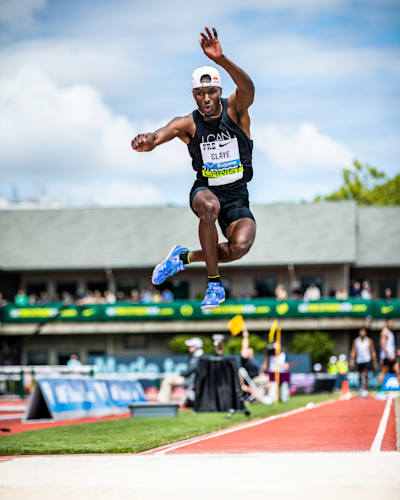
Will Claye at the 2018 Prefontaine Classic IAAF Diamond League in Oregon
© Aaron Rogosin / Red Bull Content Pool
It seems to be a human truth that people like to measure their jumps. The triple jump is rooted in ancient athletic history. Greek writings mention jumps of 15 meters (49 feet) and more in early contests. This led historians to the conclusion that it must have been a series of jumps — or poetic embellishment.
In another part of the globe, the Irish Tailteann Games held a contest for the “geal-ruith,” which is in the same vein as today’s triple jump. It’s believed these ancient games started in 1829 BC as funeral ceremonies. They stopped around 1171 AD after the Norman Invasion, but the triple jump lived on.
03
Techniques for the triple jump
Will Claye
© Garth Milan/Red Bull Content Pool
Acceleration and controlled speed are key drivers behind the triple jump. But let’s drill down further.
- The approach. As with any jump, landing the approach is vital. Here, the athlete sprints down the track towards the takeoff board. The takeoff board is often a piece of wood embedded in the track. It can also be simply a painted rectangle on the track surface. “Scratching” the mark, i.e. even the slightest overstep, disqualifies the jump.
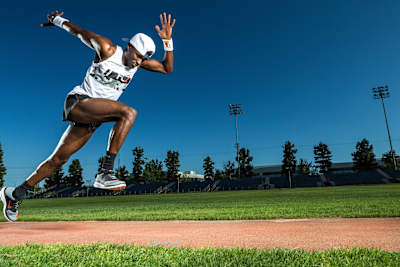
- The hop. The goal of this first phase is forward momentum. Essentially, it’s not at all like, let’s say, a bunny hop. But more of a reaching out towards the next jump, where the athlete takes off and lands on the same foot. It also marks the starting point for measuring the jump distance.
- The step. After the hop phase, now the legs have to assist with momentum mid-air as well as a hip thrust to maximize it. The magic in the triple jump is holding this position for as long as possible to prepare for the end jump.
- The jump. The athlete uses the force from landing on their opposite leg for the final jump. This is where that epic vertical takeoff that you see on TV happens.
- The landing. What awaits is, hopefully, a smooth landing in a sand-filled pit on flat feet. The mark of any body part closest to the board is where a jump is measured. That’s why all jumpers avoid leaning back for their landing.
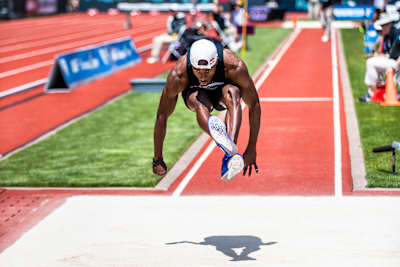
Will Claye at the Prefontaine Classic IAAF Diamond League meet in 2018
© Aaron Rogosin / Red Bull Content Pool
An athlete accidentally placing their hands behind their body and feet is another common mistake to watch out for. Sometimes young jumpers struggle with slowing down as they approach the takeoff mark. Instead, they should focus on running through the board well enough to see past the distraction. Overall, a balance of controlled speed and horizontal distance ahead of the third jump is crucial. Otherwise, it might lead to one of the phases getting cut short or achieving overbearing height.
04
Training tips for the triple jump

4 min
Train like a Pro: Triple Jumper Will Claye
Join triple-jump champion, Will Claye, for a weight session at the Red Bull Athlete Performance Center Los Angeles.
If you want to sharpen your triple jump game, you have to work on flexibility, strength, and your speed. Speed can be built with running and sprinting drills, as well as uphill running. Strength, which may be obvious, is the modifier for an explosive first hop. Flexibility is your key to gaining that momentum mid-air, but also as an overall must-have for your legs and hips to work autonomously.
Exercise tip for phase 1: the hop
For practicing takeoff and the initial hop, a good drill is to actually slow down with a standing triple jump series. It is the same routine as a regular triple jump but without the approach. Start by standing on both feet and then go through the motions of the triple jump.
Exercise tip for phase 2: the step
Step up your step game with short-approach jumps. This simply means that you’re performing the first two parts of the triple jump but without long approach runs and close to the sand pit. Land on your knees for this drill and keep an upright posture.
Exercise tip for phase 3: the jump
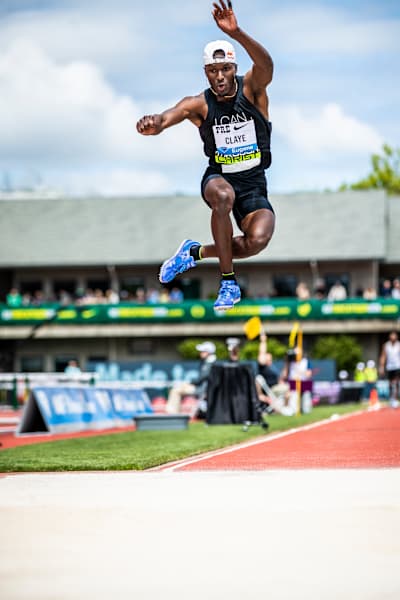
Will Claye at the 2018 Prefontaine Classic IAAF Diamond League meet
© Aaron Rogosin / Red Bull Content Pool
The biggest note for practicing your jump is to not do so in isolation of the other two phases. If you’re practicing only long jumps in hopes to gain more distance for the triple jump, you’re teaching your body the wrong thing. Jim Giroux, track coach at University of Southern Maine, instead suggests “Additional single leg hopping after some step work is a good way for the athlete to better align themselves during this phase.”
Famous triple jumpers to know
The who’s who of today’s triple jumping are Jonathan Edwards for the men’s record and Yulimar Rojas for the women’s. Great Britain’s Jonathan Edwards set the men’s world record in 1995 with 18.29 meters (60 feet). For the women, Venezuela’s Yulimar Rojas set the bar in 2022 with 15.74 meters (51.64 feet). It even earned her the nickname “la reina del triple salto,” which, as you may have guessed, means “queen of the triple jump.”
Jump the Distance
The triple jump is an underviewed event but with an overwhelming amount of history. It’s understandable why so many athletes are still drawn to it. Even if you’re not a professional track-and-field athlete, its skills translate easily into other sports such as basketball. So if you want to up your other games, get into the triple jump. It may be one of the closest things humans have to flying without machinery.