NASCAR explained: A beginner’s guide to stock car racing
New to stock car racing? Here’s everything you need to know to watch and understand all the thrilling action from race structure to flags to common NASCAR terms.
To explain stock car racing to a beginner, it might be tempting to say, “Turn left, go straight. Repeat 500 times. Try to be the fastest to do it.” But it’s so much more than that. Stock car racing, governed by the National Association for Stock Car Auto Racing - or NASCAR, for short - is an all-American pastime that goes back nearly a century.
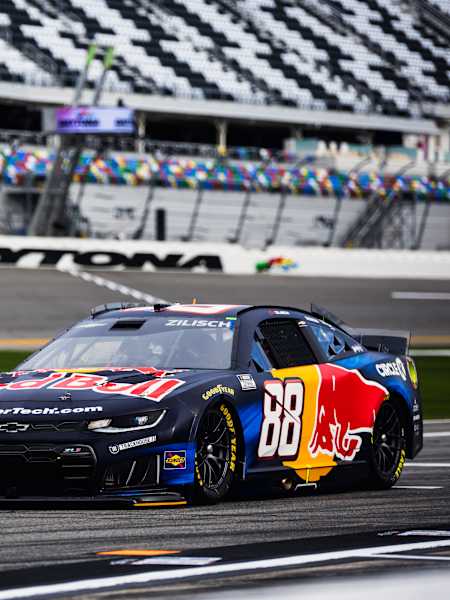
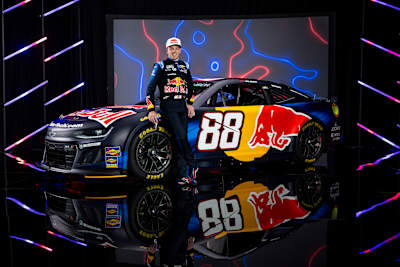
Originally, stock cars were honest-to-goodness stock cars that could have come from anyone’s driveway. Today, the cars you see athletes like Connor Zilisch driving are purpose-built racing machines designed to look like production cars. The cars are built for speeds approaching 200 miles per hour, with lots of driver safety built in. Roll cages, reinforced frames, and extensive fire systems are standard fare, and these cars are built to withstand some serious laps.
NASCAR stands for the National Association for Stock Car Auto Racing. It was founded on February 21, 1948, in Daytona Beach, Florida, by mechanic and racing promoter Bill France Sr. The very first NASCAR-sanctioned race ran on the Daytona Beach road course just days earlier, and the sport has been based in Daytona Beach ever since.
02
Where does NASCAR race?
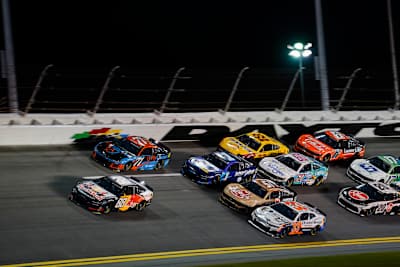
Shane Van Gisbergen battles for position at Daytona International Speedway
The short answer is that NASCAR hosts 36 races in a season, with more than half of those taking place in the Southeast U.S. Nearly all of the events are on an oval track, with just four road courses in 2026. The first road course is at the Circuit of the Americas in Austin, Texas, with Watkins Glen International, Naval Base Coronado and Sonoma Raceway later in the season.
Lap lengths for oval tracks range from a little more than a half mile at Martinsville Speedway in Virginia to 2.66 miles at Talladega Superspeedway in Alabama. On the road course side, the Circuit of the Americas is 2.3 miles per lap, 2.45 miles at Wakins Glen, and 1.99 miles at Sonoma Raceway. The Naval Base Coronado event is referred to as a street race, with a 3.4-mile, 16-turn circuit at Naval Air Station North Island. While the tracks were run on dirt and sand back in its first days, today most of the tracks are paved with asphalt.
Common track types include short tracks, which are less than 1 mile; intermediate tracks (1–2 miles); Superspeedways (2+ miles); and road courses (left and right turns). You might notice that the vast majority of NASCAR races run counterclockwise (left turn, left turn, left turn) on the track. There are a couple of outliers that are raced clockwise, including Sonoma Raceway and Watkins Glen.
Track Type
Length
Example
Short Track
Under 1 mile
Martinsville Speedway
Intermediate
1–2 miles
Multiple venues
Superspeedway
2+ miles
Talladega Superspeedway
Road Course
Varies
Circuit of the Americas
03
What do NASCAR flags mean?
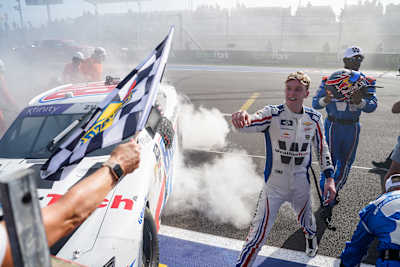
Connor Zilisch after winning at Circuit of the Americas
Half the battle of enjoying any new sport or activity is learning the lingo. There’s lots of terms, acronyms, and phrases that aren’t used anywhere else in the world, and it helps to know them to follow along.
Crew chief: This position acts as the head coach of a racing team, coordinating communications from the engineers and crew to the drivers. The crew chiefs have a big responsibility to know what’s happening all around; they are the hubs for the entire operation.
Pit road: The secure, speed-limited lane parallel to the track that’s also called pit lane.
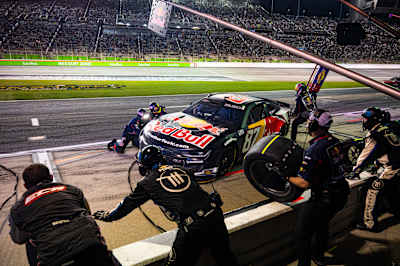
Pit crew: Made up of a highly choreographed 5-person team that performs services to the stock cars generally in 10 seconds or less.
Pit stop: During a pit stop, the driver stops at a designated spot on pit road for service, new tires, fuel, or repairs.
Spotter: At the highest point of the track at an oval race, the spotter keeps an eye on the race and relays information to the crew about what’s happening. During a road course, multiple spotters are located around the track.
Stickers and scuffs: Fresh, unused tires are stickers, and used tires are scuffs.
Most NASCAR Cup Series races last between 2.5 and 4 hours, though caution periods, weather delays, and scheduled stage breaks can extend some events beyond that.
While race length is often measured in miles, many new fans also want to know how long a NASCAR race is in real time. The answer depends on the track, the number of laps, and how many cautions occur during the event.
Race
Distance
Typical time
Daytona 500
500 miles / 200 laps
3-5 hours
Coca-Cola 600 (longest race)
600 miles
4+ hours
Typical 400-mile race
Approximately 267 laps (varies by track)
About 3 hours
The Daytona 500 is NASCAR's most iconic race and can run anywhere from three to five hours depending on race conditions. The Coca-Cola 600, held annually at Charlotte Motor Speedway, is the longest NASCAR Cup Series race by distance at 600 miles and typically lasts more than four hours.
As for how many cars are in a NASCAR race, most NASCAR Cup Series events start with 36 to 40 cars. Thirty-six chartered teams are guaranteed entry each week, while the remaining spots are filled by open entries when available.
06
How the NASCAR Championship (The Chase) works
The final thing to know about the 2026 NASCAR season is the Chase, or the championship crowning process. After more than a decade using an elimination-style playoff system, NASCAR switched back to The Chase format. NASCAR returned to the framework it used from 2004 to 2013 in the Cup Series. Drivers qualify for the Chase based on regular season points, not on a “win-and-you’re-in” rule from past playoffs. The Cup Series’ Chase spans the final 10 races of the season, and the driver with the most points at the end of the season earns the title of series champion.
Whether it’s mastering the nuances of an oval, navigating the technical demands of a road course, or chasing points in the final 10 races, NASCAR is far more complex than simply turning left. For rookies like Connor Zilisch, success comes from understanding every layer of the sport - from strategy and teamwork to mechanical precision. And for new fans, learning those layers is what makes every lap more meaningful.