
Tennis
5 lessons in resilience from US Open champion Dominic Thiem
From US Open glory to career-changing setbacks, Dominic Thiem's journey is a valuable tale of mental strength and resilience.


The US Open is now under way, with the world’s best players descending on New York for the final tennis Grand Slam of the year. For former champion Dominic Thiem, Flushing Meadows was the scene of his greatest triumph – but his career would go on to become a story of resilience as much as success.
His journey and experiences offer lessons far beyond tennis, as Thiem recently discussed with fellow Austrian athlete and RB Leipzig midfielder Christoph Baumgartner.


The journey behind the lessons
In 2020, Thiem produced one of the great US Open comebacks, recovering from two sets down against Alexander Zverev in the final before prevailing in a dramatic fifth-set tie-break. It earned the Austrian his first Grand Slam title, fulfilled his lifelong ambition and proved to be the defining victory of his career. “Until I won that Grand Slam, I had devoted 100 percent of my life to achieving that goal," Thiem says.
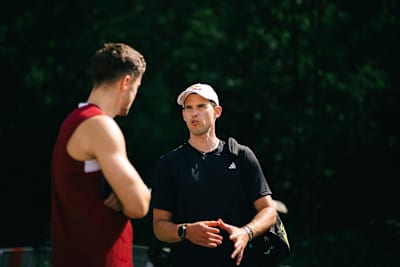
Thiem shared an honest insight into life at the top with Baumgartner
© Marvin Seibert
Less than a year later, everything changed. A serious wrist injury forced Thiem away from the tour and sparked a long battle to regain the form and fitness that had taken him to world No.3. He eventually returned to competition, but was never able to consistently rediscover his previous level and ultimately retired in 2024 at the age of just 31.
The comeback may not have ended with another Grand Slam trophy, but the experience gave Thiem a very different perspective on dealing with setbacks – and indeed some valuable lessons to pass on.
01
Handling pressure when there’s nowhere to hide
One of the biggest differences between tennis and football is obvious: when a tennis player walks onto court, they're on their own. Even on his most difficult days, Baumgartner knows football provides something tennis can’t – teammates. It's something he particularly admires about Thiem and other individual athletes.
"I think dealing with that pressure is probably even more extreme when you compete in an individual sport," he says. "We have the advantage that if you’re going through a difficult spell, there are still ten other lads out there to support you. The pressure is spread across far more shoulders for us."
It was different for Domi. If he had a bad half an hour, the match could be over
A difficult spell in football can be absorbed by the group. A teammate can take responsibility, provide a rallying call or simply give another player a few minutes to regain their composure. Tennis, on the other hand, affords no such luxury.
"It was different for Domi," Baumgartner adds. "If he had a bad half an hour, the match could be over in the worst-case scenario. You have to have huge respect for that."
For Baumgartner, there is one footballing situation that does come close.
"The closest comparison for us is probably taking a penalty. In that moment, everything rests on you. Dominic had that feeling more or less throughout an entire match. That’s pretty impressive."
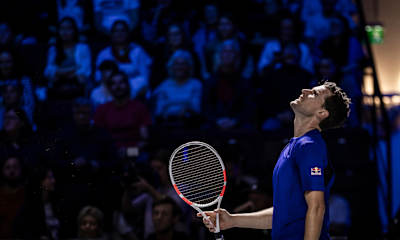
It can be a lonely place out on the tennis court
© Mirja Geh/Red Bull Content Pool
02
Never count yourself out
Thiem's greatest victory is a perfect example of that mentality. Baumgartner remembers watching the 2020 US Open final with his wife as Thiem was pushed to his physical and mental limits deep into the deciding set.
"The match was unbelievable," he recalls. "Domi was even a break down against Alexander Zverev at one stage in the fifth set, and both of them were pretty much at their physical limits."
Domi made sporting history for Austria that day
Thiem found a way through. After losing the opening two sets, he took the next two before recovering from that break down in the fifth. More than four hours after the match began, he completed the comeback in a deciding tie-break.
"Domi made sporting history for Austria that day," says Baumgartner.
It was an extreme example of something every elite athlete encounters, at least from time to time; moments when a performance or result starts slipping away. The challenge is to resist believing the outcome has already been decided.
For an individual athlete, with nobody else to help change the course of the match, that battle can be particularly tough. The responsibility to reset and go again is theirs alone.
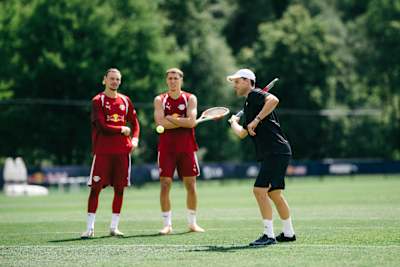
Thiem enjoyed a little knockabout with the RB Leipzig players
© Marvin Seibert
03
Sometimes slowing down is part of the comeback
Resilience doesn’t always mean pushing harder. Thiem's experience with injury taught him that patience can be just as important – a lesson particularly relevant to Baumgartner as he recovers from a serious injury of his own.
"The advice that no athlete wants to hear is probably that it's better to take your time and wait a bit longer before returning to the pitch," Thiem tells him.

Thiem back in action in 2022 following his wrist injury
© Joerg Mitter/Red Bull Content Pool
I started playing again far too soon

Thiem learned that the hard way during his own recovery: "I did the opposite back then, which was probably my undoing; I started playing again far too soon," he admits. "It's better to wait a few days, or if in doubt, a few weeks more. It's worth it in the long term."
For athletes whose instinct is to get back as quickly as possible, knowing when to slow down can be just as important as knowing when to push.
04
Give yourself time – then look forward
The physical effects of injury are obvious, but the mental side can be even more difficult to deal with. Baumgartner admits that missing the World Cup hit him far harder than the injury itself.
"The physical pain is irrelevant. That only lasts for a short while," he says. "But the mental pain was huge, I won't lie."
At some point, it's time for you to focus on the future again
Thiem knows those emotions only too well and believes they shouldn't simply be ignored. "Negative thoughts and emotions are normal," he says. "I also believe that you should allow yourself to experience them for a certain amount of time. But at some point, it's time for you to focus on the future again."
Baumgartner has embraced that approach by setting fresh targets during his recovery.


05
Resilience doesn't always bring another trophy
Thiem's journey proved that bouncing back doesn't always mean returning to the level you were at before. Although he fought his way back onto the tour following his wrist injury, he was never able to consistently rediscover the form that had taken him to the top of the sport. In the end, moving forward meant leaving professional tennis behind.
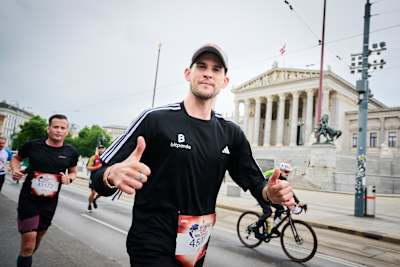
Thiem has focused on new pursuits in the years since his retirement
© Philipp Carl Riedl for Wings for Life World Run
"But one thing I had to learn afterwards was that there’s much more to life than your sporting career," Thiem says. "Of course, winning that title still makes me happy today. But that chapter of my life is over and now there’s something new."
As the US Open returns to New York, Thiem's unforgettable 2020 triumph remains one of the tournament's great comeback stories. But what followed offers a different lesson in resilience. Mental strength isn't only about finding a way to win. Sometimes it's knowing when to keep fighting, when to be patient, when to change the goal – and when it's time to move forward.