

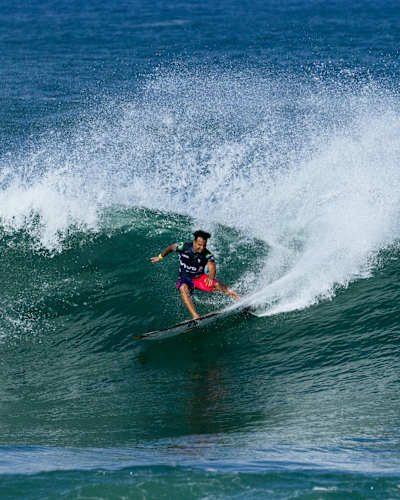

WSL Vivo Rio Pro
Saquarema, Rio de Janeiro, Brazil

Rio de Janeiro
Brazil
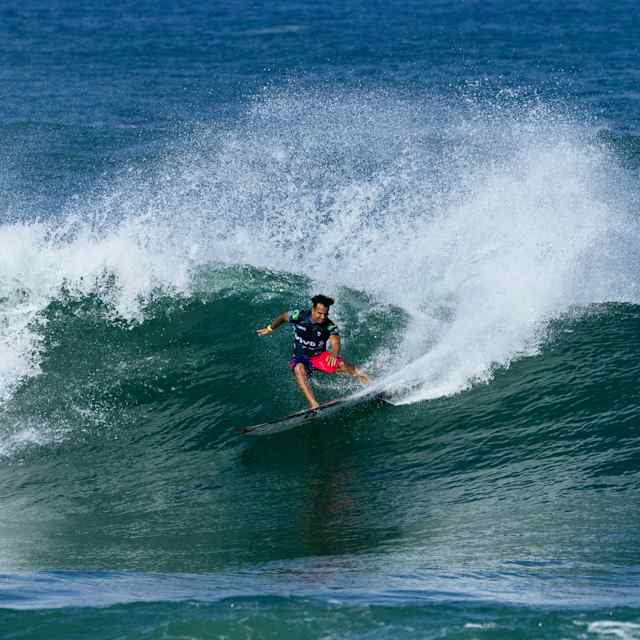


Catch all the action from surfing’s elite tour on Red Bull TV, as 36 men and 18 women travel across 12 different stops, at the most exciting surfing locations in the world on their hunt for the 2025 WSL Championship Title.
01
What is the WSL?
The World Surf League (WSL) brings together roughly 1,000 surfers to compete in events every year, across seven global regions incl. Australia/Oceania, Asia, Africa, Europe, Hawaii/Tahiti Nui, North America and South America. Surfers progress through levels of competition to hopefully reach the biggest stage of them all – the Championship Tour, where the best of the sport will be crowned.
02
How do the WSL competitions work?
There are three tiers of competition on the WSL:
- Qualifying Series: Anyone who's paid the annual WSL membership can enter, so events can have just 50 people or well over 100 fighting for points. The surfers are ranked depending on the quality of wave and size of the prize pool. That means the bigger the event, the more points to be won! Surfers who earn enough points in their region over the course of a Qualifying Series season graduate to the next tier, the Challenger Series.
- Challenger Series: Each event is composed of surfers who've qualified through the seven WSL geographic regions, two World Junior Champions from the previous year, and surfers who missed the cut on the Championship Tour or were highly ranked in the Challenger Series the previous year. That means a total of 80 men and 48 women compete, but only the top 10 men and top 5 women qualify for the Championship Tour!
- Championship Tour: The first seven events have the top 36 men and top 18 women. For the men 22 are from the previous year’s Championship Tour rankings, and 10 from the current year’s Challenger series, along with two season wildcards and two event wild cards. Likewise, for the women, 10 are from the previous year’s Championship Tour rankings and 5 from the current year’s Challenger series, along with two season wildcards and two event wild cards. Only the top 24 men and 12 women continue on to the second-half of competition. Of those, the top-ranked automatically claim a spot in the 2026 Championship Tour.
It takes between three and five days to fully run an event, but on occasion a 12-day window is allowed for conditions to improve, as wave quality can fluctuate due to unpredictable weather patterns.
03
Heats: what are they, and how do they work?
Each heat in the Qualifying Series and Challenger Series starts with four surfers. Over the course of the heat, the field narrows down to two surfers who compete head-to-head, with one winner advancing to the next round. These rounds are designed to give surfers multiple opportunities to showcase their skills.
On the Championship Tour, heats start with three surfers. However, only one surfer is eliminated after each heat, meaning two surfers advance. From then on, it’s a series of one-on-one battles until the finals where the top surfers compete for the trophy. Occasionally on the Championship Tour, heats are run in an overlapping format, where two heats run simultaneously in the water, each with a different set of surfers. This format is often used to maximize time when conditions are ideal, allowing more surfing to take place in a shorter amount of time. While this might sound complicated, it’s a clever way to ensure that the event stays on schedule and maximizes action.
Heats generally last between 20 to 30 minutes, but this time can be extended if the conditions require more time to allow the surfers to catch enough waves. This is important because surfers are given priority by the judges in terms of the order in which they can catch waves. At the start, no surfer has priority, but as soon as a surfer catches their first wave, they’re assigned priority rank. If someone with lower priority tries to catch a wave in the wrong order, it can result in a penalty of a half or full-wave deduction from the surfer’s final score. Priority can be a surfer's best friend if they're skilled at reading the ocean and can pick the better waves, but being too patient can leave them at a loss if the waves don’t cooperate, the time may run out before they get their chance.
04
How are surfers scored on their rides?
Each wave a surfer catches is scored out of 10 points in a system that rewards consistency and strategy, as surfers will aim to catch a variety of waves that fit their style and the conditions. There's no limit to the number of waves a surfer can ride, but during a heat, the surfer’s two highest-scoring waves are combined to make up their total score for that round. The judges are looking for:
Commitment: Displaying commitment to maneuvers in every turn, carve, or aerial wins more points, and surfers who push the limits with more challenging and technical moves will generally score higher.
Innovation: The more progressive and cutting-edge the moves, the more likely the surfer is to earn higher scores as new ideas to the sport, or combining traditional techniques with modern moves, earns recognition for their creativity.
Combinations: A successful wave ride often includes a combination of major maneuvers so surfers who can seamlessly link these maneuvers while maintaining the effortless flow often score higher.
Variety: Judges also look for a diverse set of tricks because the ability to adapt demonstrates skill and versatility, rather than just focusing on one type of maneuver.
Speed, Power and Flow: These three elements are the most crucial in surfing, and combining them well yields big points. Speed represents the surfer’s ability to generate momentum on the wave, power refers to how strong and controlled their manoeuvres are, and flow indicates the smoothness with which a surfer links different manoeuvres.
05
Why do the surfers wear different colours?
Surfers wear brightly coloured jerseys in the World Surf League (WSL) to ensure they can be easily identified by both spectators and judges, especially in challenging conditions like fog, sun glare, or from a distance. The vivid colours stand out against the water, making it easier for everyone to follow the action. Traditionally, the top-ranked surfer wore a red jersey, but now, moving forward, the yellow jersey will represent the top-ranked surfer on the Championship Tour.
06
What is the WSL 2025 Championship Tour schedule?
In 2025, the Championship Tour features 12 events, culminating in the prestigious one-day WSL Finals at the iconic Cloudbreak in Fiji, where the final man and woman standing will be crowned, closing out an unforgettable season. Watch all of the action on Red Bull TV.
Event
Date
Location
January 27 – February 8
Banzai Pipeline, Oahu, Hawaii
February 14-16
Hudayriat Island, Abu Dhabi, UAE
March 15-25
Supertubos, Peniche, Portugal
April 2-12
Punta Roca, La Libertad, El Salvador
April 18-28
Bells Beach, Victoria, Australia
May 3-13
Snapper Rocks, Queensland, Australia
May 17-27
Margaret River, Western Australia, Australia
June 9-17
Lower Trestles, California, United States
June 21-29
Saquarema, Rio de Janeiro, Brazil
July 11-20
Jeffreys Bay, Eastern Cape, South Africa
August 7-16
Teahupo'o, Tahiti, French Polynesia
August 27 – September 4
Cloudbreak, Tavarua, Fiji