From backyards to global fame: This is the surprising history of padel
Trace padel’s journey from Enrique Corcuera’s first court in Acapulco to Premier Padel’s worldwide expansion, with the latest figures revealing the scale of the sport’s growth.
If you're a fan of racket sports, there's a good chance you've tried padel. Combining accessibility with a social, easy-to-learn format, the sport has surged in popularity, attracting players of all ages and abilities.
That growth is reflected in the numbers. The International Padel Federation (FIP) now counts more than 40 million players and over 91,200 courts worldwide. All you need to get started is a court, a padel racket, a ball, three other players and a good pair of shoes. But how did padel become a global phenomenon? Here are some key facts about its history and development.
01
Where does the name 'padel' come from?
The name 'padel' comes from the English word 'paddle', which means 'shovel' or 'racket', a term that became part of the Spanish language after it was included in the Dictionary of the Spanish Language (RAE).
Padel. From English 'paddle tennis'.
Graphic adaptation proposed for the English word padel (tennis), 'sport similar to tennis played with wooden rackets': "Common areas with gardens, swimming pools and padel courts" (Mundo [Esp.] 23.3.01) // Game between two couples, very similar to tennis, but played between four walls and in which the ball is hit with a short-handled padel.
02
The birth of padel
The roots of padel can be traced back to earlier racket sports, like platform tennis, which originated in the United States during the 1920s. Platform tennis was played on raised platforms, typically during the winter, and featured heating elements below the deck to melt snow. Similar to padel, it used solid paddles and a surrounding net, but differed significantly in terms of court size and the use of a spongy, rubber ball. These elements may have inspired the basic structure and dynamics of padel, albeit adapted to different climates and settings.
Platform tennis is still played today, mainly in the Northeast of the United States, and the country has also embraced pickleball, another paddle sport. According to the Sports & Fitness Industry Association, 24.3 million Americans played pickleball in 2025.
Padel’s actual beginnings date back to 1969 and Mexican businessman Enrique Corcuera, an avid tennis fan. Corcuera, on one of his trips to the United States, had tried 'paddle-tennis', a game inspired by tennis, but played on a smaller court, with a lower net and replacing the racket with a paddle.
Based on that concept, Corcuera adapted a piece of land he owned in Las Brisas, Acapulco, Mexico, installing a small court 20m long by 10m wide, to which he added walls on the sides, with the idea of preventing vegetation from invading the court and the balls from getting into the neighbour's property. Squash, another influential racket sport, likely influenced Corcuera's initial court design with its enclosed playing area and wall play, aligning closely with the padel format that encourages longer rallies and strategic use of the enclosure.
Bouncing off the walls made [padel] more fun and fluid
Omar Villavicencio
Squash, another influential racket sport, likely influenced Corcuera's initial court design with its enclosed playing area and wall play, aligning closely with the padel format that encourages longer rallies and strategic use of the enclosure. Squash is also getting a boost today, with its Olympic debut set for the 2028 Games in Los Angeles.
"They tried different balls, observing that the best one turned out to be the tennis ball. Bouncing off the walls made it more fun and fluid," explains Omar Villavicencio, president of the Mexican padel Federation.
No one could have imagined back then that this improvised idea would give rise to a new sport that would eventually spread around the world.
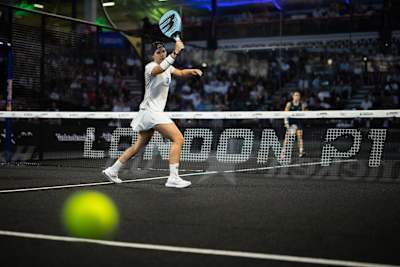
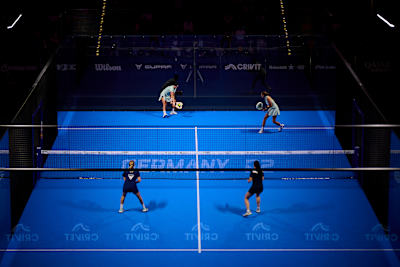
Delfina Brea in action at the Premier Padel P1 final in London
Enrique Corcuera also helped export padel to Spain. During the summer, he invited his aristocratic friends to play on his court at Las Brisas. His friend Prince Alfonso de Hohenlohe-Langenburg, a real estate developer and founder of the Marbella Club, was key to this expansion. He took it to Spain and introduced it to the Costa del Sol in 1974, building two courts in his hotel-club. These two courts were the first built in Spain and, unlike the one at Corcuera's house, used a wire fence instead of side walls.
Between 1980 and 1990, The Marbella Club courts hosted the famous 'Pro-Am' tournaments, sponsored by the Smith & Smith stores in Las Arenas (Vizcaya), owned by the man who would become the first president of the International Padel Federation in 1991, Julio Alegría Artiach, one of the most important people in the history of the sport, who established the rules of padel at an international level.
The key moment in the evolution of padel in Spain was the 1990s, when prominent figures from the political, business, and journalistic spheres took up padel, which led to it becoming a trending sport. The rapid success of padel attracted prominent tennis figures such as Manolo Santana. The Spanish champion began to practice it frequently and started to organise tournaments on the Costa del Sol, becoming one of the major promoters of padel in Spain, where several clubs began to build their own courts.
Spain remains the sport's biggest market today. According to the FIP, the country has more than 17,000 courts, and Spanish players make up more than half of the men's top 100.
04
Worldwide export and international recognition
After witnessing its success first-hand, in 1975, Julio Menditeguy, an Argentine friend of Alfonso de Hohenlohe, decided to import this new sport to his country. In Argentina, padel gained unprecedented importance, becoming the second most practised sport.
Names such as Horacio Álvarez Clementi, Cacho Nicastro, and Diógenes de Urquiza, national pioneers, contributed greatly to this exponential development. Additionally, many Argentine polo players who travelled to Spain discovered padel in Marbella and, upon returning to Argentina, became natural ambassadors of this 'new easy and fun game with cheap facilities'.
In 1988, the Argentine Paddle Association (APA) was founded, with Oscar 'Cacho' Nicastro at the helm. Nicastro, who led the group behind the Association and wanted to give the game an international boost, agreed to organize the first matches between Spain and Argentina, creating another great moment in international padel history.
In addition to Argentina, padel quickly spread to other countries in the American continent, such as Brazil, Uruguay, Chile, and Paraguay. Likewise, its extension in Europe is a fact in countries such as Sweden, Italy, United Kingdom, France or Germany, countries in which federations have been emerging, achieving great success in terms of the number of members and construction of facilities. Spain, in this sense, is recognised as the driving force behind padel in Europe.
In 1993, padel was consolidated as a sport, after its official recognition by the Spanish Superior Council of Sports [CSD - Consejo Superior de Deportes]. One year later, the constitution of the Spanish Padel Association was approved and recorded in the Registry of Sports Associations of the CSD.
Argentine, Spanish and Uruguayan associations founded the FIP in Madrid in 1991, and it now has 100 affiliated national federations. Padel debuted as a medal sport at the 2023 European Games in Krakow, and in 2026 it awarded medals for the first time at the Mediterranean Games in Taranto, the South American Games in Santa Fe, and the Asian Games in Aichi-Nagoya. Each milestone brings the sport closer to its long-term goal of reaching the Olympic Games.
05
Evolution of the game
Over the years, padel has undergone several rule changes that have shaped its modern playing style. One significant rule change was the introduction of the underhand serve, mandated to reduce serve dominance and enhance rally length, making the game more about skillful play than power.
Additionally, rules regarding wall play were refined, allowing balls to be played off the court, with players going out through the court’s doors, which added a unique tactical layer absent in similar racket sports. This adaptation has led to a more engaging and strategically complex game, attracting a broader audience.
Players are allowed to go out of the court and continue playing the point
Initially, padel rackets were simple wooden paddles, similar to those used in platform tennis. Over time, these evolved into more sophisticated designs incorporating advanced materials such as carbon fibre and fibreglass, which offer better durability, power, and control. The balls, originally adapted from tennis, have also been refined specifically for padel to balance bounce and speed, enhancing playability. Today, high-performance gear is tailored to player styles and levels, significantly impacting the sport's accessibility and appeal.
The professional circuit
For years, the best players competed on separate circuits. In 2023, Qatar Sports Investments acquired the World Padel Tour, and since 2024, the FIP-launched Premier Padel has been the sport's single elite professional circuit. Its tournaments are ranked as Majors, P1, and P2 events, and each season closes with the Premier Padel Finals, which bring together the top 16 players in each ranking.
06
The greatest padel players in history
Juan Lebrón and Alejandro Galán were among the modern-day great pairings
Padel has witnessed some legendary rivalries that have not only heightened the sport's drama but also showcased its competitive spirit. As the sport’s biggest drivers, Spain and Argentina have produced the best athletes in padel history.
By the numbers, Argentine Fernando Belasteguín is undoubtedly the most decorated player in padel history, with 230 titles in his professional career, more than 100 of which came as part of an iconic team with Juan Martín Díaz, another legend of the sport. 'Bela' played his final professional tournament at the Milano P1 in December 2024, closing a 30-year career that included 16 years as world No.1.
Together, Belasteguín and Díaz stayed at the top of the world rankings for 13 consecutive seasons. They found their main rivals in Pablo Lima and Juani Mieres, one of the only teams able to beat 'Bela' and Díaz during their historic run.
Even though they didn’t achieve the unimaginable level of greatness that 'Bela' did, other padel icons worth mentioning are Paquito Navarro - known for his raw talent and showman attributes - Sanyo Gutiérrez, and Maxi Sánchez.
Agustín Tapia and Arturo Coello have topped the rankings since 2023
While Belasteguín, Díaz, Mieres, and Lima excelled a few years ago, when strategy defined how padel was played, a new generation of remarkably fast, explosive athletes is taking over with a faster, more dynamic style that keeps strategy in mind and rewards hard-hitting teams that add speed and power to their shots and court movement.
Juan Lebrón and Alejandro Galán can be credited with initiating this new era of faster padel. Lebrón and Galán’s partnership has been particularly impactful, earning them 33 trophies and three consecutive seasons as world No.1 with a high-octane style of play, underscoring the evolution of modern padel carried forward by Agustín Tapia and Arturo Coello, carried forward by Agustín Tapia and Arturo Coello, the world’s top team every season since 2023.
Women have played a significant role in the growth of padel, with their participation contributing greatly to the sport's expansion. The number of female players has increased, and they have risen to prominence in international competitions. According to FIP data, women account for around 40% of padel players worldwide.
Carolina Navarro has been a pivotal figure in women’s padel. Known for her aggressive playing style and strategic acumen, Navarro is the most decorated player in history, having won 100 trophies over the course of her career. Navarro was the top-ranked player for nine consecutive seasons, and a three-time world champion. Her example inspired countless women to take up the sport and led the way for many girls who would become the sport’s current stars.
Alejandra Salazar is certainly one of those athletes. She has won more than 50 titles at the highest level and reached the top of the world rankings four times. Still competing at the top level in her 40s, Salazar announced that 2026 would be her final professional season. Other remarkable women’s padel figures worth mentioning include Icíar Montes (world No. 1 for eight years), the Sánchez-Alayeto twins (nicknamed 'The Atomic Twins' and ranked No. 1 for four years), and Gemma Triay.
Much like the men’s competition, the professional female padel scene is dominated by highly physical and explosive players like Bea González, Martita Ortega, Ariana Sánchez, and Paulita Josemaría (the latter two currently form the top-ranked team in the world).
González, winner of the 2025 Premier Padel Finals, now forms one of the most successful pairs on tour with Paula Josemaría. In August 2026, 18-year-old Martina Calvo won the London P1 with Claudia Fernández, becoming the youngest champion in top-level padel history. The success of these players has inspired a new generation of female players, promoting equality in the sport and highlighting the inclusive nature of padel, which appeals to all ages and skill levels.
After its introduction and booming popularity in Spain, padel began spreading across Europe. Countries like France, Germany, the United Kingdom, and Italy are witnessing padel’s skyrocketing growth firsthand. Italy has become only the second country, after Spain, to pass 10,000 courts, according to the FIP. France has rapidly expanded its number of courts and players, many of them drawn by padel’s social side and accessibility.
Sweden has developed a strong female scene, with numerous clubs and leagues that cater specifically to women, boosting female participation and visibility in the sport. The United Kingdom is the latest European market to reach the elite stage, with London hosting its first Premier Padel tournament in 2026.
Padel expands its boundaries
Padel has also seen surprising surges in popularity in regions outside its traditional European stronghold. In the Middle East, countries like the United Arab Emirates, Saudi Arabia and Qatar have embraced padel, building luxury padel facilities as part of larger sports and leisure developments. In Asia, countries such as Japan and the Philippines are beginning to incorporate padel into their sports cultures, drawn by its simplicity and the minimal space requirements compared to traditional tennis.
Indonesia has become the region's standout market, adding 769 clubs and more than 2,500 courts in a single year, according to the FIP World Padel Report 2026. Africa is also on the professional map, with Egypt’s NewGiza, a regular stop since 2023, and South Africa’s Pretoria, which hosted Premier Padel for the first time in 2026.
08
Padel by the numbers
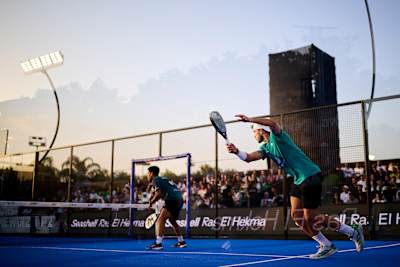
Galán performs a serve at the 2025 Premier Padel Newgiza P2 tournament
The FIP World Padel Report 2026 offers the most complete picture of this growth so far. The world now has more than 91,000 padel courts, almost 14,000 more than a year earlier, or nearly 40 new courts a day. The number of clubs grew by 3,890 in the same period, registered players rose by 30.5% to 1.11 million, and padel is now played in 191 countries and independent territories, 21 more than the year before.
Competition is growing even faster, from 290 FIP tournaments in 50 countries in 2025 to 434 events in 62 countries in 2026. For the first time, the report also measures the sport's economic weight, putting it at €8.6 billion in GDP, €6.84 billion in annual spending, and more than 235,000 jobs worldwide.
Padel's rise comes at a strong moment for racket sports in general. Tennis passed 100 million players for the first time, with the ITF's 2024 Global Tennis Report counting around 106 million people on court, a 25.6% increase in five years. In the United States, tennis participation reached a record 27.3 million in 2025, while pickleball grew 171.8% in three years.
09
How to watch Premier Padel on Red Bull TV
Red Bull TV broadcasts every Premier Padel match from the quarter-finals onwards, which means every match from Friday to Sunday.
Find more information on all tournaments, including ticketing, match schedules, current scores, player updates, and all the latest news on the Premier Padel website.
About the author
Javier is CMO at Siux Padel and a certified padel coach with deep roots in the sport, on and off the court. He previously led content and digital strategy at Babolat Padel. As a racket sports writer for Red Bull, he brings an insider's perspective on the players, events, brands, and trends shaping padel's global rise. He's also an avid player and one of the most active voices in the padel industry on LinkedIn