






Gaming
Esports
5 tips to improve your VALORANT game
There are many ways you can improve your game in VALORANT, but some methods are definitely more effective than others. Here are a few simple ways to improve your gameplay quickly.
If you’ve been playing VALORANT for a bit now and want to head into ranked play, you might be concerned you’re not good enough. Maybe you want to compete at Red Bull Home Ground. Or, perhaps, you just want to improve for the sake of improving. Whatever the reason, here are some simple ways to level up your gameplay quickly and effectively.
01
Pick a role and agents to suit you
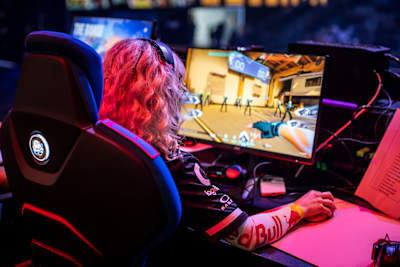
Get your agents lineup sorted and you'll be ready to dominate in VALORANT
© Fabio Piva/Red Bull Content Pool
There are four different roles in VALORANT you can play: Sentinel, Initiator, Controller and Duelist. While good gunplay is mandatory across all roles, each one also requires a specific gameplay style, so finding which of these styles best fits you is critical to getting better at the game. If you hate playing a Controller Agent, don't – you’re not going to play as well as you can if you really want to play an Initiator instead.
Here’s a quick rundown of each role and its basic playstyle:
- Sentinel: Agents that excel at holding down areas by themselves, often with traps that alert them about enemy flankers.
- Initiator: Agents who help their team gather information and enter sites through utility and flashes.
- Controller: Agents who take control of areas of the map using their abilities, usually smokes and walls, to force the enemy into unfavorable positions.
- Duelist: Agents who enter sites first (with the help of Initiators) to create room for their team and seek out early duels with the enemy.

Colve is THE Controller to have
© ©Gamosaurus
Try out each of these roles properly and start figuring out what you gravitate towards. Find two roles that you enjoy playing and then find the main Agents you prefer to play in those roles. After that, just keep grinding with those, changing roles whenever the team comp calls for it, and develop a proper in-depth knowledge of these styles so you can fully utilise them.
02
Map knowledge is winning knowledge
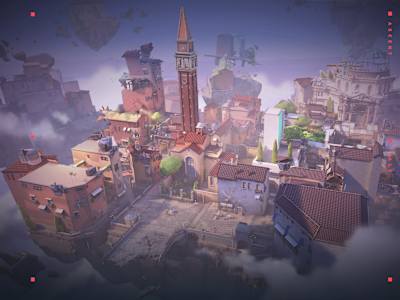
To master VALORANT, you'll first need to learn its maps
© Riot Games
Knowing the map you're playing on is going to be a critical part of getting better at VALORANT. It doesn't necessarily mean you have to pull up the map and study it – although you'll undoubtedly learn a lot doing that way - but it does mean you need to pay attention when you're unfamiliar with a map.
Part of knowing a map is knowing the various callouts players will use on that map. All maps will have callouts for things like 'A Main, B Short, B Long, Heaven, Hell and Link', but many maps have callouts based solely on that map. Below are a few examples of map-specific callouts. Knowing these will help you respond to callouts from your team-mates during a round.
Areas like Hookah, Art and Tree get callout names because it's one of the most efficient ways to relay enemy positions in a short period of time. While the developers may put a specific name on the map for an area, oftentimes the community name will stick. For example, Hookah is officially named Window on the mini-map, but everyone still uses Hookah due to an earlier version of the map having hookahs visible there. Many others get their names from a defining characteristic of that specific area that's easily recognisable.

Hookah is one of the attacker entrances onto B Site
© Riot Games

Art is how attackers will enter Pearl A site from mid
© Riot Games

Tree is one of the entrances to Ascent A site
© Riot Games
Part of improving is learning these callouts, because they are important parts of the map that you'll be dealing with every round. Hookah is the shortest route for attackers to take on their way to B Site from spawn and there will often be firefights there. Likewise, Tree is one of the two ways to get to Ascent's A site that's often used by defenders trying to retake a site. Understanding what your team-mate means when they say "2 Tree" or "They’re pushing Art" is vitally important to improving your game.
As you continue playing, you'll also start learning more about planting the Spike and the best spots for you to plant it in specific situations. Sometimes the default plant isn't the best option. For example, if you're low on health with an Odin, you might prefer to plant the Spike in a spot where you can shoot at it safely through the wall when the enemy tries to defuse it.
If you're playing Controllers or Sentinels, it's also important to learn the maps in regard to your abilities. Many Controllers and Sentinels have mollys, walls or smokes that require lineups or placements to be most effective. The same can be said of other Agents, but it's less important to know specific lineups for abilities like flashes.
03
Communication is key for ranked play

Karmine Corp competes in Red Bull Instalock
© Mark Roe/Red Bull Content Pool
With map knowledge covered, it's time to cover communication with your team. If you're going to go into ranked play, it's really important to get used to the idea of verbally communicating with your team. It's the fastest and most efficient way to get information to each other about things like enemy locations or health.
As you're learning to communicate, learn to be quick and concise. There are a lot of audio cues in VALORANT that can be missed if you're talking too much, so keep it short and to the point whether your team-mate is trying to clutch or with general callouts. Save the chatter for between rounds.
It's important that you realise the difference between relaying info – things like enemy hit for 101 – and calling out what you're going to do. Info callouts are usually about enemy positions and health while action callouts will be about abilities and your own movement. Letting your team-mate know that you're going to flash so they can enter – flashing in two – is a great way to improve teamwork and will help win rounds. Other action callouts can be:
- Go slow
- Flashing
- Ulting site
- Swinging wide
- Watching long
If you're not comfortable in voice chat, get used to typing out enemy health and using the ping system. The VALORANT ping system is mediocre without a lot of keybind customisation. However, they do offer quite a few useful pings like 'Watching here', 'Danger', 'On my mark' (which features a three-second in-game countdown) and such like.
Just remember, it'll be very easy for your team-mates to miss the pings (or your text updates) if they're concentrating on clutching, so it's not the best alternative to voice comms.
04
Crosshair placement
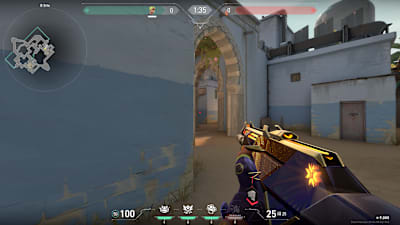
Good crosshair placement is key
© Riot Games
As we said earlier, good gunplay is the most important thing in VALORANT. So, if your crosshair is always in a bad position, you're going to struggle to get better and rank up. Good crosshair placement can be defined by looking at two main points:
- Aim at head level.
- Aim at where the enemy is likely to be.
Having good crosshair placement while moving, holding an angle, or in a firefight is really important. As you pay closer attention to your own crosshair placement, you'll notice it probably drifting downwards as you move around the map. Learn to correct this and you’ll be able to take on those sudden fights when you're flanking more often. Below you can see good crosshair placement that will likely result in a headshot or a favorable trade.
In the image below you can see what bad crosshair placement looks like. You'll notice that the gun is aimed slightly downward toward where the waist and legs of an enemy would be. If you hit an enemy in the leg, they take the least amount of damage possible. A chest shot is standard damage, while a headshot is critical damage.
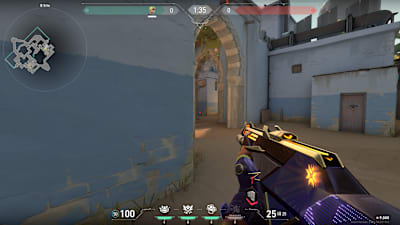
Bad crosshair placement will hold you back
© Riot Games
There are a few ways you can improve crosshair placement. One is to consciously remind yourself (or have a friend do it) while you're playing. The other is to spend time specifically practicing this. You can practice in The Range against bots, or you can use third-party tools like Aimlabs to practice with moving targets on the actual maps.
Tools like Aimlabs are especially useful, because they'll set you up to practice at common angles on the maps in VALORANT to help you build muscle memory.
05
Watch the pros, but don't copy

meL is a VALORANT pro to watch
© Mark Roe/Red Bull Content Pool
Watching professional VALORANT, or even your favorite streamer, can be a great way to learn new things about the game and how to play with a team or your favorite Agent.
Remember you're not a pro, though, and don't have pro team-mates either. Trying to execute some of the complicated plays pros do is a recipe for disaster at most elos. However, while you might not be able to execute some of the brilliantly coordinated team plays seen in professional matches, there are still many things you can learn by watching pros and streamers.
For example, professional Gekko players started throwing Dizzy straight up when on defense on Lotus behind waterfall to safely scout C and recover Dizzy, instead of throwing Dizzy out through main and not being able to recover her safely. Pros may also have new lineups or ways to take space on a map, which are great ways to level up your own game.
You'll also see pro players pre-firing as they come around corners. This is a good habit to bring into your own gameplay, especially if you're clearing corners dry (without using any utility). As you go around a corner, you fire off a shot at where the enemy would be. You're hedging your bets when you do this, because you're making noise, but it can pay off big-time if you guess correctly.
06
The random things to know
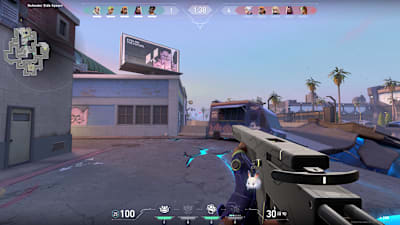
Be prepared to turn the corner already firing
© Riot Games
First, try different guns in the firing range or deathmatch to figure out what you're comfortable with. Many people prefer using the Ghost over the Classic and Sheriff as its cost allows them to have a more powerful weapon in the pistol rounds and a piece of utility. The Ghost's damage is also high enough to kill on headshots, whereas the Classic's is not. While the Sheriff also allows for a kill on headshots, the limited ammunition, slower fire rate and higher reliance on good aim make it less than ideal for many.
It's also good to learn which weapons are good for which sites and maps. A map with a lot of tight angles and potential close-quarter combat might be a good candidate for a shotgun, while B long on Pearl would be a terrible candidate.
Secondly, watch your own gameplay. While there's no official replay system for VALORANT, you can use third-party tools like Outplayed, or simply record your game with OBS. It will be easier to identify your own mistakes or triumphs on playback.
Third, play with your team. VALORANT is a team game and the most common mistakes at lower elos are going in one-by-one against an enemy and everyone dies to that single enemy. If you have a numbers advantage, use it. Attack the enemy at the same time and hopefully from different angles. If you killed the enemy Spike carrier and the enemy has to come to you to get the Spike, play together around it. Don't go hunting for kills alone.
Finally, don't ego peek. We can guarantee they're waiting for you and they’re going to win, like they did the last three times you ego peeked in the same spot.
