
Tennis
Ace your serve: the techniques every tennis player should know
Master the fundamentals of a great tennis serve, from the ball toss and body position to power and placement, with tips to build confidence and gain an edge on court.
The serve is one of tennis's most dangerous weapons. Players who can combine power and accuracy can not only win points outright but also force weak returns and immediately put opponents on the back foot. Add in variation, and the serve becomes a major advantage on any surface.
Throughout the modern era, there have always been serve specialists. Pete Sampras utilised pinpoint accuracy, John Isner possessed unmatched power and Serena Williams combined power and placement. Today, Matteo Berrettini's serve is one of the most powerful and distinctive weapons on the ATP Tour. Similarly, Jakub Menšík picks up lots of easy points with his serve and across 2026 averaged more than 11 aces per match.
But serving well takes more than just raw power. Technique, timing, placement and consistency all play a crucial role. Here's how to serve in tennis, from mastering the ball toss to developing a delivery that can put your opponent under immediate pressure.


01
Understanding the basics of serving
To the unfamiliar, serving looks like simply throwing the ball up and hitting it with your racket. In reality, so many factors influence whether the ball makes it over the net and into the service box on your opponent’s side.

Matteo Berrettini has a fastest serve of 146mph
© Gabriele Seghizzi / Red Bull Content Pool
It might look like your arm is doing most of the work, but serving is truly a full-body effort. If you want a powerful serve, you need to move fluidly from head to toe to generate momentum. As you practice, you’ll learn how to control your serves so you get exactly the level of force you’re going for.
02
Tips for effectively serving
First and second serve:
The ability to subtly adjust your serve technique comes into play in a major way between your first and second serves. Namely, with every point in a game, a server gets two chances to hit the ball. In the tennis scoring system, the first serve means no fault has occurred and no points have been awarded.
You’ll want your first serve to have the maximum impact so this is where power and placement is important. If you can hit your serve with speed and accuracy, then you will gain a major advantage.
It’s the opposite with your second serve, though, which happens when you’ve already faulted once and are in danger of losing a point. The second serve is more about control than power.
Players often use more spin because it offers a greater margin for error than a flat, power-driven delivery. Topspin helps the ball dip quickly over the net and bounce higher, while slice can pull opponents wide. This allows players to serve more aggressively while reducing the risk of hitting the ball long or into the net.


03
Grip and stance
How to hold the racket:
The grip you use can make a big difference to your tennis serve. Most coaches recommend the continental grip, sometimes called the “hammer grip”, as it allows you to generate power and spin while keeping your options open. To find it, hold your racket as if you were shaking hands with it. If you’re right-handed, your index finger’s base knuckle should rest on the second bevel of the handle; if you’re left-handed, it should rest on the eighth bevel.
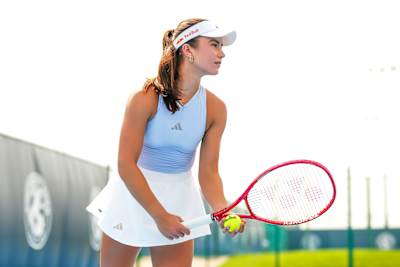
Rising American star Iva Jovic uses a fluid, high-toss service motion
© Emilee Fails/Red Bull Content Pool
Some players, including Venus Williams, have used an eastern grip when serving. This can feel more natural for some players, particularly beginners, but the continental grip is generally the best choice for developing a versatile serve.
As you prepare to serve, avoid holding the racket with its strings facing flat towards the court. Instead, keep the racket more on its edge. This helps you get into a position to swing up towards the ball and develop a more effective serving action.
How to position the body:
A good serve starts with a balanced stance. Stand behind the baseline, side-on to the net, with your front foot angled towards the net post on your hitting-arm side. Position your back foot roughly parallel to the baseline, keeping your feet about shoulder-width apart for stability.
There are two common serving stances. In a platform stance, your feet stay in place throughout the serve. In a pinpoint stance, you bring your back foot forwards towards your front foot as you prepare to hit the ball. If you’re a beginner, start with the platform stance to focus on balance and technique before experimenting with foot movement.
Whichever stance you choose, keep your knees slightly bent and your weight balanced. This will help you push upward into the serve and generate power through your legs and body.
04
Serving mechanics
Once you have established your stance, focus on your ball toss and racket position. Hold the ball gently in your non-racket hand, keeping your arm relatively straight as you raise it to toss. Meanwhile, bend your racket arm and bring the racket back into position behind you. Keep your body turned sideways to the net as you prepare to swing, helping you build power before rotating towards the ball.
Although a tennis serve looks like one fluid movement, it can be broken down into several stages. First, bring your racket back as you prepare to toss the ball. As the ball rises, drive your racket upwards and make contact at full reach, slightly in front of your body. Then follow through naturally across your body, allowing your forearm to rotate as you swing.
A smooth, controlled backswing is essential for an effective serve. It helps coordinate your arm and shoulder movements, allowing you to transfer energy into the ball. Rather than forcing the racket through the motion, focus on good timing, relaxed movement and a consistent ball toss.
The toss:

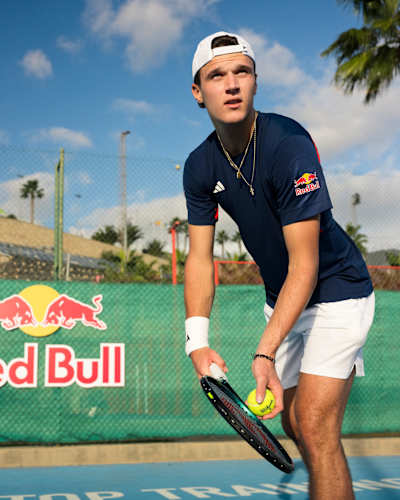
Flavio Cobolli utilises heavy spin to dictate points on serve
© Gabriele Seghizzi/Red Bull Content Pool
A good serving toss is all about consistency. You want to make contact with the ball at roughly the same height and position each time. Hold the ball gently on your fingertips rather than gripping it tightly, then raise your throwing arm smoothly and release the ball as your arm extends.
The ideal ball toss height depends on your technique, but it should rise high enough to give you time to swing and make contact at full reach. Avoid tossing it too low, which can rush your swing, or too high, which can make timing more difficult. Aim for a controlled, repeatable toss that lets you strike the ball comfortably in front of your body.
05
Common serve faults and how to fix them
If your serves aren’t landing where you’d like, try some serve troubleshooting to figure out which part of your fluid motion is off the mark. Here are some common mistakes to watch out for when learning how to serve.
- Losing control on the toss. Maintaining consistency is key to avoiding serves that go into the net, resulting in double faults. A lot of new tennis players bend their arm on the toss, but this is a surefire way to sacrifice accuracy. It’s also common for new players to get a hitch, tossing the ball so high you’re waiting too long for it to come down.
- Focusing on the toss, not the swing. A consistent ball toss is important, but it’s only one part of a good serve. Practise bringing the toss and swing together in one smooth, coordinated movement. This will help you improve your timing, make cleaner contact with the ball and develop a more reliable serve.
- Opening your upper body too soon. Open shoulders means less control, and if you do this too soon, your serve may not go in the right direction. Don’t open your shoulders until the last possible moment in your swing.
- Making contact on the wrong side of the ball. Where you make contact with the ball affects the direction and spin of your serve. If you want to serve out wide, you’ll need to adjust your contact point and racket angle to direct the ball towards the side of the service box. Practise changing your contact point and racket path to develop better control over the direction of your serve.
Watch some of the best tennis players in the world

06
Practicing your serve
A few drills can improve your serve. If you do these regularly, you’ll see positive effects on the court in each match:
- Serving from different distances. If you want to work on your serving power, try standing a few feet behind the baseline during practice. This can help you focus on generating racket speed and hitting the ball cleanly. However, make sure you also practise from the baseline so you can develop a consistent serve from the position you’ll use in a match.
- Set up a target. If you’re struggling to land your serves in the opposite service box, start by aiming for a larger target area before working on accuracy. You could use a cone or another visual marker to give yourself a clear focus. Once you’re consistently getting the ball over the net and into the service box, try aiming for smaller targets to improve your placement and control.
07
Strategies and variations
Here are some other types of serves that can help you surprise your opponent and improve your game, depending on what’s happening in your match:
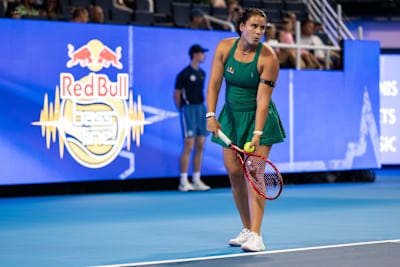
Emma Navarro has a powerful and efficient serve
© Grant Moxley/Red Bull Content Pool
- Flat serve. This involves hitting the ball with relatively little spin, allowing you to generate high speed and put your opponent under immediate pressure. It’s a popular choice for a first serve, when players can afford to take more risks in search of an ace or a weak return. However, because the ball has less spin to help it dip into the service box, accuracy is crucial.
- Slice serve. This uses sidespin to make the ball curve through the air and move sideways after it bounces. To create this effect, brush the racket across the side of the ball as you make contact. A slice serve is useful for pulling your opponent wide of the court or forcing them to return the ball from an awkward position.
- Kick serve. Combine topspin and sidespin to make the ball bounce high and kick sideways after landing. The extra spin helps the ball dip into the service box, giving players more margin for error. This makes it a popular choice for second serves, although it can be less direct than a flat serve and give opponents more time to react.
- Underhand serve. Unlike a traditional overarm serve, this involves swinging the racket forwards from below shoulder height to hit the ball. It can catch an opponent off guard, particularly if they are standing well behind the baseline. While it is less common than an overarm serve, it is a legal option in competitive tennis.
08
Start your game right with a strong serve
Mastering the swift, fluid motion of a tennis serve takes a lot of practice, but with enough time, it’ll feel second nature. Practice each component of your serve together so that it all flows perfectly on match day. If you want to show your opponents who they’re up against from the start, a powerful serve is a must.