


Fitness

Fitness Training
Fitness: New research reveals the smartest ways to train for HYROX
Discover why HYROX isn’t just a test of brute force – it’s a race engineered around human physiology. Energy management, pacing strategy, recovery and more, learn how to maximize your effort.
HYROX is rapidly evolving into one of the world’s most demanding hybrid sports, blending endurance, strength and skill.
Recent research is helping athletes and coaches understand what really drives performance, and the results give us a clear direction for smarter training.
Key HYROX training takeaways from research
This is what the research says from two recent studies, Brandt et al. (2025) and Davids (2025):
- Aerobic capacity is king. Brandt’s findings showed that VO2 max and endurance training volume are strongly linked to faster finish times, while grip strength and overall muscle mass were not reliable predictors. HYROX is best understood as an interval-based endurance sport.
- Transitions matter. Both studies highlighted that the time between stations and runs separates top performers from the pack. Movement economy and pacing are as critical as raw fitness.
- Strength is specific. Davids emphasized that not all strength is equal. Maximal power matters most for HYROX-specific stations like sled pushes, pulls and burpee broad jumps, but must be balanced with muscular endurance.
- Technique under fatigue. Mechanical efficiency and maintaining form and movement quality when tired proved to be a decisive factor across both studies.

HYROX competitors hit the rowers
© HYROX
01
Why aerobic capacity drives HYROX performance
Building aerobic capacity should be the performance foundation for every HYROX athlete. The research makes it clear: endurance training volume and VO2 max are the strongest predictors of success. Without this base, other elements of performance will struggle to hold up across the long grind of a race. This being said, further research is required to substantiate this and provide more specificity. Due to the extended high intensity demand of HYROX, it is, however, logical to consider that despite a high VO2 max being useful, what really matters is how much percentage of VO2 max an athlete can sustain for an hour's worth of effort.
How transitions affect race results
Equally important is training transition speed and pacing strategies under fatigue. The time lost moving between runs and stations adds up, and the best athletes know how to manage these moments with efficiency. Practicing transitions and learning to regulate effort under pressure can make the difference between a personal best and a plateau.
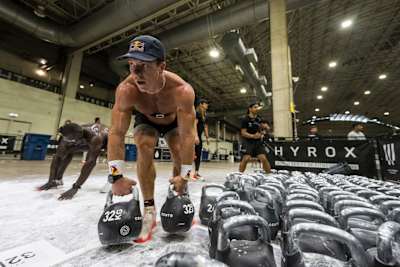
HYROX is a real test of your mental toughness
© Christian Pondella/Red Bull Content Pool
The role of HYROX-specific strength
While endurance leads, athletes cannot neglect HYROX-specific strength and local muscular endurance. Movements like sled pushes, pulls and carries demand targeted strength, but must be trained in a way that complements, rather than compromises, overall endurance.
Maintaining technique under fatigue
Finally, athletes should always prioritize bio-mechanical technique and movement economy. Maintaining form under fatigue not only protects against injury but also preserves energy, allowing for sustainable performance across the entire race.
HYROX isn’t just about how hard you can train, it’s about how smartly you prepare. Science is catching up with the sport, and the athletes and coaches who use it are the ones setting new standards.
02
Science-backed HYROX training tips
Top tip 1: Build your engine
Studies by Brandt et al. (2025) and Davids (2025) demonstrate that aerobic capacity (your heart, lungs, and endurance base) is one of the strongest performance determinants of HYROX success. That means consistent cardiovascular conditioning, zone 2 training, specific HIIT training and progressive endurance blocks are non-negotiable.

HYROX competitions pull in athletes of all ability levels
© Baptiste Fauchille/Red Bull Content Pool
Top tip 2: Nail your transitions
Every second matters moving from runs into stations. Davids (2025) highlighted that athletes who manage pacing and recover quickly between segments consistently outperform others. Practice smooth transitions in training and learn how to regulate your effort under fatigue.
Top tip 3: Train HYROX-specific strength
Not all strength carries over. Sled pushes, sled pulls, and carries are uniquely demanding. Prioritize local muscular endurance and race-specific strength work rather than chasing maximal lifts.

Preparation for HYROX training and competition goes beyond the workout
© Leo Francis/Red Bull Content Pool
Top tip 4: Prioritize technique under fatigue
Movement efficiency is key. Poor form wastes energy and slows you down, especially in later stations. Drill skills when you’re tired to prepare for race conditions.
Keep in mind: Build the base, master the details and remember: progress is your victory.
About the author
