HYROX training guide: Expert tips on strength, mental toughness and fueling
HYROX amateurs, coaches and pros weigh-in on what it takes to succeed, whether you’re signing up for your first race or aiming to one day take a shot at a pro career and the World Championship.
Typically, it starts with AC/DC’s Hell’s Bells and 15 athletes lined-up at the start line, under the eyes of the expectant crowd. In seconds, they'll be running flat-out, racing through a fitness course compromised of everything from sled pushes to burpees and rowing in a quest to be named the HYROX champion of their class.
HYROX has been around since 2017, and has rapidly become a global phenomenon. The 2024–25 season sees events on five continents, with more than 650,000 participants competing in 40 races from London to Cape Town. Which means there's a huge appetite for it, and, that you’ve probably thought about signing up yourself.
We spoke to amateur athletes, coaches and some of the biggest names in the sport to help you through the key tenets of HYROX training, from keeping your engine fuelled to how to burst through those lactate thresholds and, throughout it all, how to keep your head calm under pressure. Here’s what you need to know.
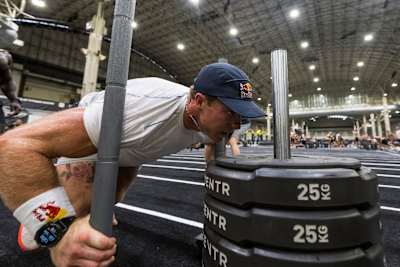
Noah Ohlsen pushing his limits at the Hyrox World Championship2025
Tommy Hatto is the epitome of a HYROX novice, having run two British races in the last year. "I've managed just under 1h 28m and I'm really happy with that," he says. "I'm new to the sport and loving it."
Hatto is the prime example of how accessible HYROX is, even for people with little to no background in fitness races. His progress also shows how rapidly one can develop a training plan to help themselves progress. For him, the basis is compound lifts – exercises most gym goers are familiar with, even if they’ve never heard of HYROX.
"I'll have days when I'm focusing on strength, so I'll do compound exercises like squats, military press and bench press. It'll be purely for strength building,” he says.
Although not directly translatable to specific HYROX stations, Hatto says this accessible general strength training is "helpful to really build strength."
Functional strength training is a vital element for most HYROX competitors
The one common element that ties the blocks together is compound lifts
HYROX age group world champ Samantha Bilbie
He even creates a sort of hybrid HYROX drill, adding runs in between reps in the compound lifts. As he gets closer to competition and his base strength is established, he'll swap compound lifts for practising specific HYROX stations.
"Practicing compound lifts builds the foundation of my fitness. As I get closer to competition, it's about putting my strength into practice by switching to focus on the eight movements from the actual course," he says.
Practicing compound lifts builds the foundation of my fitness
HYROX newcommer Tommy Hatto
The Coach
Pro level coach Lauren Calvert, who teaches athletes including Gabriella Moriarty, says your strength training should be "anchored around the priority."
"If competition is coming up, lactate tolerance [more on that below] and race-pace work take precedence. In an off-season block, strength and aerobic capacity get more attention," she says. As will lifting weights and building your muscles: "Strength training, especially heavy lower body, should be placed at least 24–48 hours away from your most demanding lactate sessions to avoid compromised output and recovery."
For example, Calvert's clients might have heavy squats, lunges and plyometric training on Tuesday morning and a track training session on a Wednesday evening, leaving 24-36 hours between the two.
The Pro
At 48-years-old, Samantha Bilbie is a coach and HYROX Age Group European and World Champion (in which athletes from different age groups compete against each other) in 2023, 2024 and 2025. She's also a four-time HYROX age group world record holder. For her, success comes down to timing.
"Strength training in the off-season looks very different to strength training in the competition phase," she says. "I keep the elements separate in the early months to build solid foundations and maximal strength using low reps at high intensity with lots of rest between sets."
Like Hatto, she's also a fan of big, heavy lifts to build a solid foundation: "The one common element that ties the blocks together is compound lifts. Just prior to a race, I mix it up, using a method that mixes heavy lifts with fast, lighter lifts, HYROX specific moves and running."
Remember, HYROX is a race. Which means speed is important. Here’s how to get a move on.
The Amateur
"Plyometric work is very overlooked," says Gabriella Moriarty. "It will help to you get faster, especially single leg movements like hopping and fast feet movements like box jumps and bunny hops."
In terms of mental speed and coordination for things like wall balls, Moriarty recommends simulating specific stations in training. "Putting time constraints on certain stations like sled pull and push really improves my sharpness," she says. Routine and diet really keep me mentally sharp, too. I'm like a metronome and I love training."
HYROX is a race so speed is key, especially in the 8 runs
Running on fatigued legs is one of the toughest challenges. Transitions are where seconds become minutes if you're not prepared
HYROX coach Peter Sjöberg
The Coach
Peter Sjöberg, is a HYROX coach from Sweden. He knows that "running on fatigued legs is one of the toughest challenges in HYROX" and that "Transitions are where seconds become minutes if you're not prepared or have poor pacing."
Daniela Weber, a HYROX athlete and coach leading the community at King Kong Club in Salzburg, Austria, adds that focusing on your weaknesses first is the key to HYROX success. With HYROX being a hybrid sport combining running and weighted movements, it's common for athletes to have a preference in one area. For some, this might mean running is their weakness and they may not train it as often.
"Generally, people stick to what they’re already good at and neglect the rest,” says Weber. So, especially if running isn't your strong suit, you need to make sure you give it extra attention. "Turning weaknesses into strengths can bring huge progress."
Sjöberg has some additional advice: "The most effective way to prepare is through brick-style workouts, where you alternate between running and HYROX stations in repeated sequences. For example: 800m run – 20 wall balls – 800m run – 25m sled push. This style of training not only conditions your body to handle compromised running, but also teaches you how to manage your breathing, control heart rate spikes and hit each station with efficient technique, even under heavy fatigue."
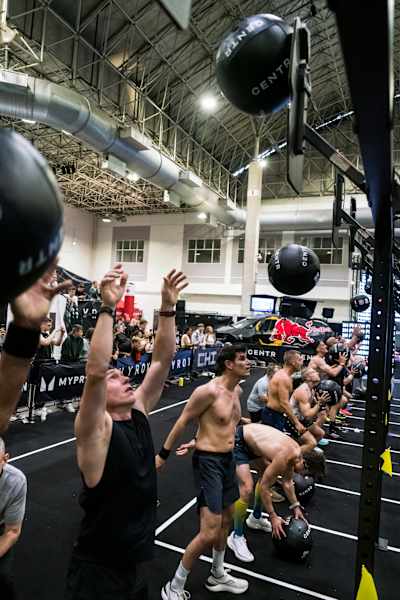
Stations like the Wall Balls also require speed and sharpness of movement
Generally, people stick to what they’re already good at and neglect the rest. So, especially if running isn't your strong suit, you need to give it extra attention
HYROX coach Daniela Weber
The Pro
With a background in running, Bilbie knows what it takes to close the gap between you and the competition. "I programme all of my clients primarily as runners," she says. Track sessions involve the following drills:
A Skip - to improve knee drive and foot position.
B Skip - to improve leg extension and hip mobility.
Butt Kicks - engages the hamstrings and promotes turnover.
High Knees - develops hip flexor strength and reinforces foot position.
Plyos - frontal and lateral single leg hops.
Strides with walk back - running fast for 50–60m with good form.
Lactic tolerance is a cornerstone of any sport. When we push ourselves during exercise, our bodies can move from aerobic respiration, in which there’s plenty of oxygen reaching our cells, to anaerobic respiration where we don't get as much oxygen as we need. A side effect of this is painful lactic acid build-up.
You’ve probably experienced this in the form of a 'stitch'. Whether you're a footballer, swimmer or HYROX athlete, giving it your all means dealing with lactic build-up at some point. Getting used to this, or delaying its onset might give you a competitive edge.
The Amateur
Moriarty says this preparation is key. "Nothing should surprise you on race day, which is why a lot of my sessions are spent wading through lactic acid. Confidence in racing is down to the fact I've survived lactic sessions and pushed through it," she says.
In other words, you just have to knuckle down and get through it, while reminding yourself that you've survived once and can survive again.
"The tough training sessions are all part of the process of being an athlete," she says. "They are sent to test us. I know that when it's hurting that's when I have to focus and give it everything. I remind myself that pain is temporary and the result of digging-in is forever rewarding."
Managing the pain of lactic acid build up is all part of the game
"HYROX is essentially a long, sustained effort with spikes in intensity," says Sjöberg. "An exceptional aerobic base allows an athlete to keep heart rate under control, recover between stations and sustain pace over the eight runs and eight stations. Without it, fatigue compounds quickly."
Again, it’s down to practice. "Functional strength endurance is the key," he says. "You don't just need to be strong, you need to have muscular endurance. The athlete who can keep moving under load without burnout wins."
The Pro
Bilbe loves to train just below and just above her lactate threshold throughout the pre-season. "Threshold training is crucial for HYROX," she says. "The frequent exposure teaches our bodies to better tolerate and clear lactate, as well as enhancing our ability to maintain higher intensities for longer periods."
Try this:
A.M.
Warm up: Run 10 minutes easy.
Session: Run 20–30 minutes right around your lactate threshold, consistent effort.
Cool down: Run 10 minutes easy.
P.M.
Warm up: Run 10 minutes easy.
Session: 6-10 x 400m working at top end threshold into VO2 max with 60-90s rest between rep.
Cool down: Run 10 minutes easy.
Endurance is every bit as important as strength in HYROX
"You don't just need to be strong, you need to have muscular endurance. The athlete who can keep moving under load wins
HYROX coach Peter Sjöberg
04
Mental grit
Finally, the key thing that will help you keep moving is remembering that it's all in your mind. Your determination, that is. Here's how you can keep your head in the game.
The Amateur
As a newcomer, Hatto keeps on track by breaking training and races into individual stations. "I say to myself, 'OK, I just need to commit to finishing this station right here', and that helps me focus on my movement,” he says.
"I personally think that when I'm too caught up on how far away from finish I am, that hinders my psyche," he says. "I also visualise the results or the times I want in the weeks leading up to an event. I want to make sure I'm going into each session thinking like an athlete and those thoughts or mantras stay with me the entire time."
I might be in pain for an hour, but it isn't life or death. I tell myself, ‘Push through, that's your job
For Bilbie, staying strong is all about getting comfortable being uncomfortable. "We expose ourselves regularly to discomfort in training to simulate that race day feeling, but most HYROX athletes will still experience negative internal chat at some point during their race," she says. "How you manage the mind will have a significant impact on your race day performance."
"Throughout I’m thinking ‘A few more reps and I'm on to the next station’"
"If I ever freak myself out during the race, it helps to refocus and take stock,” explains Elite 15 racer Lucy Procter, a HYROX World Champion in the 16-24 age category. “Throughout, I’m just thinking, 'A few more reps and I'm on to the next station', talking myself through it as I go.'
When a station doesn’t go well, she gives herself a little pep talk, reminding herself to focus and stay calm: "I might tell myself, 'That was hard, or I didn’t move as well as I would have liked to there, but keep going.'"
"If you want to be the best, you have to make sacrifices," adds Elite 15 stalwart and Men's Doubles World Champion Jake Dearden. "There's very little balance. Your number one priority must be HYROX. If you want to become the best, you have to surround yourself with the right people to support that.
"I have to run my own race," Dearden adds of his mindset during events like the World Championships. "When I'm struggling, I think of the effort that everyone has put in to get me on that start line. The people in the crowd who’ve travelled to be here. I might be in pain for an hour, but it isn't life or death. I tell myself, ‘Push through, that's your job.'"
For Gabriella Moriarty, a HYROX Mixed World Champion, keeping her engine ramped up is all about smart decisions pre-race, with a long-term aim to transition to ketosis – in which the body is trained to burn fat over carbs as a primary and more efficient fuel source.
"I rely on carbohydrates, healthy fats and protein," she says. "My fat intake is a lot higher than it's ever been as my coach is keen for my body to start utilising fat stores as energy, which has made a massive difference to my training. On race day I stick to bagels and oats in the morning."
It isn’t all strict. "After a race I'll head out for a pizza, my guilty pleasure," she says.
The Pro
It turns out, diet doesn’t differ much across HYROX classes, as Procter explains: "On race day, my diet is pretty much porridge, bagels and jam – preferably strawberry. I try to get just 400 grams of carbs, all things that are really easy and quick to digest. Protein is not something I'm focused on and I like to keep the fats low. I don't tend to carb-load. A lot of people do, but personally I haven't found it to be a huge benefit."