




Breaking
Breaking
How Seattle built a breaking legacy: Red Bull BC One Cypher
Inside Red Bull BC One Cypher Seattle, the style, community, and lineage that define the scene.
Part of this story
Defined by a communal philosophy, the Seattle scene believes that understanding where the art form comes from is inseparable from knowing how to move it forward. As Red Bull BC One Cypher Seattle approaches, that philosophy feels especially present, rooted in how breaking first landed in the city.
B-Boy Fever One, leader of Seattle's DVS Crew, learned from Icy Ice of the New York City Breakers and brought those teachings back with him to the Pacific Northwest. Away from the noise, the eyes, and the coastal scrutiny, a style rooted in philosophy had room to grow into something that was entirely its own.

Jeromeskee of Massive Monkeys competes at Red Bull Lords of The Floor
© Little Shao / Red Bull Content Pool

B-boy Buckshot competes at Red Bull BC One Cypher in Boston
© Kien Quan / Red Bull Content Pool
Learn about Red Bull BC One
As hip-hop and breaking spread through the city, the 90s became a period of growth with distinct local crews forming and finding their own style and voice. Circle of Fire emerged in 1997, breaking not just to hip-hop but also to house, techno, and whatever music moved them. Then came Massive Monkees in 1999, who took the foundation DVS had laid and the creative fearlessness Circle of Fire had modeled and slowly began building a cultural footprint.
When Red Bull Lords of the Floor arrived in 2001, it became one of those moments the culture doesn't forget. Held in an abandoned Seattle airplane hangar, it brought the country's best crews onto a stage unlike anything the scene had seen: grandstand seating, production worthy of the talent, an energy that competitors would later describe as gladiatorial. As the footage spread around the globe via VHS and DVD recordings, Seattle cemented itself as a marquee city in the global break ecosystem.
Today, Seattle’s legacy is recognized locally and globally with the City of Seattle even declaring April 26 as the official Massive Monkees Day in 2004. As the Red Bull BC One Cypher returns to Seattle on May 25, 2026, the city is ready to do what it has always done: show up, show out, and show the world what the scene has been building.
We caught up with two locals ahead of the competition: JeromeSkee, Massive Monkees co-founder and certified Olympic breaking judge, and B-Boy Buckshot, a South Seattle native stepping onto the Red Bull BC One stage in his own city for the first time.
01
JeromeSkee: Building Seattle’s breaking scene
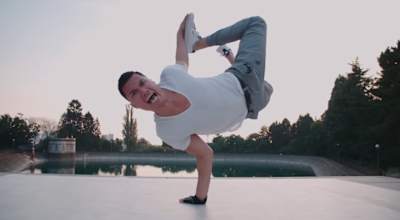
JeromeSkee of Massive Monkees
© LEVY
You co-founded Massive Monkees in 1999 and have been at the center of this scene ever since. For people who don't know Seattle breaking: why does this city have its own identity, and where did it come from?
We were very fortunate to learn from our pioneers, which is DVS Crew by way of Fever One. Fever One learned from Icy Ice of the New York City Breakers. They went to high school together, so he learned the essence of the dance, the framework, the foundation. DVS understood that hip-hop was about learning the foundation and then elevating it with your own style and originality.
Seattle became super unique because they weren't New York - but they understood and respected the art form by making it theirs. Then Circle of Fire came onto the scene. They were getting hated on because they weren't coming with a traditional philosophy of breaking, but instead were mixing house, different dance styles and evolving the dance in their own way. We as Massive Monkees had so much respect for them. We kind of fed off each other.
That lineage is such a big part of what makes Seattle distinct. As a judge for the Red Bull BC One Cypher this weekend you’re sitting on the other side of the floor, what are you actually looking for when you watch someone battle?
You can have all the tools you want, top rock, footwork, freezes, drops, power moves, but what makes it magical is how you do it. Your style. How you maximize those tools in that moment, at that time, with the music and the energy. Style is not just foundation. Style is everything. It's within how you rock your moves.
So when you're watching someone who individually melds all these tools, what actually pushes them from great to world-class in your eyes?
It's the people who add to the dance. Those who bring their own personal style, something new and refreshing. When you see someone truly expressing themselves with their own signature moves and style competing at the highest level, but doing it just slightly differently. Or they're in flow state with the music, creating in the moment, which is very hard to do. Boom. That's the separation from good to outstanding to world championship level.
Beyond this weekend, Massive Monkees has built something much larger than a crew, from The Beacon Studio and Body Language Studio to youth programs across the city. Where is your focus now, and what does the next chapter look like for this scene?
The next generation is the key right now. Through our nonprofit Breaking Boundaries, we lead breaking programs and community building workshops at elementary, middle, and high schools. We also have the Massive Break Challenge, which works differently from your standard elimination competition. It's an exhibition style format where kids are matched by experience level, so a kid with one year in the game battles another kid with one year in the game, two rounds, and they get celebrated for what they bring.
The focus is always the next generation while bringing the community together, elevating the scene, and celebrating it at the same time. The joy and the heart the youth bring to the dance floor reminds us all what this dance is about.
02
B-Boy Buckshot: The next generation of Seattle breaking

B-Boy Buckshot makes his Red Bull BC One debut in Seattle
© Courtesy of B-Boy Buckshot
Breaking was my way to channel my inner child.
You're born and raised in South Seattle, how did breaking find you, and what was it about this city's scene that pulled you in?
My journey in breaking started when I was in sixth grade, through an after-school program at Aki Kurose, a middle school in South Seattle close to my house. Both classes, the breaking and the popping, were instructed by two members from the Massive Monkees. And then for some reason the popping class got cut. So it was just breaking. Breaking was my way to channel my inner child. I was crazy as a kid.
You mentioned Jefferson Park as a place you pulled up. What were those early sessions actually like?
After the program ended they had practice sessions on Mondays, Wednesdays, and Fridays at Jefferson Park. My dad would take me, and I'd just be flipping across the whole practice. I had no spatial awareness. Everyone would be so upset — "Bro, what is this little kid doing back handsprings from here to here? Stay in your corner." But that's where my energy was channeled. Breaking was like my therapy.
In 2022 you made your first trip to Europe to compete. Alone and on a shoestring. What did that experience open up for you?
It was 11 days. I backpacked with about 400 euros to my name. I went to Outbreak in Slovakia and IBE in the Netherlands. Being there, seeing B-boys I'd been watching on screen, getting to meet them, interview them, exchange with them. It shifted something. The scene was bigger and more connected than I'd understood.
Going to Europe and seeing the breaking out there, seeing the level they're at motivated me to come back to my own city and work hard. Do my push-ups, do my pull-ups, and do all the workouts to build these muscles to do these kinds of moves.
That trip clearly shifted how you see yourself in this culture. How would you describe your style and what you're bringing to the Red Bull BC One Cypher floor this weekend?
Very unorthodox. I'm not scripted. My game plan can switch within a split second based on what song plays, what's going on in the room. I'm very funky because I like to really dance, but I also got some blowups, and I do a lot of stuff on my head. You might go in with plan A. But if plan A doesn't work out, there are 26 other letters in the alphabet.
You mentioned you passed on Red Bull BC One in Seattle once before because you didn't feel ready. What's different this time?
I didn't feel like I was ready. I wanted to give myself a fair chance. Now I really feel like, all right, I've been working. I know what my strengths are, I know what I needed to work on prior, and that's what I've been working on. My family's going to be there, my friends are going to be there. I can't wait to just go out there and show everyone why I deserve a win.
Part of this story
