
Dance
The Historian on the dance floor: Harini Nilakantan
How Harini Nilakantan brought a 1,500-year-old form to a Red Bull Dance Your Style stage.

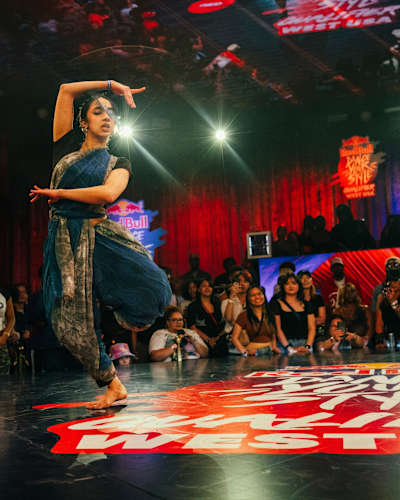
Deep in a Las Vegas club, under a wash of red light and a forest of raised phones, Chicago-based dancer, Harini Nilakantan steps barefoot onto the Red Bull Dance Your Style stage. As her saree catches the light, the opening synths of "Poison" peel through the room.
She plants. She listens. Then she moves, all flow and rhythm, the bass climbing through her soles into her spine. Bharatanatyam dissolves into freestyle then into footwork then back again before the crowd can decide what it's watching.
What was supposed to be one battle round became something else: a forty-million-view discourse about a 1,500-year-old form, what it's allowed to look like, where it's allowed to live, and who's allowed to move it forward.


As the clip traveled from phones in the crowd to the Indian evening news, Harini's following moved with it: 380K to 700K in a matter of weeks. The comments came in equal volumes of admiration and condemnation, the way they tend to when someone plays with history.


Purists will always take a stand. And Harini is always playing with history. She's dedicated her life to learning the dance forms around her, their origins, their lineages, their rules, not to replicate them, but to translate between them. What she creates in that space is Indian fusion, a type of collage in motion where distinct vocabularies converge, held intact by a single fluent voice.
I'm a permeable membrane, I'm not a box.
Originally from Chennai, Harini (she/they) has been dancing since she was four - not by design, but by instinct. She'd watch her cousin, five years her senior, practice in their shared neighborhood in Bangalore and mimic whatever she saw. Her parents, clocking the passion, set her up with the same guru as her cousin, Guru Smt. Sujatha Raghavendra. In the classical Indian arts, a guru is more than a teacher. They don't just transmit technique; they transmit lineage, interpretation, aesthetic identity. Who trained you, and who trained them, is part of your artistic biography.
To share a first guru with her cousin meant Harini entered the form through the same door, into the same unbroken chain of transmission. It is a lineage built on the idea that movement carries meaning across generations, and that understanding where a form comes from is inseparable from understanding how to do it.
Both were learning Bharatanatyam, one of India's oldest classical dance forms, once practiced exclusively by temple dancers. Rooted in Tamil Nadu, Bharatanatyam traces its origins back over 1,500 years to the Natya Shastra, an ancient Sanskrit text that functions as a comprehensive manual on the performing arts, covering dance, music, theatre, gesture, emotion, staging, even how a performer should use their eyes. It laid out a system for how movement and expression work together to produce feeling in an audience, and in doing so, codified performance as art.
That foundation didn’t end there. Harini has continued learning Bharatanatyam over the years and still trains today under Kalaimamani Guru Smt. Roja Kannan. She completed her Arangetram - the traditional solo debut that marks a dancer’s formal entry into the classical canon - under Guru Smt. Usha Rahul in Pune, and later had the privilege of learning from the late Guru Shri Adyar K. Lakshman, one of the most influential Bharatanatyam gurus of his time.
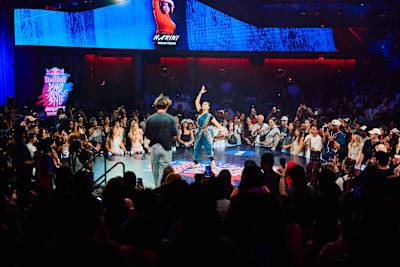
Harini Nilakantan at Red Bull Dance Your Style in Las Vegas, Nevada
© Michael Kirschbaum / Red Bull Content Pool
That sensibility, deep in Harini’s roots, traveled with her when her family relocated to Indianapolis in 2013. Harini didn't leave Bharatanatyam behind, but she became disconnected from it and had to find ways to stay involved. The culture she'd always been swimming in was suddenly three time zones away. Research became the way she stayed connected. "I am a diaspora kid… in order to maintain my connection with it, I started researching what's going on back home."
This compulsion, to move, to learn, to understand, caught the attention of an arts professor who pushed her to apply to the School of the Art Institute of Chicago. She'd already been accepted to Purdue for engineering, but took the leap. She submitted her SAIC application at 11:45 for an 11:59 deadline. After visiting Chicago with her father, who took one look at her face and encouraged her to follow her passion and forgo engineering, she landed in the Windy City.
Chicago, with its footwork lineage, house roots, and battle scene, became a new set of vocabularies to study. She joined the dance collective Movement of Desis, took classes at Puzzle Box, and quickly got acquainted with the city’s vibrant dance community. The curiosity that had driven her to research Bharatanatyam's history now turned outward. She had an entire city's worth of traditions to pull apart and understand.
At the launch event for a local Chicago-based dance mag, a cypher opened up with a house beat, breakers stretching in the corner, waackers rotating through. It was one of her first times in a freestyle space, and she did what she always does when something new is in front of her: observed, waited, and then jumped right in. "I just bulldozed my way in pretty much."
As she started appearing throughout the wider dance community in Chicago, cyphers became her training ground, a place to test her classical vocabulary in a new context, how much it could hold up when the stage was just a circle of people and a beat.

Harini Nilakantan, a Bharatanatyam dancer
© Marina Oya
Chicago has adopted me and I owe it so much for everything that's happened here. I'm very attached to Chicago and the dance scene here. It's beautiful.
Cyphering eventually led her to battling. She only entered her first battle in late 2024, approaching it the way she approaches everything: by watching first, learning the rules, understanding the form before deciding what to do with it. For someone who had spent years studying a single form in exhaustive depth, a battle was just another new language to learn.
"Battling is taking this very raw creativity and then trying to package it in the fastest way possible [to make it] visible."
And visible is exactly what it became. The battle stage put her work in front of audiences who had never encountered Bharatanatyam outside of a temple or a diaspora recital, and the internet did the rest. What she had been doing quietly for years, in cyphers, in classrooms, in research, in practice, was suddenly being watched by millions of people.
The attention brings new eyes, and with new eyes comes new noise. Purists pushing back. Commenters trying to explain her own form to her. Headlines she didn't write and can't control. None of it rattles her foundation, because the foundation was built long before anyone was watching.
"Good fusion honors both," she says. "You're not just going to willy-nilly take something and put it there because you want it as a gimmick." She's been honoring different dance forms since she was a child mimicking her cousin in Bangalore, since she stood barefoot at the Sage launch and bulldozed her way into the cypher, since she spent hours down research rabbit holes understanding not just how a form moves but why.
Her work hasn't changed. Only the audience has. And it keeps growing.