
Fitness Training
Master the standing bicycle crunch: Building core strength and balance
Standing bicycle crunches strengthen your core while improving your balance — and they’re not just for cyclists. Learn how to do this ab exercise that’s great for just about anyone.
Don’t let the name fool you — standing bicycle crunches are for all athletes of any skill level, not just bikers looking for more cycling strength exercises. A standing bicycle crunch fits your core regimen whether you’re training for volleyball, surfing, or intense dance disciplines such as breaking.
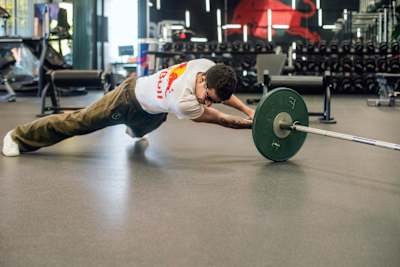
Victor working on his core and balance
© Maria Jose Govea/The Red Bulletin
"I feel like breaking is all core," says breaker Victor Montalvo. “You're always twisting and turning."

The same could really be said of any sport, so core workouts are part and parcel of any great training routine — and standing core exercises also improve your stability and balance. Below, you’ll learn how to do standing bicycle crunches and get even more out of your core workouts.
01
What are standing bicycle crunches?
Standing bicycle crunches are a version of the standard bicycle crunch that you perform on your feet instead of lying on your back. You’ll bring one of your knees diagonally inward toward your chest and bring your opposite elbow toward that knee, twisting your torso slightly as you do so.
Since you stand throughout this exercise, you’ll also get better at staying balanced and upright amid physically challenging movements. Plus, if you’re the kind of person who gets neck and back pain from floor crunches, standing bicycle crunches relieve stress on those areas.
02
Muscle groups worked in a standing bicycle crunch

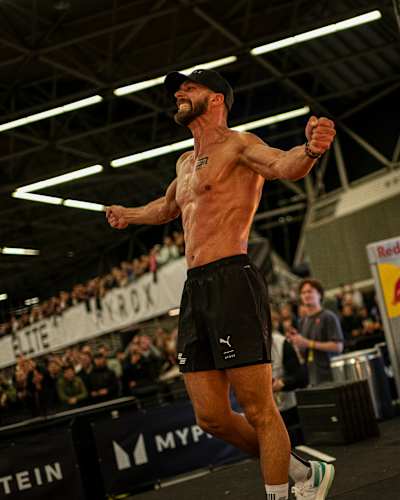
Jake Dearden and Marc Dean at the Hyrox World Championship in Nice, France
© Baptiste Fauchille / Red Bull Content Pool

With the standing bicycle crunch, muscles worked include the below two primary groups.
- Rectus abdominis. This is the scientific name for the ab muscles that give you a six-pack. All core workouts, whether horizontal or standing, work these muscles.
- Oblique. Both floor and standing bicycle crunches work your obliques (side abs), but the standing version works these muscles considerably harder. That’s a big deal: With strong obliques, rotational movements are often much easier. You can probably see how that would come in handy on just about any sports field.
Although you’ll feel standing bicycle crunches primarily in your core, they also target the following secondary muscle groups.
- Hip flexors. These are the muscles that help you move your knee toward your chest, and they’re prone to injury for many athletes. Since bringing your knee to your chest is a key part of standing bicycle crunches, these exercises train your hip flexors. It’s important, however, to make sure that your hip flexors aren’t doing the driving with this exercise, at the expense of your other muscles.
- Legs. The higher you bring your legs, the more work your quad muscles must do to resist gravity pushing them back down. In this way, standing bicycle crunches target your legs.
- Glutes. When engaging your legs and hip flexors, your glutes get engaged by default too.
03
Benefits of standing bicycle crunches

Leticia takes a well-deserved energy break.
© María José Govea
Standing bicycle crunches’ benefits include that they:
- Build your core. The more you exercise your rectus abdominis and obliques, the stronger and more stable your core, allowing for smoother, easier athletic movements.
- Improve your stability and balance. It’s not exactly the easiest thing to stay perfectly upright as you bring your knee to your elbow. The more often you do standing bicycle crunches, the more balanced and stable you’ll become.
- Exert less strain on your neck and back. That awful sensation you might get in your neck and back as you do floor crunches is much less likely with the standing version.
- Burn more calories. It takes more work to fluidly move your muscles at a gradual pace while you’re standing and gravity is taking its toll. This extra effort means that your body will need to burn more calories to power you through standing bicycle crunches.
04
How to perform standing bicycle crunches
Step-by-step instructions
- To start a standing bicycle crunch, stand upright with your feet shoulder-width apart. As with any standing exercise, keep your shoulders back, stomach in, and head level.
- Put your hands behind your head and spread your elbows wide like you would for a floor crunch, with your triceps parallel to the floor. Alternatively, start with your arms at your sides.
- Engage your core and twist your torso as you raise your left knee as high as you can to nearly make contact with your right elbow. Exhale as you go through this motion. Alternatively, if you’ve kept your arms at your sides, then start by raising your arm so that your tricep is parallel to the floor and your forearm is perpendicular. Once you’ve done that, complete this step as stated.
- Bring your leg, arm, torso, and head back to their starting position as you inhale. Now, repeat all the above steps with your other leg and arm. Continue to repeat this exercise on alternating sides.
Common mistakes to avoid
It’s easy to let your form falter with standing bicycle crunches. Here’s what to watch out for so you get the most out of this exercise:
- Not properly engaging the core. It’s not a real standing bicycle crunch unless your obliques and rectus abdominis contract, so squeeze these muscles as you complete this exercise.
- Pushing your neck or pulling your body downward. Applying pressure on your neck as you bring your leg to your elbow reduces how much work your core has to do, making this exercise less effective. The same is true of pulling your body downward. It also adds strain to your neck that you may have been trying to avoid by switching to a standing position from the floor.
- Bending at the hips. Even a slight forward bend from a full upright stand reduces how much effort must come from your core.
- Pulling your knee inward. Your leg should come directly upward almost as though you’re running. Instead of pulling your knee inward, twist your torso to activate your abs and bring your elbow close to your leg.
- Moving too fast or without control. Ask any personal trainer, and they’ll tell you that slow, controlled pacing while exercising ensures proper form that engages the intended muscles.
Variations and modifications
If you want to gradually ease into standing bicycle crunches or you need to modify this exercise for mobility limitations, try the beginner variation. Bring your leg and elbow only about halfway to the full distance, or twist your torso only partially and move more slowly as you do so. Return to your starting position and repeat on the other side.
Once you’ve mastered your form and your standing bicycle crunches feel easy, consider adding ankle weights to make them more challenging. Another advanced variation on standing bicycle crunches could be to perform them with a slight squat instead of completely upright. You’ll likely engage your legs, glutes, and hip flexors more this way too.
How to incorporate standing bicycle crunches into your routine
As you first work standing bicycle crunches into your workout regimen, complete 10 reps (repetitions) per leg, alternating between legs as you go. How many sets you complete from there depends on your goals:
- For a broad fitness routine with no specific goal, one to three sets is fine, but aim for 12 to 15 reps per set. Rest for 30 to 90 seconds between sets.
- For endurance, three to four sets of at least 12 reps is ideal. Rest for at most 30 seconds between sets.
- For bulking, three to six sets of six to 12 reps is best, with 30 to 90 seconds of rest between sets.
When you’re pressed for time, standing bicycle crunches are also great as part of a 10-minute circuit. To start your circuit, do a low-impact warm-up to get your blood flowing and your core engaged — think push-ups or mountain climbers. After spending three to five minutes warming up, start your circuit with a minute doing an ab exercise, then a minute jumping rope. Repeat until you’ve reached 10 minutes total (standing bicycle crunches are great for roughly the middle of a circuit), then cool down with light stretches.
Why standing bicycle crunches should be part of your core routine
You don’t need wheels to do standing bicycle crunches to reap this exercise’s benefits. Standing bicycle crunches are an excellent core workout for all athletes, especially if you’re used to pain accompanying floor crunches. Toss these in with all your usual ab exercises during your next core workout for a more balanced regimen — and more balance in general. You’ll notice improvements when you’re on the court with your team, alone on a sports adventure, and at every moment in between.