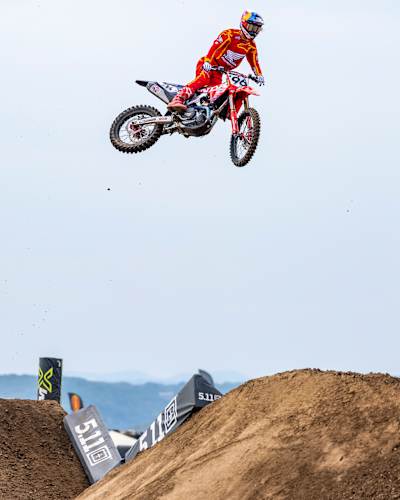
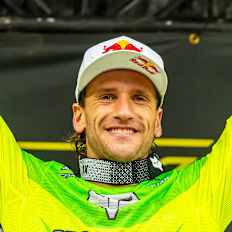
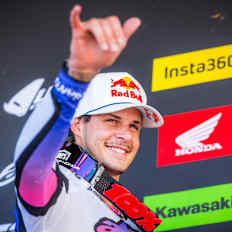
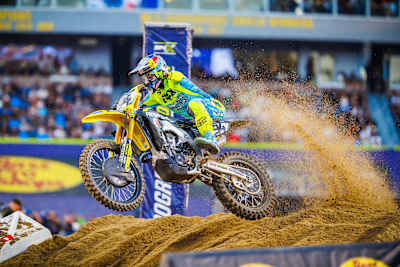
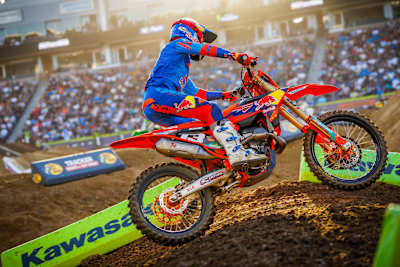
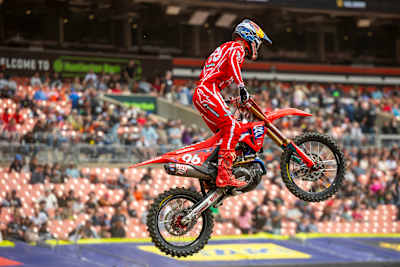
Winning supercross races and championships is impossible without the right motorcycle. A proper supercross bike looks similar to the off-road machines on the showroom floors of dealerships. It’s the components, internal parts and how they’re all set up, however, that allow riders like Ken Roczen to win races and championships.
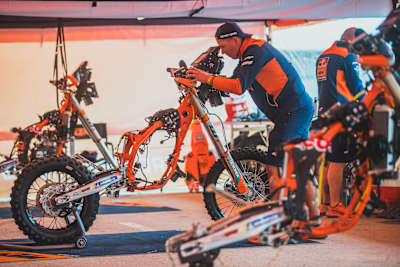
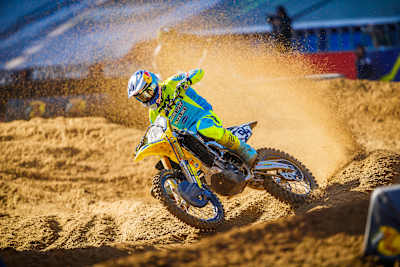
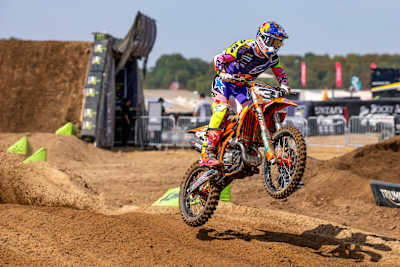
Supercross bikes, such as Roczen’s Suzuki RM-Z 450 or SuperMotocross World Champion Jorge Prado’s KTM 450 SX-F are based on the production motorcycles purchased by everyday riders. The machines that hit supercross tracks go through substantial modifications and scores of hours of testing for precise personal setup.
There are big differences between 250 and 450 supercross bikes even though they look similar side by side. Let’s start with the numbers: 250 = 250cc (cubic centimeters) of engine displacement. The 250s put out 40-45 horsepower with a total machine weight of ~225-lbs. The 450s have 55-65 horsepower and weigh around 245-lbs.
Riding each of these bikes is a different experience. The 450 is more powerful and delivers more torque, requiring riders to use more precise throttle control. A 250 is lighter, can be ridden more aggressively, and in a higher RPM range.
These two machines compete in different classes at supercross races. They are not on the tracks at the same time.
250 supercross bikes
The 250SX class serves as Supercross' primary development pathway
The 250 class in supercross is intended as a stepping-stone division; riders are separated into two regions (East and West) and each compete in 10 races during the supercross season. The divisions are broken up geographically (e.g. all the California races are West)
Three of the 250 supercross rounds are called East vs. West “Showdowns” where the divisions come together for head-to-head competition.
450 supercross bikes
The 450SX class features Supercross' fastest riders and machines
The 450 supercross riders are the premier athletes, the elite level stars who succeeded in 250 supercross first, either winning races or championships. The premier class competes in all 17 rounds of the AMA Supercross Championship. Riders, such as Jett Lawrence, the 2024 450 Supercross Champion, won East and West 250 supercross titles before moving up to 450 supercross.
03
Factory bike breakdown: How pro supercross bikes differ from stock
Factory teams rebuild production bikes into race-winning machines
To fully understand how different a supercross bike is from the production version you’d need to ride one. That’s unlikely to happen, so we’ll explain more. Supercross bikes start out as the off-road motorcycles anyone can buy from a dealership but they go through heavy modifications in several key areas:
Suspension
Engine Tuning
Bodywork & Weight Reduction
Electronics & Data
Not all of the riders (even ones riding on the same team) use the same parts/settings. For example, Hunter Lawrence and Jett Lawrence do not use identical suspension settings even though they both ride a Honda CRF 450R. Riders are all looking for a setup that feels most comfortable for their riding style.
Suspension
Factory suspension is tailored to rider preference and track demands
On a supercross bike, this is the most crucial, time consuming (and demanding) component for riders to figure out. The suspension system consists of a shock in the rear and two fork tubes in the front. The combination of settings possibilities is endless, and the factory race teams have suspension technicians who focus only on that area of the motorcycle.
The first hurdle is setting up the internal components to a rider’s height/weight and known preferences. This includes, valving, spring rates, oil weight, etc. and factory riders get access to high quality parts unavailable to the public.
Many external adjustments can also be made, such as compression rate, dampening and rebound. These are the changes being made when a rider says, “we adjusted some clickers”. Other external adjustments include fork height and sag.
Suspension on a supercross bike is particularly challenging because the abundance of jumps and whoops command a stiff setup, but the system can’t be so stiff that riders are unable to find the proper traction coming out of corners.
Engine tuning
Just like with suspension, a supercross bike’s engine includes myriad avenues for adjustment and it’s rarely as simple as “make it faster” because these motorcycles (especially the 450s) already produce more power than even most professional riders can reasonably/effectively use.
Engine tuning is about controlling how that power is delivered. Different engine tuning adjustments include:
Ignition timing
Fuel mapping
Engine braking
Throttle response
Traction control
Launch control (start)
Many engine changes can be applied through the bike’s ECU (Engine Control Unit) and a factory-level ECU is one of the most sought after pieces of equipment at the races. A challenge teams and riders will face is setting up an engine package that pairs well with the suspension.
Bodywork & weight reduction
By rule, a factory 450 supercross bike has a minimum weight of 220-lbs., about 25 pounds less than stock motorcycles. Teams will take advantage of this rule by using lighter hardware parts (titanium) and carbon fiber components. Some areas of the motorcycle, such as the frame, get ‘beefed’ up because of the punishment a professional rider puts the machine through.
The bodywork of a supercross bike is also known as the plastics, (fenders, number plates, etc.). These are covered in decorative decals that display a rider’s racing digits and sponsors/teams.
Electronics & data
Look closely and data sensors can be found on supercross bikes. There are sensors for the forks and shocks, engine RPM, temperature, oxygen, brake pressure, throttle position and more. The data from these sensors can be captured through the ECU or a data logger and then downloaded into a team computer after a race/riding session. Teams can study not only how specific systems are performing and behaving but also how a rider is using them and responding.
04
The beginner pathway: From junior bikes to the pro ranks
Eli Tomac is among the stars to emerge from KTM Junior SX
Everyone starts somewhere and for most professional supercross athletes it was in their backyard on a dirt bike with a 50cc engine. Aspiring racers can find local, regional, and even national-level events where they compete against other riders in their age range. One of those events is the KTM Junior Supercross program, an exhibition open to 15 riders (7-8 years old) at 10 rounds of the professional AMA Supercross series in an intermission race.
The 150 total riders are chosen by lottery, and they race identically prepared. KTM SX-E 5 electric mini-bikes. For one day, they’re treated like factory riders, and even ride the entire Supercross course. Since 1997, 3000 riders have gone through the program, including champions such as Ryan Dungey and Eli Tomac.
Junior & amateur bikes
There are many models and brands of junior bikes and they’re available in gas-powered and electric, such as the KTM SX-E 5 used in the KTM Junior Supercross program. Small displacement motorcycles are scaled down versions of full-sized bikes, built for riders aged 4-8 and typically have automatic transmissions.
As kids grow, so do the motorcycles (65cc, 85cc, 125cc) until they’re ready for a full-sized 250cc or 450cc machine.
Turning pro: 250 SX
Ryder DiFrancesco developed his skills through SMX Next competition
A rider who wants to compete in 250 supercross first demonstrates their abilities at national-level amateur competition and then gets invited to compete in SMX Next, a developmental program where expert and intermediate level riders, aged 15-20, compete at real supercross races in a truncated version of the professional format. Their main event is 8-minutes +1 lap.
Think of it as a step before the stepping-stone of becoming a premier-class athlete. It helps prevent racers from going pro before they’re ready. Riders such as Red Bull KTM’s Julien Beaumer and Ryder Difrancesco raced SMX Next.
At 18, riders are eligible to become a full professional and compete in the 250 SX East or West region, where the main events are 15-minutes +1 lap. There is no upper age limit but any rider who wins a 250 SX championship gets one additional year in the class (to defend) and then must move up to the 450 class.
Graduating to 450 SX
The starting line of a 450 supercross main event is filled with former 250 champions and race winners. This is the premier class of the AMA Supercross series, where athletes compete in all 17 rounds in feature races that are 20-minutes +1 lap. Taming a 450 supercross bike requires special skills, developed only after rising through the ranks like Jett Lawrence did before winning the 2024 AMA Supercross title as a rookie.
05
Supercross gear guide: What riders wear
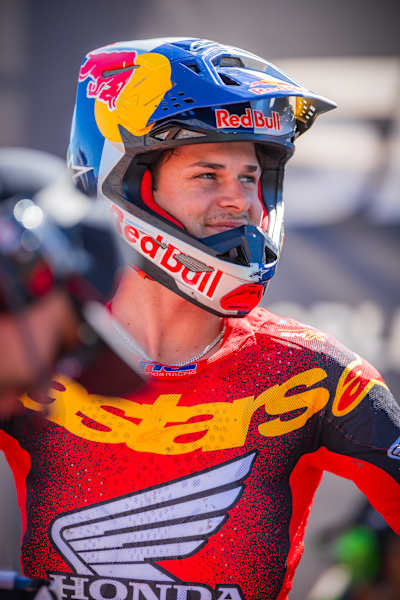
Modern racing helmets are engineered to help reduce impact forces
While a properly tuned supercross bike is essential to winning races, riding gear is a required and important component. Every rider wants to look good, and they work closely with apparel companies to keep them both safe and stylish in purpose-built products:
Helmet
Boots
Jerseys & Pants
Body Protection
Helmet
The helmets supercross racers wear are highly engineered and use carbon fiber, energy-absorbing foam, engineered plastics, and specialized fabrics. Good helmets are designed to absorb the impact of a direct blow, increasing the time the head decelerates when contacting a surface. This is to reduce the possibility (or effects) of a concussion. When a helmet is involved in a crash where the shell hits the ground hard, it has done its job and is no longer used.
Boots
Motocross boots face the same conundrum as suspension; riders are looking for the right amount of support but enough compliancy to allow freedom of movement, especially to reach the shift and brake levers. Riding boots are comprised of a mix of plastic, rubber, carbon fiber and leather to protect the ankles, feet and shins from the punishing blows of riding a supercross bike. They're difficult to walk in and even require a ‘break-in’ period to work out the stiffness.
Jersey & pants
Unlike helmets and boots, which have drastically improved in quality and support, the jerseys and pants have evolved differently. Riders today prefer lightweight and breathable moisture-wicking fabrics. Today’s jerseys and pants are made of polyester, nylon, and elastane (spandex). Riders of a certain age still call the pants “leathers” because there was a time when they were made of actual leather. They were heavy and didn’t breathe well (like, not at all).
Today’s riders prefer their jerseys and pants to have a tight form but flexible enough to allow freedom of movement. The challenge for the apparel makers is making them durable enough to handle the constant abrasion that occurs while racing supercross.
Body protection
Supercross racers also wear equipment under their jerseys and pants to protect them from crashes, roost and hyperextension (knees). Nearly all racers wear chest protectors and knee braces.
The chest protectors are like shields fastened to their torso. Mostly made of plastic and polyester, they protect against blows to the chest and back. Some protectors have airbag systems with sensors that can detect a crash and expand before a rider contacts the ground.
Knee braces are much more than just protection for the patella. Braces are highly engineered frames that cover the area from mid-thigh to mid-shin and protect the knees’ structural integrity.
Motocross and supercross racing involves lots of impact and torsion, especially in crashes. Knee braces limit hyperextension and lateral and twisting forces that can damage ligaments, which are always season-ending injuries.
Other body protection includes wrist braces and ankle supports but these are not nearly as ubiquitous as the above.