
Dance
Distdancing pairs out-of-work dancers to new audiences
With most public performance on an enforced hiatus, dancers are finding new platforms for their artistry – bringing their bold and beautiful moves to some unexpected places.
It’s an overcast Sunday afternoon in East London, and a small crowd has gathered on the towpath of the Regent’s Canal. On the other side of the water sits Hoxton Docks, a renovated warehouse complex turned events space, with a floating pontoon just outside its tall wooden cargo doors. To the left of the pontoon is a barge carrying a giant yellow inflatable balloon that looks like some sort of bizarre sea Zeppelin. To the right is a family of four model sharks emerging menacingly from the water.
With just a few minutes to go until the clock strikes three, you can feel the energy rise in the assembled throng as they wait to discover what will emerge from behind the cargo doors. The crowd is here for DistDancing, a new series of free pop-up weekend performances created by dancers whose regular careers have been brought to a halt by COVID-19 restrictions that have shuttered theatres and venues in the UK and beyond.
However, unbeknownst to those waiting patiently – and socially distanced – on the towpath, the police are already inside Hoxton Docks, and the plug is pulled on the sound system after just five seconds. What’s more, the organisers are told they’ll be arrested if they hit play again. Another van full of police officers marches onto the towpath and orders the crowd to leave, just as dancer Rebecca Bassett-Graham was going to begin her routine. As the police continue with their dispersal efforts, the crowd begins chanting in unison: “Let them dance!”
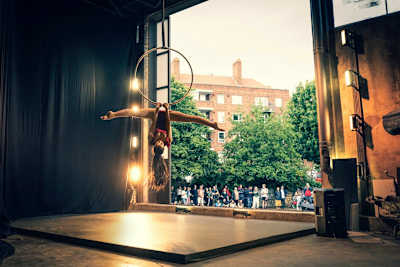
Aerialist Annalisa Midolo wows the towpath crowd
© Andrej Uspenski
Inside, there’s an intense back-and-forth between the dancers and police. Once it becomes clear that only the organisers would be arrested, not the performers, freelance aerialist Jackie Le decides to complete her routine as a protest. She begins her descent from rigging hoisted from the roof, hanging like a spider on a thread as the stand-off continues on the towpath.
After eight consecutive weekends of free shows throughout the summer, this short-lived experimental attempt to find a way to dance and perform despite COVID restrictions has been brought to a close, for now.
“At least we went out with a bang,” says Chisato Katsura, First Artist of The Royal Ballet, forcing an optimistic smile.
“But it’s depressing, seeing this come to an end. It feels like losing a baby, when we had a whole month of shows planned. And it really doesn’t make sense: right now, there are hundreds of people in the parks, going out in Soho, or sitting on planes. Yet with all these gatherings happening we’re the only ones being shut down.”
At a DistDancing show, you can tell people are still thirsty for live performance
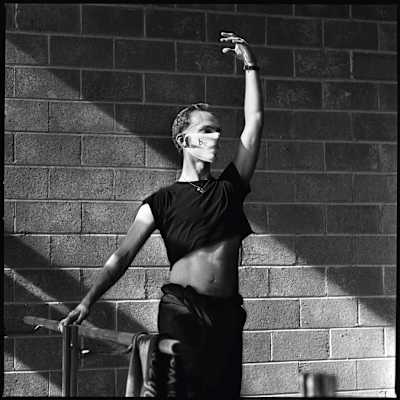
Polish-born dancer Andre Kamienski
© Theo McInnes
Rewind a few days and the mood is more upbeat – despite the pouring rain outside – at a rehearsal for the weekend’s performance. In an elegant, wooden-floored yoga studio in London Bridge, Katsura leads the session as Francesca Velicu, 22, and Erik Woolhouse, 24, from the English National Ballet (ENB), and Bassett-Graham, 29, from Company Wayne McGregor, practise their routines. The moment is made even more special by the fact Katsura has been out of action since October due to a stress fracture to her left shin, which necessitated crutches.
First, Velicu and Woolhouse, who are a couple, practise a breezy duet together. Then, for their solo pieces, Velicu floats across the floor, seemingly as light as a feather, and spins on one foot in a pirouette, every bit the classical ballerina, while Erik dances with a more muscular and modern energy, throwing out his arms and legs in wide, sweeping movements, like a warrior psyching himself up for battle. Bassett-Graham shows off her contemporary, almost glitchy solo, with her body contorting itself into expressive, abstract shapes, before all three join on the floor for what will be the show’s finale: dancing in synchronisation with one another. You can feel their sense of joy and excitement at being able to dance together again after months of lockdown.
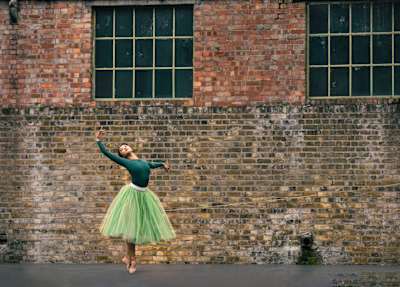
Chisato Katsura, co-founder of DistDancing
© Theo McInnes
For dancers, whose very meaning in life is to move, the lockdown came as a particularly harsh blow
“I remember back in March, slowly everything was cancelled, minute by minute, hour by hour,” remembers Bassett-Graham, originally from New Zealand.
“This isn’t just a job to us, it’s part of who we are as humans. After more than a week off, you start itching for that physicality. The uncertainty of not knowing when I would be able to perform again, or when it would be possible to dance in a studio with other people again… all of these things really started weighing on me.”
For dancers, whose very meaning in life is to move, the lockdown came as a particularly harsh blow. Not only were all their shows cancelled and their companies put on hiatus, but there was no way of knowing when they’d even be able to dance again, let alone in front of an audience. Often confined to small shared flats – especially those living in London – and dancing or training in bedrooms and kitchens, they did what they could to stay active and prevent their bodies from losing the intense physical conditioning for which they had worked most of their adult lives.
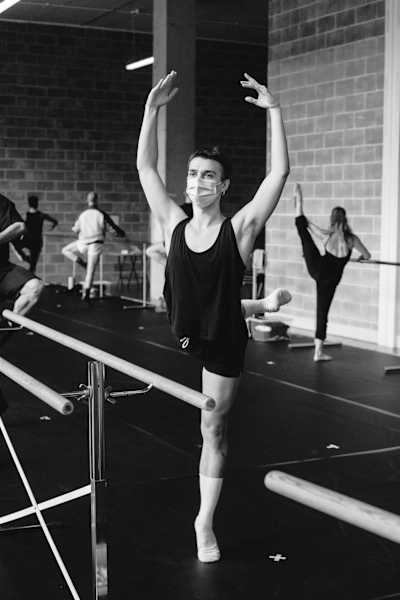
Jordan Bautista danced with the Polish National Ballet
© Theo McInnes
“The whole dance community really pulled together,” Bassett-Graham says. “Everything went onto Zoom, and people began opening up their classes to whoever wanted to watch.” Across the industry, the barriers came down, membership of particular institutions no longer mattered, and professional dancers became one big family online, sharing tips, classes and workshops with each other and legions of amateur dancers, too.
Woolhouse embraced the change in routine and the opening of his world to other forms of dance, music and movement. At 15, he relocated to the UK from Japan to train with the Royal Ballet School, and he has been in the ballet bubble of the ENB for the last five years, training and rehearsing for upwards of six hours each day. The ENB’s season usually starts with an autumn tour of five or six cities in the UK, then a five-week “intense marathon” of Nutcracker at London’s Coliseum, followed by original shows such as Creature by celebrated choreographer Akram Khan, which has had to be postponed due to COVID.
It’s an intense schedule that often doesn’t leave much time or energy for anything outside ballet. So, during lockdown, Woolhouse has taken the opportunity to expand his repertoire and dance to other styles of music he enjoys, including jazz, hip hop and techno. In July, the ENB returned to training, albeit in much smaller groups of around eight to 10 dancers, all confined to their own personal boxes taped onto the floor, dancing for just four hours a day, Monday to Saturday.
It wasn’t only training and fitness but also performance that flourished – and continues to flourish – online. The ENB joined other companies in offering shows for free, with its popular Wednesday Watch Parties helping to open up ballet to a new audience. For Velicu, who originates from Romania and moved to the UK in 2016 after training at Moscow’s world-famous Bolshoi Ballet, these free online shows were particularly special as her mum could now watch all her performances from back home.
“I really hope the intense interaction and engagement we’ve had on social media continues,” Velicu says. “It’s been so great for bringing in new, younger audiences. For the first time, people from around the world can easily see the work produced in London. My mum is enjoying it so much, she’s watching an opera from the Met in New York or a ballet show from London every day.”
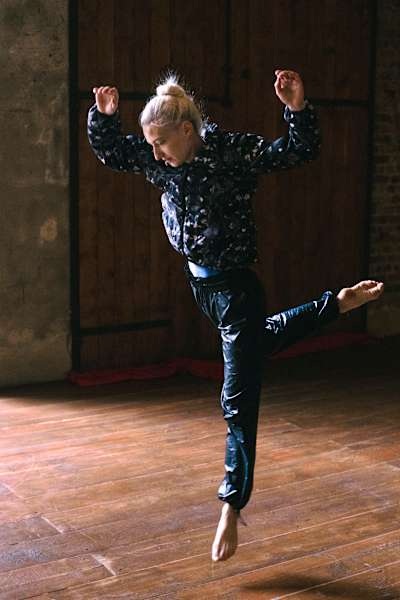
"Slowly everything was cancelled," remembers Rebecca Bassett-Graham
© Theo McInnes
Dance needs to be more approachable. That’s what is great about DistDancing
Woolhouse believes the ruptures created by the pandemic were necessary for an industry with a tendency towards elitism. “Dance needs to be more approachable to the public,” he says. “Young people nowadays can’t afford an £80 ticket and a suit to go to the ballet. That grandness and tradition must be kept alive, but the industry will die without the next generation, so I think something with a more casual atmosphere is necessary [in order] to move forward. That’s what’s so great about DistDancing: you can just drop by with a coffee on the side of the canal, watch a performance and realise you really enjoyed it.”
Dance companies around the world have taken an enormous hit. The ENB, for example, lost two thirds of its income and was forced to furlough more than 85 per cent of its staff through the UK Government’s Coronavirus Job Retention Scheme. Having received an emergency grant from the Arts Council that helped it stay afloat, adapting to a world of online-only performances is crucial to the ENB’s survival, as staging shows for a reduced audience just isn’t financially viable for most larger companies.
However, Katsura and her Italian-born colleague Valentino Zucchetti, a First Soloist at The Royal Ballet and co-founder of DistDancing, remain passionate about finding ways to bring live performances back – both for dancers’ and audiences’ benefit. “Online content is a cure for the moment,” says the Japanese dancer, “but it’s just not the same effect as in real life. Online, people click a button and get what they want; they get bored easily and there’s no opportunity for those chance encounters with the unknown.
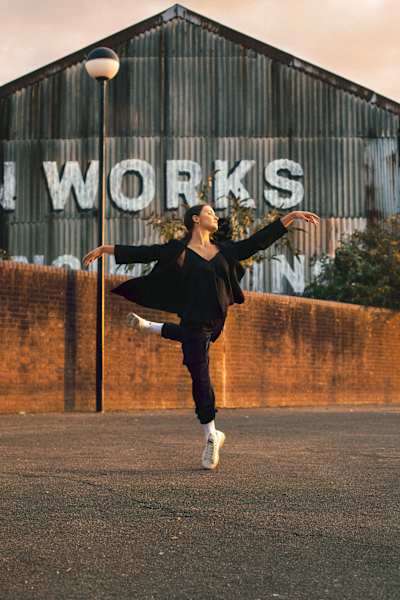
Velicu has seen interest from a whole new audience
© Theo McInnes
“As a performer, you feel the energy of the audience’s applause,” Katsura continues. “It’s hard to put into words how it feels to hear 2,000 people cheering for you. You can be in so much pain for two hours, but then you hear the applause and it just pushes you through to the end. I want to give performers the opportunity to feel that audience response again and keep doing what they love.”
Head east along the towpath from Hoxton Docks and you’ll find yourself at Here East, a creative complex that backs onto the River Lee Navigation and was built for the 2012 Olympics. Here, a corner room has been turned into a makeshift dance studio for Company Wayne McGregor’s RESET 2020 programme, which began in August and offers a free 10-week programme of ballet, contemporary and fitness training to both the company’s own dancers and freelancers who have fallen through the cracks support-wise. The three-and-a-half-hour daily programme is a far cry from Bassett-Graham’s pre-COVID routine of being on tour for the majority of the year or rehearsing in London from 10am to 6pm. But getting back into the studio with other dancers – even if it is socially distanced – is still very welcome.
I hope people become more appreciative of what dance brings to our culture
One of the freelancers to benefit from RESET 2020 is Jordan Bautista (who uses the pronouns they/them), a 25-year-old dancer originally from Gibraltar. After dancing with the Polish National Ballet in Warsaw, Bautista relocated to London, and it was while they were searching for work following surgery that the pandemic struck. Today, they’re confined to their own square opposite Bassett-Graham, which has been marked out on the floor with white tape so that they and the other dancers can train in a COVID-compliant way. Each square has its own barre, a plastic box for possessions, and a supply of disinfectant wipes.
When the class is ready to start, the instructor reels off a list of positions so fast it sounds unintelligible to the untrained ear, like an alien language or the shipping forecast. But the masked inhabitants of all 18 white boxes move through their positions in perfect sync, throwing their bodies into the kicks, spins and curtsies of the physically demanding ballet routine.
“I think one of the changes that will come out of this pandemic is that both dancers and audiences are going to be much more aware of how much it takes to come together and collaborate to create work,” Bautista says. “I hope people will become more appreciative and understand how much work goes into things, and how much dance contributes to our culture.”
In mid-September, following intense negotiations with the council and police, and considerable support from the public, the landlord of Hoxton Docks allowed DistDancing to return. “We’re still very much on alert, and there’s the possibility of another shutdown,” says Katsura. “We had to change our format and drop the strict scheduling to prevent a crowd gathering or police intervention.”
Now, in late September, it’s time for the final show of the relaunched DistDancing. It’s grey and overcast again, but because of the lack of notification there’s no crowd outside Hoxton Docks. The Royal Ballet’s Giacomo Rovero walks onto the pontoon stage and starts his routine. Passers-by hear the music, stop to look, and by the end of his three-minute solo there are 20-30 people watching in awe. These aren’t the legion of fans DistDancing amassed through social media, but rather new people stopped in their tracks by a chance encounter with dance – just as Katsura and Zucchetti had originally intended.
“Things will never go back to ‘normal’ as we know it; they’ll only move forward,” Katsura says. “When the theatres shut, we worried we’d lose our connection with audiences. But at a DistDancing show you can tell people are still thirsty for live performance. The connection is maybe even stronger. I think lockdown has made people realise how much they need arts and culture in their lives.”
After more than a week off from dancing, you start itching for that physicality
Fittingly, Katsura is DistDancing’s fifth and final performer. Due to her recent recovery, she performs a modified version of the Emeralds solo from choreographer George Balanchine’s ballet Jewels. She avoids going en pointe, but sweeps her arms gracefully in a port de bras as her flowing skirt billows around her, and finishes kneeling with her arms crossed, facing the audience on the towpath across the canal. The crowd has now grown to around 50 spectators, who applaud wildly as Katsura takes a bow before being joined on stage by the other performers.
“We’re so grateful to be able to bring joy to people again,” Katsura says, relieved at the hitch-free performance. “The support we’ve had during the shutdown has been incredible. To see everyone come together to keep the arts alive is so heartwarming. It’s the strength and hope we need during these dark times.”
ballet.org.uk; roh.org.uk; waynemcgregor.com; Instagram: @_distdancing_

