As you explore your desire to participate in a multisport event, the first step is to figure out which one is right for you. Significant differences between each one shape your training, equipment needs, and even whether you can participate. This guide to triathlons and decathlons provides the side-by-side comparison you need to decide which sport is best for your goals.
01
What is a triathlon?
A triathlon is a multi-sport endurance event that consists of three distinct events: swimming, cycling, and running. It’s the ultimate endurance test — many athletes regard triathlon participation as a way to push their limits. Both hobbyists and professional athletes participate in triathlons.
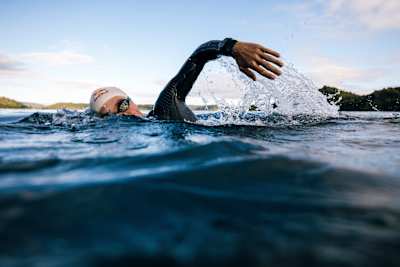
Hayden Wilde trains at Lake Rotoma in Whakatane, NZ in 2023
There are multiple triathlon types, each of which covers a different distance or running type. These variations include:
Standard: The standard triathlon consists of swimming 1500 meters (1.5 km), biking 40 km, and running 10 km.
Sprint: This variation of the triathlon involves swimming 750 meters, biking 20 km, and running 5 km.
Super Sprint: An even more condensed version of the sprint involves 400 meters of swimming, 10 km of biking, and 2.5 km of running.
Mixed relay: This race consists of 300 meters of swimming, followed by 7.2 km of biking and 2 km of running.
Super League: This variant involves swimming for 300 meters, biking for 4 km, and running for 1.6 km.
Ironman: A full Ironman consists of swimming 3.8 km, biking 180 km, and running 42.2 km. The half-Ironman, often called the middle-distance Ironman, cuts these distances in half.
02
What is a decathlon?
A decathlon is a 10-event, multi-day sporting event that’s regarded by many as one of the most challenging an athlete can attempt. The events are performed in order in a stadium setting. Each event is scored, with the goal of achieving the highest possible score among all participants. Its origins trace back to the Greek, five-event pentathlon during the ancient world stage games.
Decathlons are not for casual athletes by any means. They take significant training and dedication to achieve. Not only does each sport require its own specialized and well-honed skill set, but these events take place in rapid succession of one another, with little time for recovery in between.
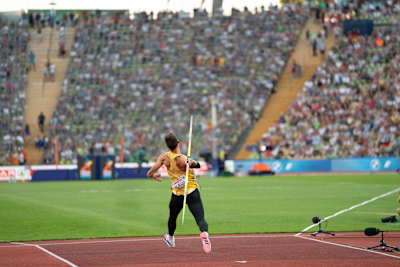
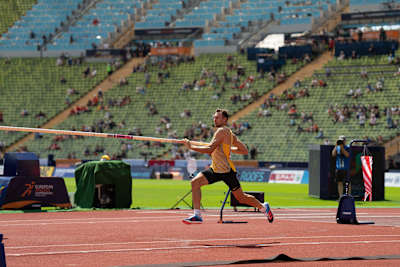
Niklas Kaul at the 2022 European Championships in Munich, Germany
For men, the first day of a decathlon consists of a 100-meter dash, long jump, shot put, high jump, and a 400-meter dash. The second day features 110-meter hurdles, discus, pole vault, javelin, and a 1500-meter race.
Traditionally, the sport was limited to men, and women were required to participate in a seven-event heptathlon. However, the International Amateur Athletic Federation (IAAF, also known as World Athletics) approved a women’s decathlon scoring system in 2001.
The women’s competition is held in a slightly different order than the men’s. For women, the first day of a decathlon consists of a 100-meter dash, discus throw, shot put, javelin throw, and a 400-meter dash. The second day features 100-meter hurdles, long jump, shot put, high jump, and a 1500-meter race.
03
Key differences between a triathlon and a decathlon
Number of events
The first and most obvious difference is what they entail. Triathlons have three events, while decathlons have 10. It’s all in the name — tri means three and deca means 10.
The number of events also influences length. A triathlon is typically completed in a day, while a decathlon needs two days, with five events per day.
Niklas Kaul at the 2022 European Championships in Munich, Germany
Triathlons and decathlons take drastically different approaches to training. First, the two events don’t share much in common at all — triathlon participants don’t need to practice javelin throwing, while decathlon athletes don’t need to improve their swimming.
Even for the shared running component of both events, the two types of running are quite different. Running short bursts in a decathlon requires endurance and strength, with workouts like tempo runs and interval runs to help improve those numbers. Long runs require workouts like High Intensity Interval Training, plyometrics, and strength training that focus on improving the stamina needed to run many kilometers at once.
Participation
Any athlete in good shape can train to participate in a triathlon. They can incorporate training to improve running, cycling, and swimming speed and endurance. Triathlons are also open to men and women of all ages.
Decathlons, however, are much more difficult for amateurs to train for and join. The required knowledge and specialized training for each event makes training more time-consuming from the get-go, and much harder for inexperienced athletes to access. Additionally, women were traditionally excluded from this event; they were only allowed to participate starting in 2001.
Equipment
Each race requires vastly different equipment. While runners could benefit from running spikes for both events, everything else is different. Triathlon participants need swimming gear like goggles, a bike, and protective gear like a helmet. Decathlon participants need a javelin, discus, and pole vault pole.
Scoring
Triathlons are measured by how long it takes you to swim, bike, and run each part. Decathlons are scored by various metrics depending on the event in question, with points awarded for each event. The running events are measured in seconds, while all other events are measured in meters.
Triathlon vs. decathlon comparison chart:
Triathlon
Decathlon
Number of events
3
10
Length
One day
Two days
Scoring
No point awarded
Points awarded
Equipment needed to participate
Swimming, biking, and running equipment
Running equipment, javelin, discus, shot put, pole vault pole
04
Getting started: training for success
It takes significant commitment and consistency to train for either a triathlon or a decathlon. While your precise routine will depend — and may benefit from the assistance of a professional coach — here’s what you can generally expect as part of your triathlon or decathlon training routine.
Triathlon training
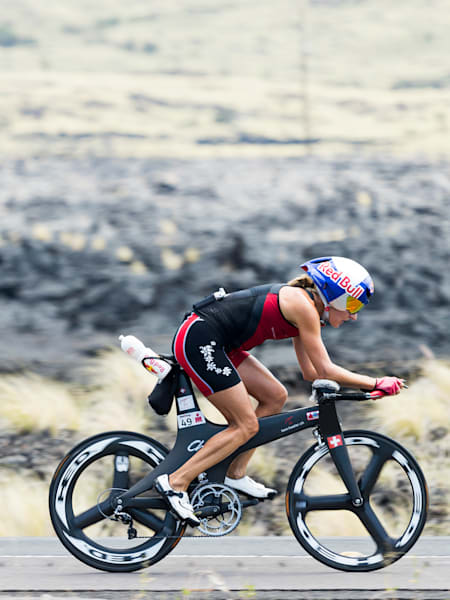
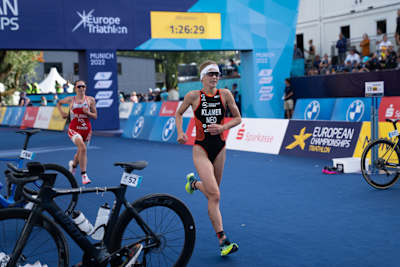
Rachel Klamer at the 2022 European Championships in Munich, Germany
Triathlon training is based on building endurance and the strength and energy needed to participate in three very physically demanding events. Expect to train for several months before jumping into the fray. The precise training you’ll undergo depends on your prior experience and current physical condition.
Triathlon training consists of a few distinct components, which may change depending on the type of triathlon you’re training for. No matter which event you’re participating in, though, you can expect to build training phases structured around maintaining consistency, improving endurance, improving race fitness, and focusing on proper nutrition and recovery.
Each week of training focuses on improving your RPE, or rate of perceived exertion, for each of the three triathlon events. You’ll alternate between biking, swimming, and running each day of the week, increasing intensity and duration each week. One rest day is built into the calendar as well. The only time you’ll decrease how much you’re swimming, biking, or running is the week of the race; this is to conserve your energy.
Decathlon training
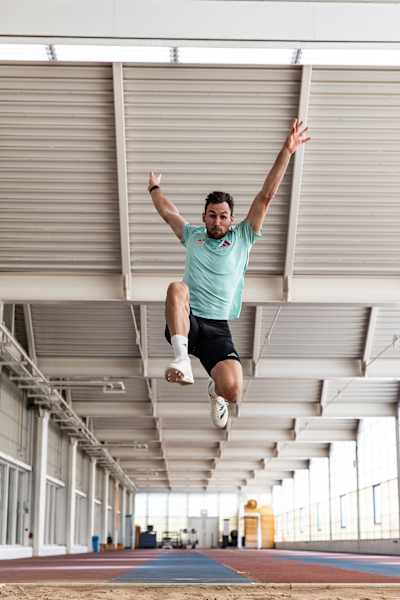
Niklas Kaul during his decathlon training in Mainz, Germany in 2024
Decathlons require endurance, speed, stamina, explosive strength, and skill-building. Preparing for each stage takes months of work and many different types of workouts. To that end, you may benefit from a training planner or a professional who can help you organize each workout and stay on track.
As you train for a decathlon, you can expect to practice shot put, javelin, discus, and pole vaulting two or three times per week over multiple weeks. This is in addition to running exercises, proper nutrition, and recovery days.
Some components of your decathlon training may include:
Technical work. Perfecting your javelin throwing, pole vaulting, discus throwing, and shot put skills is foundational to decathlon training.
Strength training. Spending time at the gym builds the muscle necessary to burn calories and, therefore, fuel your decathlon.
Tempo runs. This exercise builds speed and endurance by pushing you to run for longer and faster before you reach your anaerobic threshold, or the point where your body produces lactic acid that can make your muscles feel tired and sore.
Triathlons and decathlons: elite athletics
Triathlons and decathlons are both multisport events, but that’s about where the similarities end. The sport types, required training, and more are all drastically different. One thing stays the same, though: it requires peak physical skill and mental focus to complete either one.