

Tennis
Why do players wear white at Wimbledon? The tradition explained
With Wimbledon fast approaching, we take a closer look at one of tennis’s most iconic rules and find out why it is still enforced by the All England Lawn Tennis & Croquet Club.
Part of this story






Every major tennis tournament has its own distinctive character. The French Open at Roland Garros is associated with its famous red clay courts, the US Open with its vibrant night matches, and the Australian Open with its intense summer sunshine. Wimbledon, for its part, is defined by a single color: white.
On the grass of the Lawn Tennis & Croquet Club, the clothes worn by the likes of Matteo Berrettini, Iva Jovic and Jakub Menšík are not simply a matter of personal style. It reflects one of the tournament's most famous traditions and strictest rules. Shirts, dresses, shorts, skirts, caps, headbands, socks and shoes must all be almost entirely white. Not grey or light blue: at Wimbledon, there is only one acceptable color, and that is white.


At first glance, this rule may seem archaic, especially in a sport that has become ultra-modern. Yet it remains one of the tournament’s most powerful hallmarks.
01
One of the strictest dress codes in sport
Wimbledon’s regulations leave very little room for interpretation. Players must wear an almost entirely white tennis outfit from the moment they step onto the court.
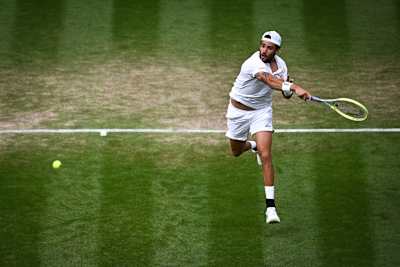
Matteo Berrettini has always enjoyed the traditions on display at Wimbledon
© Sebastien Bozon/AFP/Getty Images
Colored details are tolerated only marginally, notably in the form of colored stripes (no more than one centimeter wide), and are strictly regulated. Even accessories are subject to these rules: headbands, wristbands, socks, caps and shoes are all covered.
The strictness of the rules makes Wimbledon a unique case in professional tennis. Elsewhere, players have much greater freedom to express their own style or that of their kit sponsor. In London, the tournament organizers take control.
02
Has Wimbledon always required an all-white outfit?
To understand the all-white rule, we must look back to the social origins of tennis. In the late 19th century, the sport was played in private clubs, on grass courts, within a highly private environment.
White became established as a color associated with elegance, discipline and a certain notion of respectability. It conveyed a sense of restraint, closely linked to the social norms of the Victorian era.
But there was also a practical reason. White made sweat less visible than on colored clothing. In a society where physical exertion was expected to remain discreet, this function was almost as important as elegance itself. Thus, the white of the outfits made it possible to combine sporting performance with the cleanliness demanded by 19th-century London high society.
03
Dressing in white: a visual signature that has gone global

Matteo Berrettini is known for his fashion choices on and off the court
© Shi Tang/Getty Images
Over time, this constraint has become a considerable asset to the sport’s image. White against green grass is now one of sport’s strongest visual identities. A wide shot of Center Court is all it takes to recognize Wimbledon. The white lines, the grass and the immaculate silhouettes form an iconic visual language.
In a sporting world saturated with colors, logos and special collections, Wimbledon opts for simplicity. This understated style also creates a striking contrast with the intensity of the modern game. The players appear in outfits inherited from another century, yet strike the ball with the power, speed and precision of today’s tennis. This is where the tournament stands out: it contrasts the calm of the setting with the controlled intensity of the performance.
Delve into more unmissable tennis content


04
A way of putting the game center stage
The all-white rule also serves a simple idea: at Wimbledon, the spectacle must come from the tennis rather than the outfit. By standardizing the players’ appearance to a great extent, the tournament minimizes visual distractions. Personality does not disappear, but it must find expression elsewhere.
This approach reflects the identity Wimbledon has carefully cultivated over the years. The tournament presents itself as a place where tradition matters more than individual expression, where long-established customs shape behavior, and where every detail reminds players and spectators alike that they are part of a history much larger than themselves.

Jakub Menšík uses splashes of green to match the iconic grass courts
© Clive Brunskill/Getty Images
For the champions, this constraint becomes almost an additional test. Winning at Wimbledon is not just about mastering low bounces, slippery footing and the pressure of Centre Court. It is also about accepting the tournament’s codes and managing to thrive within that framework.
05
A strict tradition, but not entirely set in stone
The all-white dress code has long been seen as one of Wimbledon’s most rigid symbols. It remains so, but it has also undergone a significant evolution. Since 2023, female players have been allowed to wear medium- or dark-colored shorts under their white outfits. This change addresses a practical concern: reducing anxiety linked to the rules and improving the comfort of athletes during competition.
This was a significant development as it showed that Wimbledon can adapt its traditions when the issue directly affects the athletes’ performance and well-being. The tournament retains its identity, whilst accepting a crucial nuance.
Part of this story