
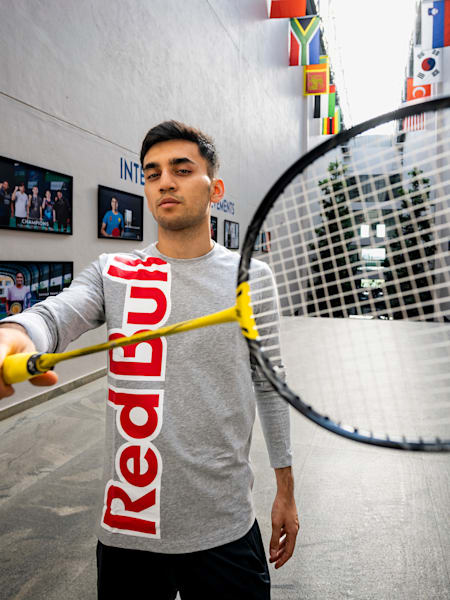
Badminton
Lakshya Sen explains his ideal hand grips for badminton racquets
The Indian shuttler says hand grips are a fundamental of the sport that you learn early in your career so it becomes a natural part of your game.
Part of this story


There’s speed, stamina, and guile. Then, there’s dexterity and determination. These are the ingredients that can make the difference between a win and a loss.
But there’s another critical element of a shuttler’s repertoire that can determine the outcome of a point. The simple yet vital art of how the racquet is gripped to execute each stroke.
The grip is something you learn at the start of your career. Once you’ve figured it out, it comes naturally.

It’s something that Lakshya Sen grasped during his younger days while picking up the fundamentals of the game under his father, Dhirendra.

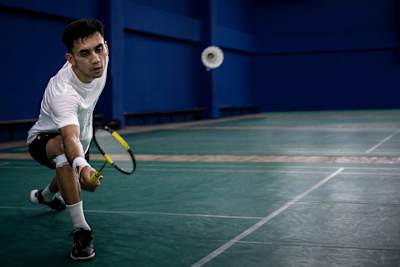
Lakshya using a front hand grip at the base
© Focus Sports
Today, he compares it to driving a car, where once you’ve understood and mastered the basics, things simply flow each time you get behind the wheel.


“The basics of badminton are one of dad’s strong points and every athlete who’s trained under him has developed a really good foundation. The grip is something you have to learn at the start of your career. Once you’ve figured it out, it comes naturally and you don’t have to worry about it,” Lakshya says.
Commonly, badminton thrives on four basic grips – the forehand, backhand, bevel, and panhandle.
As for Lakshya, he mostly uses the forehand and the backhand grip with personalized variations that come naturally to him.
These variations can be as simple as the position of his hand up or down the grip. For example, if he wants more control over the stroke, Lakshya will position his hand higher up the grip, but if he wants more power he will hold the racquet at the base of the grip.
Another variation is to secure his grip with his thumb, which helps him get more power in the shot. He uses this only on backhand shots though.

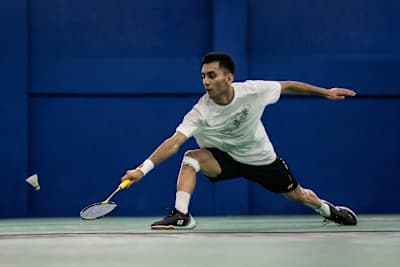
Lakshya using a back hand grip in a defensive position
© Focus Sports
The constant switching between grips needs deft handling, akin to how a craftsman works with his tools.
If I want more control, I hold the racquet towards the front. If I want to generate power, I hold it from the end.
The easiest way to understand the forehand grip is to think of a handshake, with the V-shape intact between the thumb and the index finger. This is the key to execute forehand smashes, drops, drives, lifts and net shots.
On the other hand, the backhand grip requires the racquet to face the ground and the thumb on top, aligned with the stem of the racquet. This is important to pull off backhand drives, lifts, net shots and serves.
“Most of the strokes that I play are with the forehand grip. The backhand grip is usually to get more power on the drives or when you know the shuttle is late and you’re playing from the back. When the shuttle is in front of the face, the backhand grip helps generate quick power from the wrist and the thumb because you cannot swing the racquet,” Lakshya says.
“If I want more control or want to execute something quickly, I hold the racquet more towards the front (higher up). Then, if I want to generate power, I hold it more from the end (base of grip),” he adds.

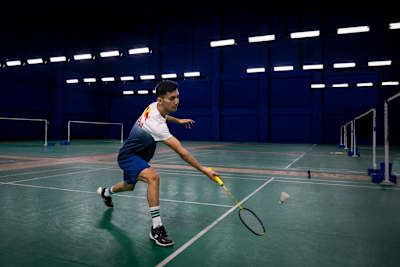
Lakshya during a training session
© Focus Sports
The bevel grip is a modification of the backhand grip, where one needs to turn the racquet head at an angle to the ground. This can be useful for backhand rear court shots, a few forehand and backhand net shots, and for defensive manoeuvres. Finally, the panhandle grip is where you rotate the handle about 90 degrees from the forehand grip and is what most beginners tend to start off with.
“You can play most strokes with the forehand grip where the racquet is held in the middle of the handle. As you make progress, these grips happen automatically after a point and you don’t have to think much about it,” he says.
Part of this story