














Wintersports
Freeskiing
Inside the halfpipe: How skiers and snowboarders push freestyle's limits
Halfpipe is the ultimate test of flow, amplitude and creativity. Discover how the world’s best skiers and snowboarders take flight - and what's required to land smoothly every time.
Part of this story
Halfpipe is where freestyle skiing and snowboarding meet pure creativity, a snow-sculpted stage for some of the sport’s most progressive athletes. To understand what makes it so special, we asked Kiwi freeskier and Olympic gold medallist Nico Porteous to explain the fundamentals of riding the pipe, from technique and gear to the athletes who’ve shaped the scene.
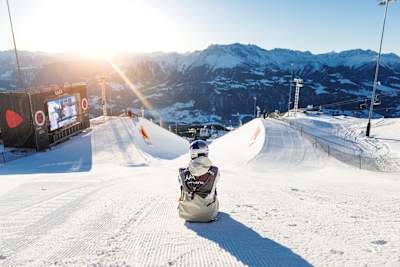
Maddie Mastro visualises her next run
© Ondrej Kolacek/Red Bull Content Pool
01
What is halfpipe?
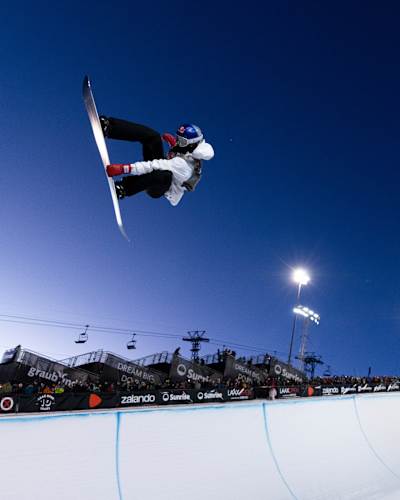
In its simplest terms, halfpipe skiing and snowboarding are freestyle snow sports that see an athlete perform tricks on skis or a snowboard on a U-shaped course made of hard-packed snow. An athlete will ski from one side of the ramp wall to the other and propel themselves up off the sides to go as high as they can and perform tricks whilst in the air.
The walls of the halfpipe are usually set at 6.7m – 7m high. Course length can be variable, but is usually around 250m. In competition terms, an athlete tries to complete as many tricks as possible before the course ends..
"The beauty of this sport is that there are no rules! For example, there's no time limit to your run. Rather, the goal is to turn the halfpipe into a playground and do whatever you want in it," says Porteous.

14 min
Nico's rewind
Freeskier Nico Porteous tells us how winning is more than nailing a few tricks on the day.
02
What's the history of the halfpipe?
The rise of halfpipe owes much to snowboard pioneers in the late 1970s, who wanted to replicate the thrills of what they did on halfpipes on their skateboards. Builds were few and far between initially, but there seemed to be a demand and snow resorts started to build halfpipes to attract snowboarders.
The invention of a halfpipe grooming machine in the 1990s allowed for permanent builds and the popularity of snowboard halfpipe grew further, and it wasn't long before freestyle skiers started taking to the halfpipe walls.
Snowboarding halfpipe was included for the first time in the 1998 Nagano Winter Games in Japan, while skiing halfpipe made its Olympic debut in Sochi 2014.

Tricks score you points in halfpipe. Bigger is better in contests
© Peter Morning/Red Bull Content Pool
A run is judged on five criteria: amplitude, difficulty, variety, execution and progression
03
What's involved in the tricks that you see at halfpipe contests?
There's not a lot of differences in the approach to ski and snowboard halfpipe. A lot of the tricks that are performed are similar, although skiers are able generate more speed than snowboarders can.
Tricks can be simple or extremely complicated. They usually involve rotations, flips, spins, grabs, can be off-axis or straight and can see you taking off and landing in different directions. Athletes also have to land perfectly to give themselves the speed and momentum they need to launch off the opposite wall.
"I would say the standard trick is the Double Cork 1260 – that's two backflips and three and a half rotations in a single jump," explains Porteous. "And mine? Let's say a simple straight air, which just consists of going very high. Controlling such a jump is a trick in itself, because the landing requires a lot of technique and strength."
Get to know halfpipe star Birk Irving:
04
How do halfpipe contests work?
In competition, there's usually a qualification round and then finals. The qualification round is used to whittle down the numbers of athletes competing in finals. Qualification consists of two runs, with the best-scored run being taken as an athlete's result. Athlete's who qualify for finals don't carry their scores to the final, where everything begins afresh.
A final normally consist of three runs and like qualification, an athlete's best score from those runs will count towards the final results.

Maddie Mastro with the dictionary definition of amplitude
© Ondrej Kolacek/Red Bull Content Pool

Twin tip skis are essential kit when you're spinning in both directions
© Christian Pondella/Red Bull Content Pool
"Generally, we have about 20 participants at the start. Everyone goes through a qualification phase and then the top 10 go to the final," says Porteous. "A run is judged on five criteria: amplitude, difficulty, variety, execution and progression.
"The amplitude is the height to which the athlete goes. The difficulty is the complexity of the attempted tricks. Variety is the diversity of tricks offered during a run. Execution is the quality of tricks - for example, did you let your hand drag on the snow or did you accidentally sit down when landing a jump. Finally, progression is about how innovative the run was. The way you push the boundaries of sport."
Depending on the competition, five to seven judges decide he scoring of a run, with scoring based on a 1-100 points scale. They will give an overall impression score based on the judging criteria mentioned by Porteous above. The best and worse scores from the judges are dropped, with the remaining three then averaged to give a rider's overall score.
05
Is specialist equipment needed in halfpipe?
Halfpipe skis have a twin-tip design, which means that both ends of the skis are slightly curved up to allow for easier skiing in different directions. "We wear racing-style ski boots and our skis are very stiff in order to resist the G-forces. They also have very sharp edges, just like in ski racing," adds Porteous.
Like halfpipe skis, both ends of halfpipe snowboards are curved up and they also tend to be shorter and wider compared to ones used on the slopes.
06
Who are the legends of Half Pipe
In skiing halfpipe there's obviously Porteous, the current Olympic champion, on the men's side of thing. He himself names Tanner Hall, Simon Dumont and Candide Thovex as his heroes. Present stars include Americans David Wise and Alex Ferreira, and Frenchman Kevin Rolland. For the women, look no further than Eileen Gu, a woman taking the sport to new highs.

Snowboarder Scotty James is a contest-winning machine
© Lorenz Richard/Red Bull Content Pool

Eileen Gu is taking women's freeski halfpipe to new heights
© Syo van Vliet/Red Bull Content Pool
In snowboarding halfpipe, one name stands above all others in terms of global profile - Shaun White. He's now retired and new greats like Australians Scotty James and Valentino Guseli have taken over the mantle. For the women, American Chloe Kim has been the lady to beat, but veteran campaigners Queralt Castellet, Maddie Mastro and rising star Mitsuki Ono are also always podium threats in any contest.
07
Nico's advice on getting involved
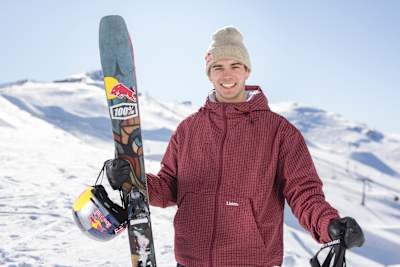
"Don't let fear hold you back," says Nico Porteous
© Miles Holden/Red Bull Content Pool
Experience the thrill: "I think people really should attend competitions. It will ignite something in you. The tricks we do have been perfected for years and it's a sport that involves big risks, but also big rewards. There really isn't much between a bad injury and a perfect landing. In short, it's very exciting.'
The best age to get started: "Personally I got into it at seven years old. But let’s say you should at least be able to control your skis. Of course, there's a relatively flat part at the bottom of the halfpipe where you can start practicing. But if the simple act of skiing the ramp scares you, I think you'd better not go for it."
Don't let fear hold you back: "Yes, it's scary, but you get used to it. The more you practice, the more normal it becomes. But we live with fear – mainly because we always push the boundaries of the discipline."
Get to know halfpipe queen Queralt Castellet in her episode of Winter Heroes:

11 min
Queralt Castellet
Spanish snowboarder Queralt Castellet has competed since 2005 – and only gets better every season.
Part of this story
