

Fitness
Fitness
Strength training: benefits, exercises and equipment
Are you planning to take part in the next Wings for Life event, or simply want to stay in shape? Here’s our comprehensive guide to strength training.
Whether you’re a regular exerciser or not, strength training is one of the keys to staying healthy and feeling good about your body. It can, for example, improve your posture, prevent injuries and, for those who already exercise, help you make progress (slowly but surely). From gym workouts to home exercises, including the latest programmes that are all the rage, we take a look at these activities that will help you run a few extra kilometres at the Wings for Life, or make it to the Elite 15 in HYROX.
01
Advantages and benefits of strength training
We could write a novel about the benefits of strength training for our bodies, whatever our body type. That said, let’s be honest – we’re not sure you’re here to read 185 pages about the increased flexibility of a tendon or the development of basic endurance. So let’s try to summarise these benefits quickly:
Unsurprisingly, exercise – whether it’s strength training or running – encourages the body to develop whilst becoming more toned. This is a far cry from bodybuilding. As always, the key to success is consistency (and that’s obviously the hardest part).
As we get older, the size of our muscles tends to decrease. Through efforts that are far from superhuman (but consistent), it is possible to delay this process and, for older people, to maintain a degree of independence well into later life.
Still on the subject of health, regular exercise reduces the risk of bone disease. It also significantly lowers the likelihood of injury, whilst helping to prevent back or legpain by improving posture and strengthening muscles.
02
Tips for getting started
Before embarking on any type of exercise, it’s always worth remembering this: starting off by lifting 25-kilo weights in each hand isn’t a good idea. To make progress, you need to take it… step by step. Whatever your fitness level, the key principles listed below form the basis of any effective training programme.
Warm-up and physical preparation
This is an absolute must, yet all too often we see people diving straight into heavy exercises that risk being completely counterproductive. First and foremost, it’s important to warm up and prepare your body for physical exertion. Why? Because it’s this step – which isn’t necessarily much fun – that will raise your body temperature, preparing your body in the process and reducing the risk of injury. A bit of discomfort is fine, but pain isn’t always a sign of progress, so please do stretch.
Correct technique and form
Let’s stick with a side of sport that isn’t necessarily thrilling. Rather than unleashing devastating forehands from the very first minute, it’s highly advisable to make sure you’re using the correct technique. Beyond whether or not you can leave your opponent in the dust, this will, above all, help you avoid injuring yourself. Tendinitis, sprains or other injuries… none of this is anything to be happy about, so before each exercise, make sure you’re performing the movement correctly by taking it slowly.
Weekly routine
We’ve touched on this point before, but any activity – from music to physical exercise – is far more effective when practised regularly. Yes, that biting wind or that freezing cold wooden floor might not make you want to get started, but in the long run, the results will be undeniable. And if you’re after the ultimate routine, here’s what HYROX athlete Jake Dearden has to say.
Rest and recovery
In the ‘I do things properly’ family, here’s the patriarch. Every exercise you complete successfully brings a sense of satisfaction, but that doesn’t mean you should just keep chaining sessions together. Rest is just as important as technique or stretching. If we don’t give our muscles time to rebuild, we simply risk injury (or not being able to lift our arms for three days). There’s no magic formula – everyone’s different – but bear in mind that one session a week is already a good start.
03
The best muscle-building exercises

Sasha Zhoya in training
© Little Shao/Red Bull Content Pool
Push-ups – The foundation of strength training
A true classic amongst classics, push-ups have the advantage of being able to be done anywhere, and require absolutely no equipment. What’s more, they work the chest, shoulders, arms, core and glutes.
How to do them: place your hands flat on the floor and stand on your toes; with your body straight (or knees on the floor if it’s too difficult), lift your body using your arms.
Squats – For powerful legs
Although squats have a certain reputation, their benefits go far beyond that. It’s a basic movement that works the quadriceps, hamstrings and – as you may have heard – the glutes. From balance to mobility, the benefits are significant.
Standing with your feet shoulder-width apart, a squat is essentially like sitting down. In fact, if you find the exercise difficult, you can easily do it using a chair to start with. With your arms in front of you, sit down, stand back up, and so on, keeping your back as straight as possible.
Pull-ups – For a strong, muscular back
Here’s one that traumatised quite a few secondary school pupils (including this writer) during their first PE lessons. It’s true, pull-ups aren’t for the faint-hearted. However, the benefits are undeniable: back, arms, shoulders, abs… they’re all put to work.
To improve and incorporate them into your routine, check out our guide to pull-ups.
Burpees – The all-round exercise
Whilst squats and push-ups were a bit more ‘relaxed’, the rest of this list is far from it. After pull-ups, we move on to burpees, which, whilst great for boosting your cardio, also give your whole body a workout. They’re therefore incredibly effective (and incredibly tiring).
Starting in a standing position, do a squat, then place your hands on the floor and move into a plank position, keeping your back straight without lifting your hips. After that, do a push-up, bring your feet back behind your hands to get into a crouching position with a small jump, and push back up. Repeat, and good luck.
Plank – For a strong core
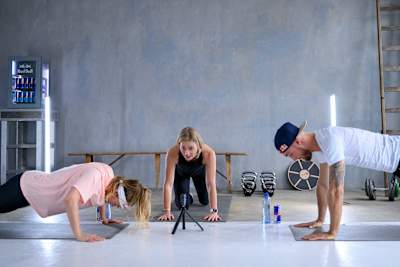
We’re holding our own!
© Jarno Schurgers/Red Bull Content Pool
The ‘plank’ described just above is a core exercise. Here too, it engages all the muscles in the body and helps to improve muscle tone.
To do this, lie face down on the floor, supported on the balls of your feet and your forearms. Keep your body straight and hold the position for as long as possible.
04
The different types of strength training
Suitable for all fitness levels and budgets, you have several options before embarking on the wonderful world of strength training. You can train using your own body weight, but if you’re already a high-performance athlete, adding weights may be a good idea. Another approach, aimed at minimising the risk of injury and protecting your joints, is to use resistance bands.
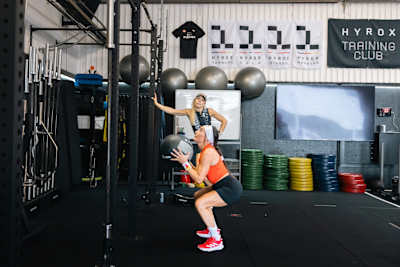
Wall balls can be used as weights
© Andrea Zaffaroni / Red Bull Content Pool
Alternatively, the machines at your nearest gym will do the trick, with adjustable weights and staff on hand to explain which exercises to do.
The final option is known as high-intensity interval training, or HIIT. This slightly complicated name is based on a principle that couldn’t be simpler: repeating exercises with very short recovery periods. A session lasts an average of 30 minutes, but that doesn’t mean it’s a walk in the park (quite the opposite, in fact). To find out everything about this form of exercise, check out our guide.
05
How do you choose your strength training exercises?
Personal goals and current fitness level
Before you start any exercise, it’s a good idea to think about your goals. If you want to improve your running, pull-ups aren’t necessarily an absolute prerequisite. Depending on your goals and your level, we strongly recommend tailoring your training, because gaining a few millimetres of jump height and being able to keep up with Oriane Bertone on an overhanging route are two different things (who’d have thought?).
Availability of equipment
Those who’ve prioritised feng shui over performance might not have a pull-up bar standing in their living room. In that case, barring a gym membership or nearby street furniture, it’s simply better to opt for a plank, squats and push-ups.
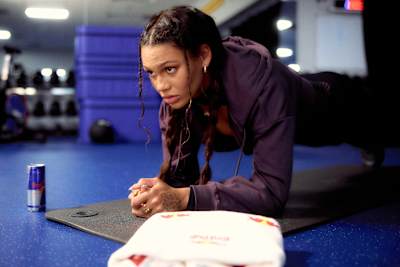
Trinity Rodman in action
© Jared Martinez/Red Bull Content Pool
Other exercises, such as chair dips, dips, crunches (abs) or lunges, can also be done with little or no equipment (admittedly, chair dips require you to lean against a wall, but you should be able to find one).
Frequency and duration of workouts
It’s obviously difficult to give a standard figure; it all depends on your training programme and your individual fitness level. In any case, start your sessions with a 5- to 10-minute warm-up. If you’re aiming to improve your sporting performance, you can do 30-minute sessions two to three times a week. If you’re feeling sore, space out your sessions (at least 48 hours apart). For example, you could do 6 to 10 sets of 12 repetitions of a single exercise, remembering to rest between each set.
As you progress, you can increase the duration of your sessions, for example to 45 minutes. However, it is not advisable to do too many sessions without giving your body time to recover.
06
Current trends in strength training
Today, strength training – and fitness more broadly – has become a phenomenon; you only need to look at the rise of a discipline such as HYROX to see the proof. Here are the latest ‘trends’ fuelling this positive momentum.
CrossFit
CrossFit combines weightlifting, gymnastics and endurance sports. As you’ve probably guessed, it’s not the most relaxing discipline on this list. Nevertheless, since its creation in 1995, many enthusiasts have given it a go, tackling running, rowing, push-ups, rings, deadlifts and other exercises in succession.
Calisthenics (Street workout)
This is one option for those who don’t want to take out a gym membership. As mentioned above, street workouts require access to equipment, and more generally a pull-up bar. The word ‘calisthenics’ comes from Greek and means (roughly) ‘beauty’ and ‘strength’. Today, it mainly refers to workouts aimed at improving performance, where one’s own body weight is the primary challenge.
Pilates and Yoga for strength and flexibility
Yoga and Pilates are equally effective and much gentler alternatives. Both disciplines can be practised with little or no equipment (a mat – we’ve seen worse investments) and deliver results, particularly when it comes to the ‘core’.
Functional Strength Training
Like HYROX, functional strength training is booming. The idea is simple: to replicate everyday movements to work all the muscles in the body.
07
FAQ
How long should you do strength training for?
Strength training can be done for between 30 and 45 minutes, one to three times a week.
What are the best times of day for strength training?
Morning or evening – that’s the big question that’s hotly debated amongst fitness enthusiasts. On the one hand, training in the morning when you’re not yet fully awake can be unpleasant. On the other hand, training in the evening can interfere with sleep by stimulating the nervous system. Whatever your preference (and your circumstances), both options have their pros and cons.
How should you manage muscle soreness after a workout?
If you experience muscle pain, give your body time to recover. If the pain persists, don’t hesitate to consult your doctor. Above all: don’t neglect to warm up and stretch before any physical exertion.
