





Red Bull Motorsports
F1
F1: Red Bull and Ford together on the threshold of the 2026 season
It won't be long before the first Red Bull car with the Ford logo on the engine cover will start its debut F1 race. Let's find out what the collaboration between the two giants is all about.
For most of Formula One's history, teams could be divided into two categories: engine manufacturers and customers. Manufacturers used their own power units, while customers bought engines from others. Red Bull was also a customer team for many years, working with Renault and Honda. In recent years, the Milton Keynes-based team has expanded its own factory, where it has jointly produced engines with Honda under the Red Bull Powertrains banner. Since the 2026 season, however, Red Bull's engine partner has been Ford, which supports the production of the units produced - now without Honda - by Red Bull Powertrains.
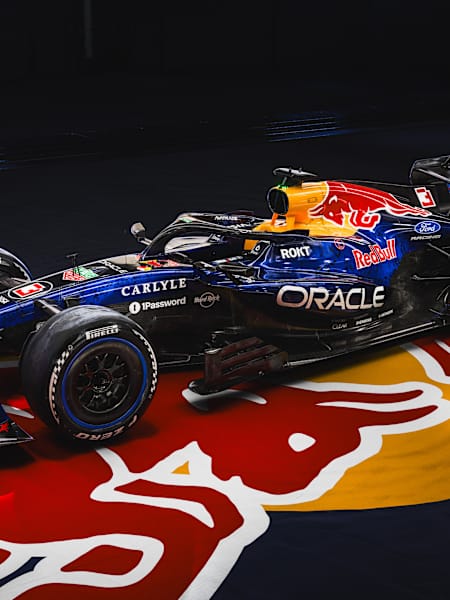
Beneath the livery will run the first-ever ORBR-made engine
© Oracle Red Bull Racing/Red Bull Content Pool
Initially, it was assumed that the American company would focus on the electric part of the powertrain. It was to be responsible for the battery and power distribution system. Over time, these assumptions have evolved. Today, however, the partnership between Red Bull and Ford covers not only the electric components, but also the work organisation in the factory.
New engine - new opportunity
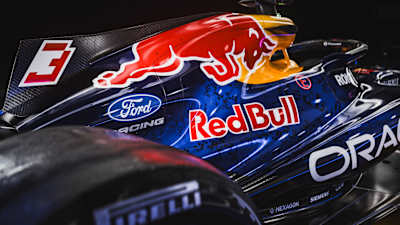
The glossy finish is a nod to the team's heritage
© Oracle Red Bull Racing/Red Bull Content Pool
Together with Ford, Red Bull has built a new combustion engine and a new hybrid component. The biggest differences compared to previous years are precisely in the hybrid: the power and capacity of the MGU-K has been increased and the MGU-H has been eliminated. This involved enlarging the MGU-K battery and re-engineering the entire drivetrain to align all the parts in the right way in relation to each other. At first glance, this may seem straightforward, but in reality it involved a lot of specialists with a lot of experience, who spent a really long time on it.
Over time, it became apparent that in order to make everything work well, it was necessary to extend the collaboration. As a result, Red Bull's engineers in Milton Keynes and Ford's engineers in Michigan are now jointly developing, among other things, components for the combustion engine or the supercharging system. They are by no means content to create just a few examples of a component, but develop them and introduce further modifications and improvements.

1 min
Red Bull Racing’s story of F1
Before the lunch of the RB10, we celebrate Red Bull Racing's history in Formula One
Compared to other engine manufacturers who have been producing their units for decades, Red Bull is a newcomer. This means that the Red Bulls have to make up for many years and practice solutions that others have known for a long time. It is a difficult task, but not impossible. Already, the team from Milton Keynes has something to celebrate, as this year's Red Bull and Racing Bulls cars have covered the first kilometres and so far no drivetrain problems have been reported.
More and faster
One way to speed things up is to change the procedure for manufacturing components. For several years now, the teams have been using components created through 3D printing in their cars, and this is where Red Bull has a competitive advantage. Normally, it takes around 16 days to produce a part using this method, but by working with Ford and implementing its production methods, Red Bull has gone down to as little as five days in some cases. This means a threefold acceleration of the entire process. In Formula 1 terms, this is a real blessing.

3 min
Red Bull Racing: The Life of a Bolt
See how a front suspension bolt is created before it makes it onto the Red Bull Racing RB12.
The new software developed by Ford is also not insignificant.
One of our simulation engineers at Ford Racing, Kevin Ruybal, has developed a unique control model, working with the Red Bull team at Milton Keynes. It runs as much as 1,000 times faster than real time.
The model, Christian Hertrich said, became the most important control and calibration tool, allowing the simulator to be set up to capture the experience of using the new engine even before the real unit was physically ready to fire. The new technical era in Formula 1, which begins in the 2026 season, poses new challenges for drivers. It is no longer enough just to switch on extra power on the straight. From now on, it will be necessary to think carefully about where and how to use the extra power, as well as where to collect energy and charge the battery. It may be that a driver who analyses such nuances well will post better times than a rival who is weaker in this area, even with a theoretically faster car.
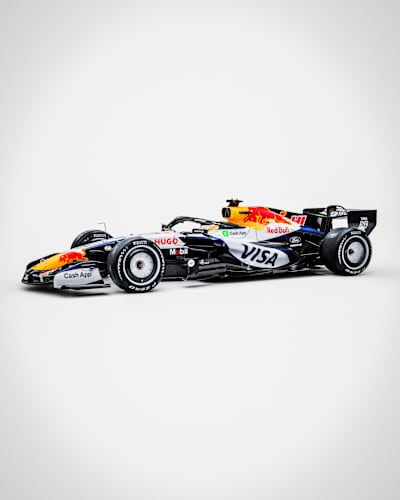
The addition of blue is a reference to the partnership with Ford
© VCARB/Red Bull Content Pool
The riders are to be supported in this by computers. This is another area of joint activity between Red Bull and Ford. The American company's engineers Sam Angeli and Mike Huang - especially the latter - are the faces of a new solution in this area, which optimises the use of electric power in combination with energy from the combustion engine.
Mike has developed an advanced tool using dynamic programming that effectively acts as a real-time strategist, advising the system on exactly when to consume or save energy to find the fastest route on the track, including energy calibration and steering.
See also
From the track to the street
Formula 1 is the pinnacle of motorsport technology. Plenty of innovations that were first implemented in the cars of the queen of motorsport have, over time, found their way into ordinary road cars. The same would be true of the components and software for heat and battery management. This is where the 'Red Bulls' will help the American company: what is developed and refined for the F1 cars will later find its way into the electric trucks that Ford is working on.
