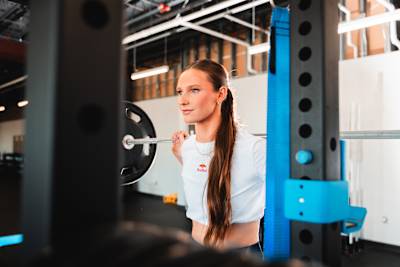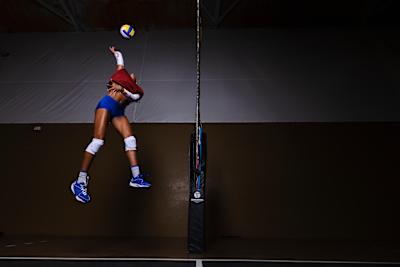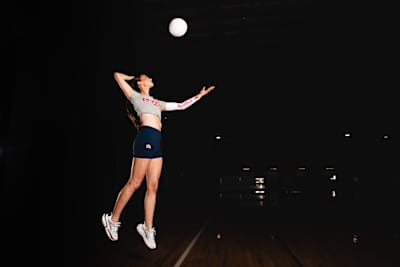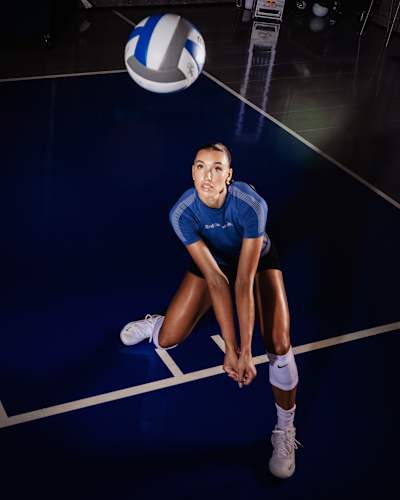
Madisen Skinner volleyball
© Maria Jose Govea / Red Bull Content Pool
Volleyball

Volleyball exercise plan: Workouts for strength and agility
Gain the stamina, agility, and strength needed for volleyball with an exercise plan that’s effective both at the gym and at home.
By Max Freedman
9 min readPublished on
Although committing to a structured volleyball exercise plan doesn’t quite rank among the rules of volleyball, it’s how pros like Jonatan Hellvig build enough strength, conditioning, and endurance to devise game-changing moves like the Swedish Jump Set.
“To be able to do a vertical leap into the air and simultaneously decide whether to spike it or pass it back to your team-mate whilst fooling the blocker in the other team, it’s not easy,” Hellvig said.
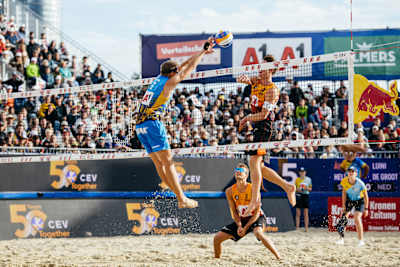
Jonatan Hellvig competing at the A1 CEV BeachVolley Nations Cup 2023 in Vienna, Austria on August 6, 2023.

Jonatan Hellvig

© Ulrich Aydt/Red Bull Content Pool

It’s easier, though, for athletes who come up with a volleyball training routine that improves their performance and reduces their risk of injuries.
01

Understanding volleyball fitness requirements

Workouts for volleyball players train these athletes to build enough stamina and endurance to last a full game. They also include agility exercises and plyometrics since volleyball players need to make quick, powerful movements on the court.
Speaking of power: A great volleyball fitness program includes strength training so that hits and serves are as powerful as possible. It’s all rounded out with flexibility exercises that improve performance and lessen the chances of injury on the court.
02

Components of a volleyball exercise plan

Warm-up and mobility

To start a workout or get ready for a game, volleyball greats do five to 10 minutes total of five to 10 dynamic warmup exercises. These exercises often double as mobility drills that improve volleyballers’ ability to make wide-ranging, unexpected moves amid the commotion of a match. The Art of Coaching Volleyball offers a comprehensive list of 20 exercises, with videos and instructions, to consider for dynamic warmups and stretches.

Strength training

Bergen Reilly

Bergen Reilly

© Charlotte Gottfried / Red Bull Content Pool

In a volleyball fitness program, strength training comprises three groups of exercises. Most of these exercises are explained in detail in this football workout plan.
  • Upper body. Push-ups, pull-ups, and shoulder presses build the chest, shoulder, back, and arm muscles required for stability when volleyballers pass, set, or receive. And for athletes spiking or serving, these muscles are key to powerful, accurate hits.
  • Lower body. Squats, lunges, and deadlifts are similar to the motions that volleyball players make when getting into setting, passing, and receiving positions. They also build leg and core muscle that’s important for quickly getting around on sand or gymnasium floors.
  • Core. Lower body workouts are only the start of building up core muscles. The Russian twists, leg raises, and planks from the ski workout plan are tried and true exercises for staying upright and maintaining control as athletes swiftly rotate and run to reach the ball.

Plyometric and agility workouts

Box jumps and ladder drills, as well as lateral hops, rank among the best plyometric exercises. These movements develop the body’s fast-twitch muscle fibers, which power rapid, explosive movements — the heart of great volleyball. Plyometrics are often paired with agility drills since these drills train the body on how to near-instantly pivot and move in a different direction.

Conditioning

Volleyball is fast-paced and long-lasting, so it requires athletes to be well-conditioned. In everyday language, this means that volleyball players should be able to transition from standing still to running quickly at the drop of a hat. Endurance is the term for sustaining this ability throughout a full volleyball match.
Sport-specific exercises for volleyball conditioning workouts include interval sprints, lateral shuffles, tuck jumps, burpees, and jumping rope. These movements double as cardio exercises and strength-building motions. They’re most effective when incorporated into a high-intensity interval training (HIIT) regimen.
Interval sprints and jumping rope is familiar to most athletes. Brief instructions for the other exercises are below.
  • Lateral shuffles. Stand upright with feet about shoulder-width apart. Step to the right with the right foot, then step to the right with the left foot, reaching about halfway to the right foot. Switch sides and move in the opposite direction.
  • Tuck jumps. Start in a squat position with the butt and back down. Bring the arms forward and upward, then leap upward as high as possible. Bring the knees up so that the thighs are roughly parallel with the floor. While descending, fold the hands together in front of the chest with elbows bent.
  • Burpees. From a standing position, descend into a squat. From there, kick the legs back and bring the arms forward to enter plank position. Return to squat position, then to standing position.

Flexibility and cool down
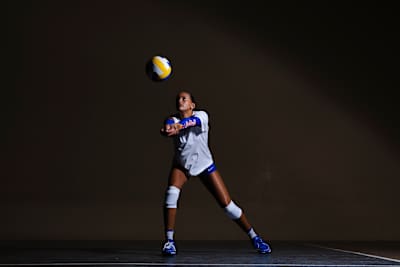
Olivia Babcock

Olivia Babcock

© Harrison Barden / Red Bull Content Pool

Volleyball workouts can be intense, so following them with a cool-down that includes static stretches is essential. Unlike dynamic stretches, which involve motion and get the muscles ready for a workout, static stretches don’t involve motion. They loosen tight muscles, leading to smoother post-workout recovery.
Static stretches ideal for volleyball players to cool down with include the below. Hold each stretch for 30 seconds.
  • Cobra stretch. Start in push-up position but with the torso directly on the floor. Use the arms to elevate the upper body so that it’s nearly perpendicular to the floor.
  • Hamstrings. While standing, bend down and bring the hands, which should be fully extended, as close to the feet as possible.
  • Hip flexors. Descend into a lunge so that the calves are at right angles with the quadriceps. Correct form involves feeling this stretch in the back leg’s hip.
  • Calves. Lean forward on a wall. Position the front leg slightly bent and the back leg completely outstretched. The back leg’s calf should be where this stretch is felt.
  • Prayer stretch. While lying face-down, stretch the arms and hands all the way out front, then lean the hips and buttocks back over the heels. Relax the upper body and head into the floor.
  • Quads. Find a support for balance, then use the right hand to guide the right heel to the buttocks while bending the knee backward past the hip. Repeat with the other leg.
  • Glute cross. While lying on the back, bend one leg at the knee so that the foot is flat on the ground. Using the opposite hand, pull the knee across the body for a stretch in that leg’s glute. Resist the urge to twist the hips.
  • Lats. Stand with the hands grabbing a door frame above the shoulders. Sink into the floor until there’s the sensation of stretching in the back.
  • Chest. Place the forearm on a door frame while keeping the upper arm parallel to the floor. Rotate the torso slightly in the direction opposite the arm.
03

Sample volleyball workout plans

Olivia Babcock

Olivia Babcock

© Harrison Barden / Red Bull Content Pool

An important note for all these exercise plans: No volleyball workout schedule is complete without warm-up and mobility exercises beforehand and flexibility and cool-down exercises afterward. Below is a sample volleyball workout plan and can be adjusted to each person's individual needs.

Beginner volleyball workout plan

Day 1: Upper body strength and agility

Exercise

Sets

Reps

Push-ups

4

10 to 20

Ladder drills

3

1 rep per side

Shoulder presses

3

6

Lateral hops

4 to 8

1 minute per set

Day 2: Lower body and core strength

Exercise

Sets

Reps

Squats

4

4 to 8

Russian twists

3 to 4

8 to 10 per side

Lunges

4

4 to 8

Planks

3 to 4

Hold for 60 seconds

Day 3: Upper body, lower body, core, and agility

Exercise

Sets

Reps

Push-ups

4

10 to 20

Ladder drills

3

1 rep per side

Squats

4

4 to 8

Planks

3 to 4

Hold for 60 seconds

Intermediate volleyball workout plan

Day 1: Upper body strength

Exercise

Sets

Reps

Push-ups

4

10 to 20

Pull-ups

4

10 to 20

Shoulder presses

3

6

Push-ups

4

10 to 20

Pull-ups

4

10 to 20

Shoulder presses

3

6

Day 2: Lower body strength

Exercise

Sets

Reps

Squats

4

4 to 8

Lunges

4

4 to 8

Deadlifts

4

4 to 6

Squats

4

4 to 8

Lunges

4

4 to 8

Deadlifts

4

4 to 6

Day 3: Core strength

Exercise

Sets

Reps

Russian twists

3 to 4

8 to 10 per side

Leg raises

3 to 4

8 to 10

Planks

3 to 4

Hold for 60 seconds
Russian twists

3 to 4

8 to 10 per side

Leg raises

3 to 4

8 to 10

Planks

3 to 4

Hold for 60 seconds

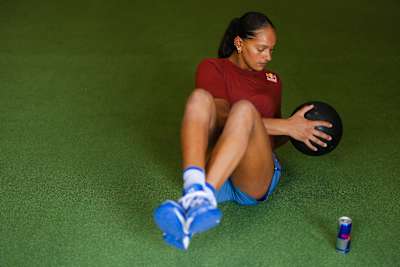
Olivia Babcock training

Olivia Babcock training

© Harrison Barden / Red Bull Content Pool

Day 4: Plyometrics and agility

Exercise

Sets

Reps

Box jumps

3 to 4

10 reps

Ladder drills

3

1 rep per side

Lateral hops

4 to 8

1 minute per set

Box jumps

3 to 4

10 reps

Ladder drills

3

1 rep per side

Lateral hops

4 to 8

1 minute per set

Advanced volleyball workout plan

Day 1: Conditioning

Exercise

Sets

Reps

Interval sprints

6 to 10 sprints

20 to 30 seconds per sprint, with 20 to 30 seconds of walking between sprints

Lateral shuffles

3

10 per side

Tuck jumps

3

10

Burpees

3

10

Jumping rope

6 to 10 intervals

20 to 30 seconds per interval, with 20 to 30 seconds of rest between intervals

Day 2: Upper body strength

Exercise

Sets

Reps

Push-ups

4

10 to 20

Pull-ups

4

10 to 20

Shoulder presses

3

6

Push-ups

4

10 to 20

Pull-ups

4

10 to 20

Shoulder presses

3

6
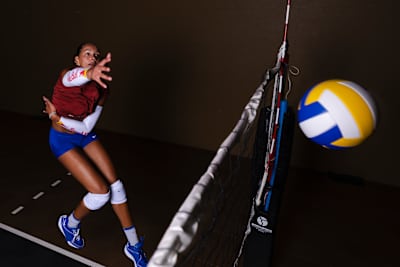
Olivia Babcock training

Olivia Babcock training

© Harrison Barden / Red Bull Content Pool

Day 3: Lower body strength

Exercise

Sets

Reps

Squats

4

4 to 8

Lunges

4

4 to 8

Deadlifts

4

4 to 6

Squats

4

4 to 8

Lunges

4

4 to 8

Deadlifts

4

4 to 6

Day 4: Core strength

Exercise

Sets

Reps

Russian twists

3 to 4

8 to 10 per side

Leg raises

3 to 4

8 to 10

Planks

3 to 4

Hold for 60 seconds

Russian twists

3 to 4

8 to 10 per side

Leg raises

3 to 4

8 to 10

Planks

3 to 4

Hold for 60 seconds

Day 5: Plyometrics and agility

Exercise

Sets

Reps

Box jumps

3 to 4

10 reps

Ladder drills

3

1 rep per side

Lateral hops

4 to 8

1 minute per set

Box jumps

3 to 4

10 reps

Ladder drills

3

1 rep per side

Lateral hops

4 to 8

1 minute per set

04

Volleyball workouts at home

A volleyball player conditioning plan may involve equipment that some athletes might only be able to access at a gym. Box jumps, for example, require an exercise box, which not all athletes are willing or able to keep at home. It’s simple to replace gym exercises when doing volleyball workouts at home.
For example, the first stair toward the very bottom of a staircase can be a reasonable substitute for a box. Transitioning the box jump to the stairs, while taking extra precautions to avoid falls and injuries, can make for an effective volleyball workout.
Beyond this adaptation, the good news is that most volleyball exercises can be done with bodyweight. Push-ups, pull-ups, leg raises, and so many more require no extra equipment. If there’s a desire to increase resistance, holding objects such as, for example, a bag of books over the head during core exercises can make things more challenging.

Tracking progress and setting goals

Bergen Reilly serving

Bergen Reilly serving

© Charlotte Gottfried / Red Bull Content Pool

SMART goals, a principle borrowed from the business world, often help volleyballers set meaningful objectives for their workout plans. A goal is SMART when it’s specific, measurable, attainable, relevant and time-based. An example for someone new to volleyball might be completing the beginner-level workout in under 45 minutes. Once this goal is complete, decreasing the timespan to 40 minutes or moving on to the intermediate plan could be another goal.
Depending on one’s goals, a fitness journal, tracker, or app might be the most effective way to measure progress or results. The ultimate sign that a volleyball player is making progress, though, is that they find it easier to do each exercise in their workout plan.

Elevate your game with a strong volleyball exercise plan

Whether for beach volleyball or the indoor courts where superstars like Bergen Reilly, Madisen Skinner and Olivia Babcock shine, a tailored volleyball exercise plan unlocks the door to success. Getting through all the exercises might not feel easy every day, but keeping at is the best way to see results. From the gym to the court, exercise is exactly how to hit it over the net and land that much-needed point every time.